Sunday Spotlight on Never Too Late

Yesterday, the Bluestocking Belles announced the name of our 2017 box set, out in time for holiday reading on November 1. You’ve heard me talking about my story for the set: Forged in Fire. Here’s the description of the book as a whole, and of each story in it.

Eight authors and eight different takes on four dramatic elements selected by our readers—an older heroine, a wise man, a Bible, and a compromising situation that isn’t.

Set in a variety of locations around the world over eight centuries, welcome to the romance of the Bluestocking Belles’ 2017 Holiday Anthology.

It’s Never Too Late to find love.

25% of proceeds benefit the Malala Fund.

(Read on below the buy links for individual story blurbs.)

Preorder Links (will add other eretailers as the links go live):

US: https://www.amazon.com/dp/B075VDCLCB
AU: https://www.amazon.com.au/dp/B075VDCLCB
BR: https://www.amazon.com.br/dp/B075VDCLCB
CA: https://www.amazon.ca/dp/B075VDCLCB
DE: https://www.amazon.de/dp/B075VDCLCB
ES: https://www.amazon.es/dp/B075VDCLCB
FR: https://www.amazon.fr/dp/B075VDCLCB
IN: https://www.amazon.in/dp/B075VDCLCB
IT: https://www.amazon.it/dp/B075VDCLCB
JP: https://www.amazon.co.jp/dp/B075VDCLCB
MX: https://www.amazon.com.mx/dp/B075VDCLCB
NL: https://www.amazon.nl/dp/B075VDCLCB
UK: https://www.amazon.co.uk/dp/B075VDCLCB

The Piper’s Lady

By Sherry Ewing

True love binds them. Deceit divides them. Will they choose love?
Coira does not regret traveling with her grandfather until she is too old to wed. But perhaps it is not too late? At Berwyck Castle, a dashing knight runs to her rescue. How can she resist?

Garrick can hold his own with the trained Knights of Berwyck, but they think of him as a piper, not a fighter. When his heart sings for the new resident of the castle, he dares to wish he is something he is not. Will failure to clear her misunderstanding doom their love before it begins?

Her Wounded Heart

By Nicole Zoltak

An injured knight trespassing on Mary Bennett’s land is a threat to the widow’s
already frail refuge. Even so, she cannot turn away a man in need and tells him he has her husband’s leave to stay until Christmas.

Doran Ward wishes only to survive for one more day. However, as he begins to
heal and to pay for his lodgings by fixing the rundown manor, the wounds to Mistress Bennett’s heart intrigue him.

Can two desperate souls find hope in time for Christmas?

A Year Without Christmas

By Jessica Cale

London, 1645
Edward Rothschild returns home from war defeated in more ways than one. His friends killed and his property seized, he is an earl in name only. His family and his servants have all deserted him– all except his housekeeper, Lillian Virtue.

Lillian feels like home in a way that nothing else does, but as his servant and a recent widow, it would be impossible for them to be together. Then again, Christmas has been banned and the social order fractured; can one more impossible thing happen this year?

The Night of the Feast

By Elizabeth Ellen Carter

As a spy deep in the heart of Revolutionary France, Michael St. John hopes to make amends for a wasted life his by helping the citizens of the Vendée stage a counter-revolution.

Jacqueline Archambeau, tavern owner and cook, accepts that life and love have passed her by. She never dreamed she would fight her own countrymen for the right to keep her customs and traditions.

When they plot together to steal plans at a regimental dinner will they risk their lives—and their hearts?

The Umbrella Chronicles

George & Dorothea’s Story

By Amy Quinton

Lord George St. Vincent doesn’t realize it, but his days as a bachelor in good standing are numbered.

He has a fortnight, to be precise—the duration of the Marquess of Dansbury’s house party.

For I, Lady Harriett Ross, have committed to parting with several items of sentimental worth should I fail to orchestrate his downfall—er, betrothal—to Miss Dorothea Wythe, who is delightful, brilliant, and interested (or will be).

If I have anything to say about matters, and I always have something to say about matters, they’re both doomed.

Did I say doomed? I mean, destined—for a life filled with love.

I’m just an old woman with opinions. On everything.

A Malicious Rumor

By Susana Ellis

Vauxhall gardener Alice Crocker has had to defend herself from encroaching males all her life, but the new violinist is a different sort. So when she discovers that he is the victim of a malicious rumor, she naturally wants to help.

Peter de Luca greatly admires the lady gardener, but this is his problem to resolve.

What will it take to prove to this pair that they would be stronger together as a harmonious duo than two lonely solos?

Forged in Fire

By Jude Knight

Burned in their youth, neither Tad nor Lottie expected to feel the fires of love. The years have soothed the pain, and each has built a comfortable, if not fully satisfying, life, on paths that intersect and then diverge again.

But then the inferno of a volcanic eruption sears away the lies of the past and frees them to forge a future together.

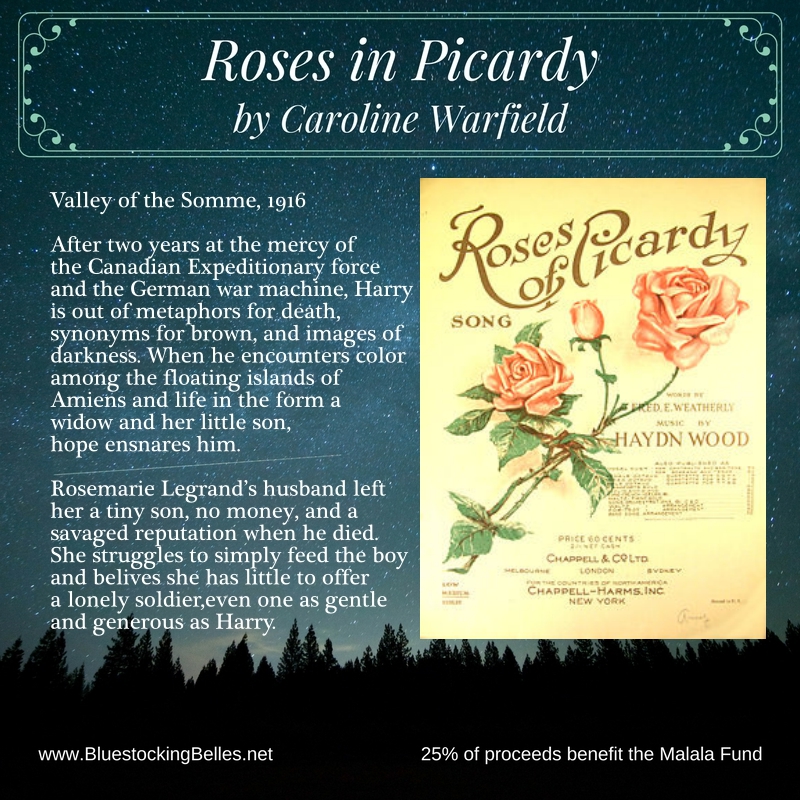
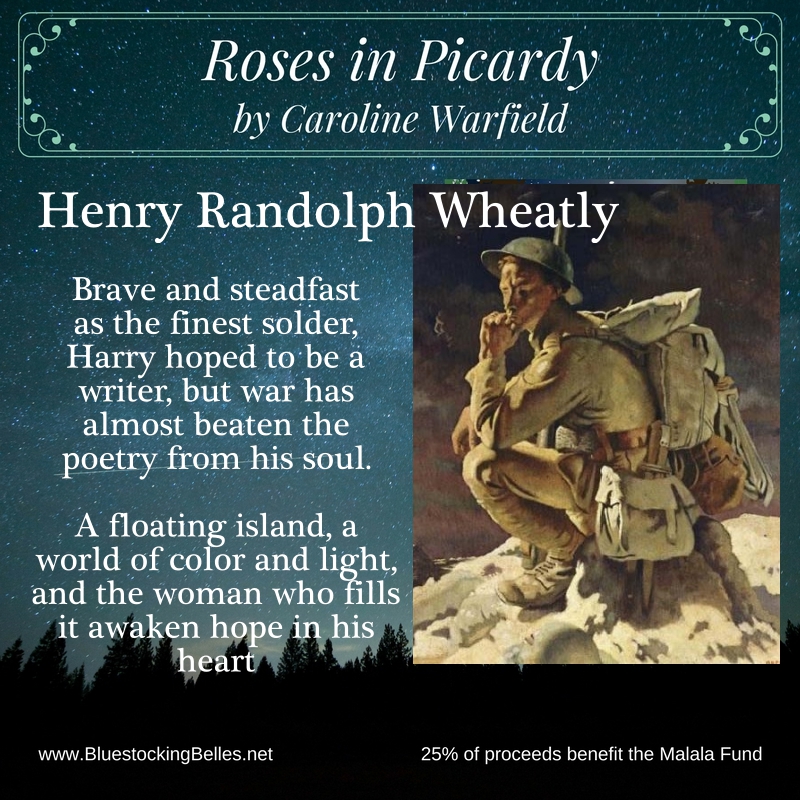
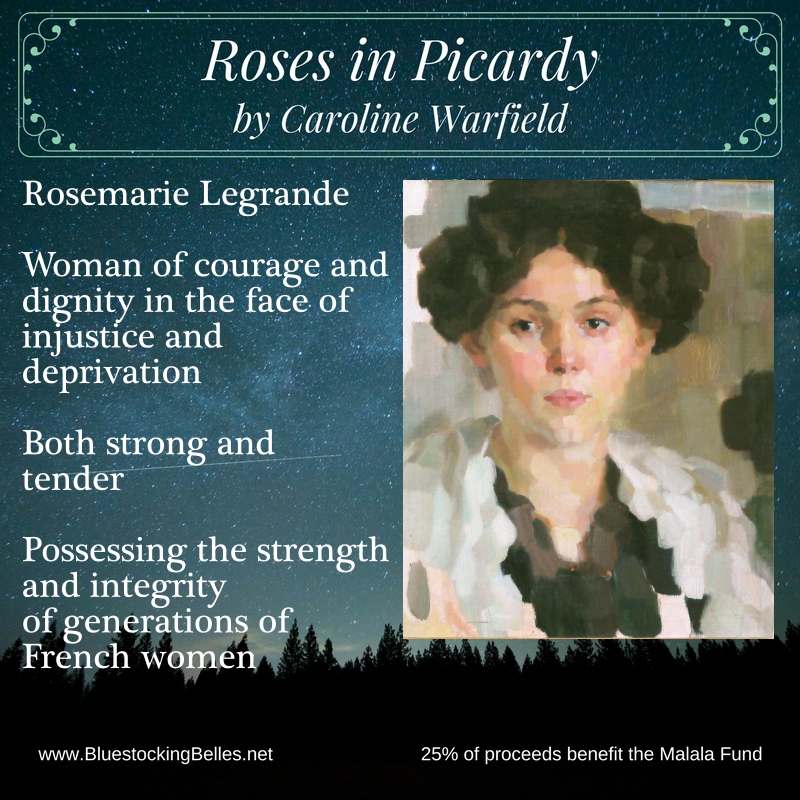
Roses in Picardy

By Caroline Warfield

After two years at war, Harry is out of metaphors for death, synonyms for brown, and images for darkness. Color among the floating islands of Amiens and life in the form of a widow and her little son surprise him with hope.

Rosemarie Legrand’s husband died, leaving her a tiny son, no money, and a savaged reputation. She struggles to simply feed the boy and has little to offer a lonely soldier.

Descriptions in WIP Wednesday

One of my beta readers on my contemporary novella pointed out that I described two secondary characters, but not the hero and heroine. Which was true. In fact, sometimes I barely describe my characters at all, though I almost always work from photographs and paintings so that I can see the person in my mind’s eye as I watch them act the dramas I document.

How about you? Do you see your characters? Do you describe them, and if so, is it eye of God or in another character’s viewpoint or the old ‘in a mirror’ trick?

This week, please share a description of someone in your work in progress. My excerpt describes, Ottilie, the heroine of Forged in Fire, which will appear in the box set for the Bluestocking Belles. We announce the title and reveal the cover this coming weekend.

She wasn’t as meek as she pretended. He’d seen the steel in her, the fire in those pretty hazel eyes.

The word ‘pretty’ put a check in his stride, but it was true. She had lovely eyes. Not a pretty face, precisely. Her cheeks were too thin, her jaw too square, her nose too straight for merely ‘pretty’. But in her own way, she was magnificent. She was not as comfortably curved or as young as the females he used to chase when he was a wild youth, the sort he always thought he preferred. Not as gaudy as them, with their bright dresses and their brighter face paint. But considerably less drab than he had thought at first sight. She was a little brown hen that showed to disadvantage beside the showier feathers of the parrot, but whose feathers were a subtle symphony of shades and patterns. Besides, parrots, in his experience, were selfish, demanding creatures.

Transport on WIP Wednesday

Boat, carriage, horse, train, rocketship or shanks pony, our characters need to get around. In today’s WIP Wednesday, I’d love to see your excerpts about travel. Mine is from Forged in Fire, my Bluestocking Belles’ box set story for 2017. My characters are tourists in New Zealand’s Rotorua in 1886.

Lottie was pleased to be on the road again. The morning had been a trial with Myrtle determined to exact vengeance for Lottie’s avoidance of her trap. She might calm down a bit now they were once more with the rest of the party, since Mr. Farthingale was avoiding Lottie’s gaze and speaking to her as seldom as politeness allowed, though a gleam in Mr. Farthingale’s eye suggested she should be careful not to let him catch her alone.

The Pritchard family normally took one carriage, while Mr. Farthingale joined Myrtle’s party in the other. How could Lottie avoid the horrid man? Fortunately, her interests and Myrtle’s aligned, and when Myrtle suggested that the two Misses Pritchard might like to join her carriage to discuss London fashions ‘to while away another boring bush trip’, Lottie eagerly seconded her, but lowered her lids to veil her eyes when Mr. Berry climbed up to take the seat opposite her. If Myrtle caught a hint of how Mr. Berry affected her, Lottie would never hear the end of it.

The road wound around the shores of the lake, and then struck up into the hills. They would spend two nights at Te Wairoa, since the trip to the famed terraces of Rotomohana would consume the day in between.

Mr. Berry was distant today, too, but he smiled when he caught her looking at him, so she acquitted him of prejudice and just wondered what had him out of sorts. No. Sad. Something had happened to distress him, though he hid it well.

She left him to his brooding and Myrtle and the young ladies to their discussion, all but pressing her nose to the window. Boring? By no means. Lottie could not see enough of the ever-changing textures and the unending variety of greens in the passing scenery.

Relatives on WIP Wednesday

This week’s post is about relatives. All of our protagonists have them, even the orphans. And, dead and alive, they contribute to our hero’s and heroine’s situation, if only by helping to form their character.

As always, I invite you to put an excerpt in the comments where a relative of your hero or heroine is mentioned or appears. Mine is from Forged in Fire, my story for the Bluestocking Belles 2017 boxed set.

Bother. Botheration. Not for the first time since Cousin Myrtle had offered her a refuge from her disgrace, Lottie wished she had dared a few of the choice epithets she’d heard her brother use. He always apologised for offending her delicate sensibilities, and at the time, she had been shocked, as her upbringing demanded. But oh how she wished he was still alive to shock her again.

She tucked her guilt and her grief back where they belonged, deep below the surface. This evening would be trial enough. Mr Berry was waiting for an answer, his eyes fixed on hers.

“Thank you, but I suspect that will just make things worse. Mr Berry, I should warn you that my cousin is very likely at this moment impugning your reputation to the other guests. I am very sorry. I should not have come, or at least, I should have asked for a maid to accompany me.”

The brows dived inwards as he frowned. He really was remarkably good looking; the contrast between his workman’s muscular build and sun-darkened skin, and his gentleman’s speech and good manners, only adding to his appeal. “My reputation? And yours? But we have not been alone, Miss Thompson.” He waved to the group of natives who were chatting just outside the door, Mr Berry’s partner, Mr Te Paora, among them. A magnificent young woman with a tattooed chin waved back.

“I did not realise that the old harridan was your cousin,” Mr Berry continued. “My commiserations. Why would she spread malicious gossip about her own relative?”

To keep Lottie under her thumb, of course. Myrtle had been a bully from the first, but when Lottie recovered enough from her grief to rebel, she found herself trapped. Without money of her own, she needed a paid position or a husband, and in the circumstances of her disgrace, Myrtle had the perfect weapon to keep her from either. It was old news now, more than a decade gone. But Myrtle had added to it over the years with supposition and outright lies. And circumstances like this, which were not what they seemed.

The Grand Tour through the Pacific

In the last quarter of the nineteenth century, New Zealand was one stop on a circuit for wealthy tourists making a six-month grand tour of the world. The majestic Milford Sound, the grand Whanganui River and, of course, the magical thermal wonderlands of Rotorua made New Zealand a special destination for those able to afford the long journey.

The Pink and White Terraces at Rotomahana were the climax of any visit. They were in the hands of the Tuhourangi people, who provided guides, canoes, meals, accommodation and entertainment. Their loss in the Tarawera eruption of 1886 was a serious economic blow to the tribe, made worse as the Government slowly took over the businesses they attempted to establish in their new homes in Rotorua, employing them as guides and entertainers.

Another important stop for our intrepid European and American travellers was Hawaii, about which E Ellsworth Carey wrote in Thrum’s Annual (1893):

An epitome of the world’s scenery is found in Hawaii. There
cliffs and caves; grand canyons and measureless waterfalls; spouting
caves and singing sands; bottomless and rivers of lava.

Sydney, Australia, was on many steamer ships’ itineraries, part of a circuit from San Franciso through New Zealand, Sydney, and then various Pacific Islands and back to San Francisco. Other ships came from Europe passing through Egypt and the Suez Canal, then making stops at India, Indonesia, and Singapore on their way down under.

Women tourists were common enough that Lillian Campbell Davidson made a great success with her 1889 publication “Hints for Lady Travellers at Home and Abroad” (recently republished and available on Amazon). One contemporary review notes that the preparation for such a trip may make it a burden rather than a pleasure.

The ” Hints ” inform us that the lady who wishes to be well equipped for a journey, must carry with her a bath and bath towels, a bottle of kid-reviver, a dressing-bag, a spirit-lamp for boiling water, with a sufficient quantity of methylated spirits, a flask, and a small filter.

To these comforts the lady-traveller must add provisions, including extract of meat, “one’s own tea and coffee;” waistbelts for money, a holdall for rugs and umbrellas, a hot-water bag, a lamp for reading at night, some light literature (it must be light in two senses, for “books add enormously to the weight of one’s luggage “) ; a small medicine-chest, which, among other articles, should contain pills and ointment, and a roll of fine old linen.

Matches and a candle, too, should always be carried ; a door-wedge is a great convenience ; “a tin of insect-powder should never be omitted ;” with a railway-key “one is quite independent;” and “a compass is a most useful accompaniment to the traveller who has to be her own guide.”

It is necessary also to carry an eyestone, “the use of which is a common custom in America.” If there is dust in the eye, this tiny stone, or rather fishbone, is inserted within the lower eyelid. “Almost immediately it begins to work its way slowly round the eyeball, and never stops till it has made the complete circuit of the eye, when it drops out, bringing with it whatever object of an alien nature it has encountered on its journey.”

Then if ladies curl their hair, capital little cases may be had, containing a pair of tongs and a minute spirit-lamp ;” a good toilet-water also is often desired by ladies in travelling, and sulpholine lotion may be carried for sun- burning and freckles.

Full particulars, too, are given with regard to clothing ; each dress must have a tray to itself, for “gowns are the terrible part of packing,” and, finally, “it is as well, for every reason, to travel with as little luggage as circumstances admit.”

It is to be feared that if a lady who proposes to travel studies these ” Hints ” previously—and we have mentioned only a few of them —she will be tempted to wish that the new conditions of life had not arisen, which make “a thousand conveniences and comforts” necessary to the traveller. (Review in The Spectator, 16 November 1889, p44, my paragraphing)

Attraction on WIP Wednesday

At some point in our stories, if they include a romance, those involved must each become aware of an attraction to the other. In this week’s WIP Wednesday, I’m inviting excerpts about that moment, from one or the other.

It might be just the stirrings of desire. It might be seeing something in the other that prompts a deep sense of recognition. It might be falling in love, as I did during a long evening at the Outward Bound Old Boys Ball in Auckland in August 1969.

I saw the moment that he fell, on the same evening.We were waltzing, having spent the whole evening dancing, talking, enjoying good food and wine. And I looked up and saw his eyes change, the suddenly intense warmth hinting at a depth of feeling that belied our so far casual association. It lured me, drew me in, and by the time we set off for home, I was head over heels in love. We finished the evening kissing and conversing in his father’s car outside my mother’s house, and by the time we parted we had chosen the name of our first son. Next month marks our 48th year together since that moment.

For this excerpt from my Christmas novella for the Bluestocking Belles, I’ve picked an earlier point in the process:

Miss Thompson was entranced by the concert party, and even Mrs Bletherow was interested enough to forget her usual pointless errands and pointed remarks. Tad had taken a seat close by, ready to offer his escort if Miss Thompson was sent on another wild goose chase, and was surprised by his own disappointment when it didn’t happen.

She was nothing to him. He was sorry for her, that was all. As he’d be sorry for anyone stuck in her predicament. She’d be better off staying in New Zealand, where Mrs Bletherow’s malice couldn’t reach her. There was work in Auckland, in shops and factories. Not that a proper English lady would consider such a thing.

She could do it, though. She wasn’t as meek as she pretended. He’d seen the steel in her, the fire in those pretty hazel eyes.

The word ‘pretty’ put a check in his stride, but it was true. She had lovely eyes. Not a pretty face, precisely. Her cheeks were too thin, her jaw too square, her nose too straight for merely ‘pretty’. But in her own way, she was magnificent. She was not as comfortably curved or as young as the females he used to chase when he was a wild youth, the sort he always thought he preferred. Not as gaudy as them, with their bright dresses and their brighter face paint. But considerably less drab than he had thought at first sight. She was a little brown hen that showed to disadvantage beside the showier feathers of the parrot, but whose feathers were a subtle symphony of shades and patterns. Parrots, in his experience, were selfish, demanding creatures.

The sleeping giant

In the early morning of 10 June 1886, a 17 kilometre rift opened in the mountains on the far side of this lake, spewing out steam, fire, and finely pulverised rock.


It sleeps on the far side of the lake with the same name. Tarawera. The translation is something like the peaks (or cliffs) that burn. And on 10 June 1886, it did, indeed, burn, and more than a dozen villages around the shores of the lake ceased to exist in a cataclysmic six hours.

Until that day, Lake Tarawera had been part of the journey to the famous Pink and White Terraces, silica deposits cascading down the hillsides of Lake Rotomahana in a series of delicately coloured terraces, studded with hot pools.  Tourists came from Europe to see this scenic wonder of the world, making the long trip by ship and then by coach and finally by whale boat or canoe.

In the early hours of the morning of 10 June, the tourist trade died, along with over 150 people.

It began with a series of violent earthquakes that woke people in the village of Te Wairoa, starting point for the Lake Tarawera crossing. When the mountain began erupting around 2am, tourists left the hotels to climb a nearby slope to see the fireworks, retreating as the great clouds of ash, lava and lightening began to rain debris down on their heads.

The view from the road down to Lake Tarawera. The mountain is in the distance. Te Wairoa was tucked behind the ridge to the right.

It was the beginning of a bombardment that would last six hours and leave the village buried in metres of mud and ash. At that, the village got off lightly. Te Wairoa was protected in a valley and sufficiently distant for most residents and visitors to survive. Those closer to the mountain were not so fortunate, their settlements completely destroyed and buried.

The Pink and White Terraces vanished, leaving a 100 metre crater that later filled with water. Ash choked the skies, so that the day was turned to night. Refugees from the disaster began to trail towards Rotorua, meeting rescue parties as they trudged.

The story of that night is told in diaries written by the tourists and European residents of the area, in the oral tales handed down through the local people, and excavated from the material thrown up by the volcano.

My novella for the Belles’ 2017 holiday box set takes place against the background of the eruption. 


Love between the classes

This month, most of the Bluestocking Belles are publishing the novellas that were part of our 2016 box set, Holly and Hopeful Hearts.  My contributions to the set were A Suitable Husband. and The Bluestocking and the Barbarian. I’m not releasing Barbarian yet. I want to expand it into a novel. But I have A Suitable Husband up on prerelease and it will be published on 30 September.

As the Duchess of Haverford’s companion, Cedrica Grenford is not treated as a poor relation and is encouraged to mingle with Her Grace’s guests. Perhaps among the gentlemen gathered for the duchess’s house party, she will find a suitable husband?

Marcel Fournier has only one ambition: to save enough from his fees serving as chef in the houses of the ton to become the proprietor of his own fine restaurant. An affair with the duchess’s dependent would be dangerous. Anything else is impossible. Isn’t it?

So far, I just have it up on Amazon, but I’ll add other links over the next week or so. Read on for an excerpt.

✶´`´*★ ☆EXCERPT – A SUITABLE HUSBAND☆ ★.¸¸,.✶ 

“He does not look at me and see a woman. No one does.”

 Lady Sophia spoke decisively. “You are blue-devilled, my dear. Who knows whether any of us will meet a man who can see past our elderly exteriors to the treasures we all are? If we do not, you and I shall be old maids together.”

“Yes,” Lady de Courtenay agreed. “Perhaps we should set up house together. Certainly Sophia and I have no more wish to live forever on the sufferance of our brothers than you do on the Haverfords’. Who needs men, after all? Selfish, conceited creatures, always jumping to conclusions.”

This time, Mademoiselle Grenford’s laugh was more genuine.

Lady Sophia said, “Rest for an hour. Read a book. I will order a pot of tea and some cakes, and Grace and I shall deal with anything that arises.” Her voice was coming closer.

 Swiftly, before she could open the door and find him listening, Marcel retreated down the hall and around the corner, all the way back downstairs, thinking furiously.

 First, he must order a tray set with the most delicate of cups, the finest tea, and some of the little cakes from the test batch he had made that morning, in preparation for the real challenge of Christmas Day’s dinner. Each was a work of art with its own sugar flower, and it had not escaped his notice that his mademoiselle liked them.

Then, while his assistants made the tray, he must make peace. This war must end. If that meant giving Madame Pearce her way on the tower, then so be it. He could not be part of causing pain to his mademoiselle.

His! How foolish he was. He was a chef. She was an aristo, of a family with a duke, despite her humble words. Yet un chien regarde bien un évêque. A dog can take a good look at a bishop. The English proverb was similar. A cat may look at a king. What would Mademoiselle Grenford think if she knew Marcel saw her as a woman, as she put it?

Perhaps bread to go with the cakes? Bread sliced thinly and buttered by his own hand and topped by some of Madame’s conserve. A peace offering from them both.

Determined, he gave his orders to his kitchen and braved the kitchen of Madame Pearce. An odd quest, but would not a knight dare anything, brave any danger, undergo any humiliation, for the lady he must adore from afar?

Bullies, blaggards and other nasties

Some books have real villains, with evil in their hearts and mayhem in their wake. In others, the trials our protagonists face come from circumstance, or perhaps from careless, overbearing, or self-centred relatives. I’m inviting you to put an excerpt in the comments when we see your hero or heroine having a bit of a hard time at someone else’s hands. An ex-mistress? An employee? A relative? Over to you.

This week, I’m sharing an excerpt from Forged in Fire, my 2017 Bluestocking Belles holiday box set novella. My Mrs Bletherow is not a villain, precisely. But she is certainly no sweetheart.

Mrs Bletherow was castigating her poor companion again, oblivious to her audience.

Every group was different, and most groups had someone who was troublesome. Tad Berry could cheerfully handle the drunkards, the would-be Casanovas, the know-it-alls. But he hated bullies. His muscles burned with the effort it took to keep from rescuing the Bletherow hag’s drab shadow. Not his place. She was a free adult woman, and if she chose to stay with an employer who treated her so poorly, it was nothing to do with him.

His partner nudged him. “She don’t run out of steam, that one, eh?”

“Miss Thompson should tell her to go soak her head, Atame. Old crow.”

Tad and Atame had met them in Auckland two days ago, eight tourists seeking to view what Rotorua billed as the eighth wonder of the world. Tomorrow, they’d make their way to Te Wairoa, and the day after the locals would convey them to the Pink and White Terraces, dimpled with hot pools and cascading down their respective hillsides to a peaceful lake.

All through the boat trip to Tauranga and the coach journey to this Rotorua guest house, Mrs Bletherow had found fault with everything Miss Thompson did or failed to do. She had brought her employer the wrong book, failed to block out the sun, been too slow in the queue for food, put too much milk in Mrs Bletherow’s tea. Tad wouldn’t have blamed Miss Thompson for adding arsenic.

The withered wiry maid was as sour as her mistress, and attracted none of the old harridan’s contempt. She stood now at Mrs Bletherow’s elbow, nodding along with the woman’s complaints. “You knew we would be dining properly this evening. You deliberately packed the green gown in the large trunk. You must go and find it this instant, do you hear me?”

“Yes, ma’am,” Miss Thompson said.

“See that you are quick. Parrish shall attend me in my room, and I want my gown by the time I am washed.” Mrs Bletherow sailed up the stairs, Parrish scurrying along in her wake.

Tad unfolded himself from the wall as Miss Thompson approached, her rather fine hazel eyes downcast. She began apologising while she was still several paces away. “I am very sorry for the inconvenience, Mr Berry, but I need to ask you to offload another of Mrs Bletherow’s trunks.”

“Of course, Miss Thompson. If you tell me which one, I shall bring it up to her room.”

She looked up at that, her brows drawing slightly together. “I am not sure, Mr Berry. I know which one it should be in, but Parrish finished the packing. May I come with you?”

He nodded, though the stables were no place for a lady. And Miss Thompson was a lady, and of better birth than the Bletherow, unless he missed his guess. Which, come to think of it, might be part of the reason for her ill-treatment. Not that a bully needed a reason, beyond opportunity and a suitable victim.

They needed to unload half the luggage before uncovering the trunk Miss Thompson wanted, and then it proved to be the wrong one.

Tad brushed off Miss Thompson’s apologies. “No matter. We shall just try the others.” But the gown was not in the smaller trunk, any of the leather bags, or even the hat boxes. They had offloaded all Mrs Bletherow’s baggage and even the single trunk holding her own spare wardrobe and a second belonging to Parish, and Miss Thompson had unlocked and hunted through them all.

“If this is everything, Miss Thompson,” Tad said at last, “I fear the garment has been left behind at a previous stop.”

“Do you, Mr Berry?” Tad’s hands on the straps he was rebuckling stilled at the bitter undertones in the lady’s voice, and he looked up. They were working by lamplight, but he could see well enough. Blazing eyes, thinned lips, skin drained of colour but for two hectic spots of colour high on her cheeks. Miss Thompson was quietly furious. “Perhaps you are right. I apologise for putting you to all this trouble.”

Tea with Esther

monday-for-tea

Esther Baumann squeezed her fingers together in a futile effort to control her nerves when Miss Cedrica Grenford approached her in the anteroom to the Duchess of Haverford’s drawing room. The woman’s kind eyes behind wire-rimmed spectacles reassured her, however. She took a deep breath.

“Her Grace is so pleased you came,” Miss Grenford told her.

Esther rose to her feet, hoping she did it as gracefully as she intended. This caused Reba, her ever present companion, to do so as well.

“Would you care for refreshments, miss?” the duchess’s companion asked Reba.

esther-baumannEsther put her hand on the woman’s arm. “I’ll be fine Reba. Do let Miss Grenford see to your comfort.”

A moment later the door closed softly behind her, and she found herself alone with the Duchess of Haverford.

“Miss Baumann, how lovely of you to come. Your message requesting an interview pleased me.” The duchess gestured to the seat next to her with a graceful hand. Afte pouring tea, offering biscuits, and making sure of Esther’s comfort she went on, “How may I help you?”

“Oh, you already have, Your Grace. I asked to see you to thank you for your invitation to the Hollystone Hall house party and to give you my acceptance in person.” Esther handed a sweetly scented missive to the woman she admired so greatly.

“I’m delighted you will come! May I hope this means your parents have accepted my invitation as well?” the duchess asked turning the little missive over in her hand.

“I fear not, Your Grace. That is the reason I wished to speak to you face to face. My mother is not well.” Esther felt tears well up. When the duchess reached over an put a sympathetic hand on her arm they spilled over, earning her the use of a lace trimmed linen handkerchief.

After a moment to gather her emotions, Esther went on. “She worries about me attending a house party without her, and I’m loathe to worry her. Still, I want badly to come; my father has arranged for my Aunt Dinah to attend come with me.”

“Please assure your mother I will happily stand in her place while you are my guest, Miss Baumann. Will your father accompany you?”

Esther shook her head. “He tells me the demands of business forbid it.” She stiffened at that and watched for the other woman’s reaction. Many looked down on bankers like Nathaniel Baumann, and Esther would not hesitate to defend him if she had to. She didn’t.

“Men like your father are much needed in these difficult times,” the duchess replied.

Esther had a surge of pride, even greater than her relief at the woman’s sensitivity. “Yes! Even the government—” She snapped her mouth shut, aware she had almost revealed things she should not.

The duchess laughed, leaned closer, and whispered. “Yes I understand your father’s young assistant has accompanied Viscount Rochlin to Spain. Such delicate matters must weigh on Mr. Baumann.”

“How do you know that?” Esther gasped. “Adam left only last week!”

“I fear there is little my son Aldridge doesn’t know, at least a it applies to the country. Adam is it? Well, well.” The duchess’s eyes twinkled. “I will look forward to meeting this courageous young man. Shall I invite him as well?”

“He won’t come,” Esther responded morosely. “Adam… that is, Mr. Halevy, has very traditional views and a narrow circle of friends.”

“Oh dear. That must be difficult for one as outgoing as you,” the duchess replied sympathetically.

Her mood had turned gloomy, an unfamiliar situation for Esther. She took a deep breath and reached into her reticule and retrieved a heavy vellum packet, eager to change the subject. “My father asked me to deliver this to you in person as well.”

The duchess glanced over at Esther once or twice while she opened Baumann’s message. At the sight of the enclosed cheque her eyes grew wide. “My goodness, this is extremely generous.”

Esther grinned broadly. “My father is always happy to contribute. He believes very strongly in education.”

“Does he know our charity supports education for women and girls?”

“Certainly. He is…”

“Learning?” the duchess asked with a laugh.

“Conflicted,” Esther replied. “He will also contribute directly to Mr. Montefiore’s project to build a Hebrew school in London.”

“One that won’t admit girls.”

“No. It won’t.” Esther couldn’t keep the irritation out of her voice.

“You sound unhappy about that. Did you wish for that sort of education?”

“I would have liked to study the Torah at the feet of the rabbis, but I know of no girls who do. ”

The duchess sighed. “Perhaps some do and we don’t know about it yet. She raised her chin and went on, suddenly radiating the power of her position. “It is the same for all girls. We will change that. Maybe not overnight, but it will change.”

The fire in her eyes softened when she looked at Esther. “I will send my gratitude to your father and assure him he is welcome at the house party, even if he can only come for the ball.”

Esther smiled back. The duchess and the banker’s daughter’s eyes met in perfect accord.

__________________________________

It might have surprised Esther to know that some girls did have the opportunity she longed for, as Adam is about to find out.

an-open-heart-fbAn Open Heart, by Caroline Warfield

Esther Baumann longs for a loving husband who will help her create a home where they will teach their children to value the traditions of their people, but she wants a man who is also open to new ideas and happy to make friends outside their narrow circle. Is it so unreasonable to ask for toe curling passion as well?

Adam Halevy prospered under the tutelage of his distant cousin, powerful banker Nathaniel Baumann. He’s ready to find a suitable wife, someone who understands a woman’s role, and will make a traditional home. Why is Baumann’s outspoken, independent daughter the one woman who haunts his nights?

BUY LINKS for HOLLY AND HOPEFUL HEARTS

Amazon UShttp://ow.ly/INwa3049Ey3

Amazon UK: http://ow.ly/ZMuH3049ELM

Amazon Australiahttp://ow.ly/TczG3049EQ2
Amazon Canadahttp://ow.ly/IERm3049EYM

Smashwords: https://www.smashwords.com/books/view/664559

Kobo: http://ow.ly/Vx1n304jGzj

Barnes & Noble: http://ow.ly/LqCI304jGuS

iBooks: http://ow.ly/JcSI304jGWE

About the Author

carol-roddyTraveler, poet, librarian, technology manager—award winning author Caroline Warfield has been many things (even a nun), but above all she is a romantic. Having retired to the urban wilds of eastern Pennsylvania, she reckons she is on at least her third act, happily working in an office surrounded by windows while she lets her characters lead her to adventures in England and the far-flung corners of the British Empire. She nudges them to explore the riskiest territory of all, the human heart.