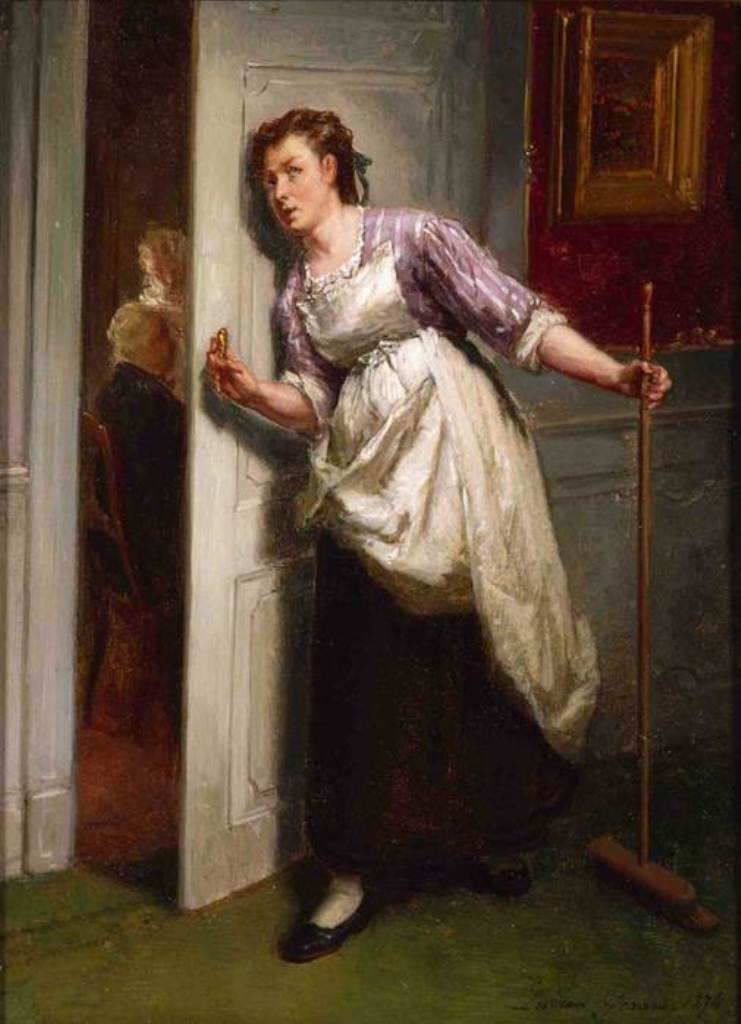
After the kiss on WIP Wednesday

canal-path-at-nightIn a romance, so various mentors have told me, the sexual tension builds and builds until at last the couple kiss. And if that moment is not at the end of the story, when all the conflicts and plot twists are resolved, than the writer has a problem.

We’ve got them together. Now how do we pull them apart? For the tension to continue, their relationship can’t stay in calm waters. Our readers need to feel their longing. After the kiss comes the slap, or the fight, or the pull between loyalties, or some other interruption to their courtship.

This week, I have another excerpt from A Raging Madness. It comes when my couple’s first kiss, began almost accidentally but continued with enthusiasm, has been interrupted by external noises.

She dropped her hands from his shoulders, tried to cover her breast and pull down her hem, blushed furiously in the dark. “I am so sorry, Alex,” she said. Though whether she was sorry to stop or sorry that they had ever started, she had no idea.

After a moment, he pulled away, swinging his legs around so that he sat beside her on the bed.

“I am not that kind of woman,” she said, trying to sound convincing to herself when her whole body was screaming to complete what they had begun.

“Right.” He sounded strained. She could hear him sucking a breath in, then letting it slowly out through his teeth.

“I cannot apologise enough…” Ella began, but Alex interrupted, his voice as courteous as ever, though she could hear the strain in it.

“The fault is mine, Ella. I meant only to salute you for the gift of my future, and I forgot myself. I..” He stopped, and took another deep breath. “I cannot bring myself to apologise. For any impression of disrespect, yes, indeed. I beg your pardon with all my heart if I have offended. But for offending you, not for kissing you.” He stood, and moved away from the bed. She could not make out what he was doing, but he had not returned to his own bed on the other side of the cabin.

“It was everything I have dreamed this age,” he said, almost under his breath. This age? He had been dreaming of kissing her this age?

But she had to correct his misconception. “Each other,” she said.

Whatever he was doing—it sounded as if he was putting on his boots—he stopped. “Each other?”

“We kissed each other,” she explained.

The amusement was back when he replied. “We did, and very nicely too.”

“And we cannot do it again,” Ella warned, hoping her regret was not obvious.

“No, I suppose not. I am going to take a short walk, Ella. I won’t go far, but the cold will be— beneficial.”

He had opened the hatch and was leaving before she spoke again, giving him a gift of words in return for his.

“It was better than I dreamed.”

His only response was a catch in his step before he continued, but a few minutes later she could hear him begin to whistle as he walked the canal path.

Tea with Sophia

monday-for-tea

On this fine afternoon in September, the duchess had ordered tea served on the terrace overlooking the rose garden. “We should enjoy the sunshine while we can,” she told her goddaughter, Lady Sophia Belvoir.

Sophia had been surprised—and somewhat disconcerted—to find she was the only guest. What was Aunt Eleanor up to?

But Her Grace discussed only the weather and the roses as she poured the tea and passed the cucumber sandwiches; tiny triangles of finely sliced bread with the cool crisp vegetable melting on the tongue.

Sophia took a sip of her tea. Ah. The finest oolong with just a touch of lemon. Aunt Eleanor never forgot.

At that moment, the duchess pounced. “Tell me about Lord Elfingham, my dear.”

Sophia’s hand jerked as she returned her cup to its saucer, and it clicked loudly. She blushed. At her clumsiness, of course, not at the mention of the young viscount who had been everywhere she went for months

“You met him even before most of London, his aunt tells me,” the duchess prompted.

“Not met, exactly,” she demurred. “We were not introduced.”

Aunt Eleanor said nothing; just raised her brows in question, and after a moment Sophia added, “I was visiting the orphanage at Bentwick. A child ran out of the gate into the road, and was almost run down by racing curricles. Lord Elfingham rescued the child and returned him to the- the orphanage servants.”

Appearing from nowhere just as she emerged from the gate and saw disaster unfolding before her. Riding down on the cowering boy right under the noses of the teams that threatened to trample the child underfoot. Scooping up the runaway and leaping to safety on his magnificent stallion. Fixing her in place with a fervent gaze from his dark eyes. Haunting her in dreams ever since.

“He has been pursuing Felicity,” she told Her Grace. “Hythe will not consider it.”

The duchess’s brows rose again. “Your sister Felicity? Are you certain? It is you his eyes follow when you are at the same entertainments, Sophia.”

For a moment, Sophia’s heart leapt, but Aunt Eleanor was wrong. She was too old for the marriage mart, and had not been as beautiful as Felicity even when she was a fresh young debutante. Besides, her brother the Earl of Hythe would not countenance the connection, whichever sister was being courted.

She shook her head, not trusting her voice. “May we speak of something else?” Which was rude, but Aunt Eleanor graciously allowed it.

“Very well. Let us discuss next week’s meeting to set up the fund for the education of girls. You will take the chair, my dear?”

******

Sophia is the heroine of The Bluestocking and the Barbarian in the Belle’s box set Holly and Hopeful Hearts, now on sale.

the-bluestocking-and-the-barbarian-fb


Thou mixture rank, of midnight weeds collected

drugs-mrs-winslows-soothing-syrupI’ve been researching drugs and poisons for A Raging Madness. The book opens with my heroine forcibly addicted to laudanum, which was a mix of opium and alcohol. And then things get worse.

I needed a potion or a poison, or a variety of them, that the heroine could be fed without her knowing, and one that was available in England in the early 19th century. I found that I had a wealth to choose from.

Opium was out. She knew the effects, had fought her way out of addiction, and would have known immediately if it happened again. In describing both the addiction and the withdrawal, I drew (among other sources) on a first-person account from Victorian times.

I’m just mad at myself for having given in to such a fearful habit as opium-eating. None but those who have as completely succumbed to it as I did, could guess the mischief it would do. Even you, with an experience which must be extremely varied, being as you are, in such a good place for studying people’s brains (or rather their want of them), cannot know the amount of harm it did to me morally, though I must say you did seem to have a pretty fair idea of it. It got me into such a state of indifference that I no longer took the least interest in anything, and did nothing all day but loll on the sofa reading novels, falling asleep every now and then, and drinking tea. Occasionally I would take a walk or drive, but not often. Even my music I no longer took much interest in, and would play only when the mood seized me, but felt it too much of a bother to practice. I would get up about ten in the morning, and make a pretence of sewing; a pretty pretence, it took me four months to knit a stocking!

Worse than all, I got so deceitful, that no one could tell when I was speaking the truth. It was only this last year it was discovered; those living in the house with you are not so apt to notice things, and it was my married sisters who first began to wonder what had come over me. They said I always seemed to be in a half-dazed state, and not to know what I was doing. However they all put it down to music. Mother had let me go to all the Orchestral Concerts in the winter, and they thought it had been too much for me. By that time it was a matter of supreme indifference to me what they thought, and even when it was found out, I had become so callous that I didn’t feel the least shame. Even mother’s grief did not affect me, I only felt irritated at her; this is an awful confession to have to make, but it is better to tell the whole truth when you once begin, and it might be some guide to you in dealing with others. If you know of anyone indulging in such a habit, especially girls, just tell them what they will come to.

Of course its effects differ according to one’s nature, and it’s to be hoped few get so morally degraded as I did. This much is certain, few would have the constitution to stand it as I did, and even I was beginning to be the worse for it. For one thing, my memory was getting dreadful; often, in talking to people I knew intimately, I would forget their names and make other absurd mistakes of a similar kind. As my elder sister was away from home, I took a turn at being housekeeper. Mother thinks every girl should know how to manage a house, and she lets each of us do it in our own way, without interfering. Her patience was sorely tried with my way of doing it, as you may imagine; I was constantly losing the keys, or forgetting where I had left them. I forgot to put sugar in puddings, left things to burn, and a hundred other things of the same kind. [Letter in the British Journal of Medical Sciences, 1889: Confessions of a Young Lady Laudanum Drinker]

Laudanum, as the young writer says, was readily available and often prescribed for things as diverse as “Laudanum, the most popular form in which opium was taken (dissolved in alcohol) was recommended in cases of fever, sleeplessness, a tickly cough, bilious colic, inflammation of the bladder, cholera morbus, diarrhoea, headache, wind, and piles, and many other illnesses” [See more at: https://www.bl.uk/romantics-and-victorians/articles/representations-of-drugs-in-19th-century-literature#sthash.v6f0LIBt.dpuf].

drugs-vin-marianiAnother common tincture — too late for my story — was Vin Mariani: coca leaves ground into Bordeaux wine. Red wine and cocaine. It debuted in 1863, and took the polite world by storm.

Devotees of the drink included Alexander Dumas, Emile Zola, Presidents William McKinley and Ulysses S. Grant, and countless monarchs including Queen Victoria of England. In addition, actress Sarah Bernhardt and Pope Leo XIII (who gave him a Gold Medal!) were among the many who actually appeared in advertisements. [http://vinepair.com/wine-blog/vin-mariani-bordeaux-wine-coca/]

Mercury, arsenic, and cyanide were all used in medicines, their effects often more dire than the illnesses they were intended to treat.

I wondered about marijuana, which was readily available and eaten in cakes. I thought maybe it could be stirred into a drink, but I was assured by a friend that the taste would be a clear giveaway.

I’ve finished up with nutmeg, salvia divinorum, and morning glory.

drug-nutmegNutmeg contains myristicin, a naturally occuring drug with effects similar to LCD when consumed in high enough doses. Doses high enough to cause the effect are also really hard on the heart, so it wouldn’t be my drug of choice, since the villain wants her alive. I haven’t yet figured out how high the dose needs to be, and whether it could be slipped past the victim without her knowing. If I’m arrested, it’ll be for this research.

drugs-salvia_mainachtSalvia was used as a drug by shamans in Mezo-America, and is another hallucinogenic. The leaves are bitter though, so as a tea or an addition to a salad, it seems unlikely. Perhaps a tea sweetened with honey? Or an extract made into a tincture with alcohol, and introduced into an otherwise harmless drink.

And the same with morning glory. A heightened sense of awareness and a diminished sense of reality, my sources say. Poor Ella.

(The heading is a quote from Hamlet.)

Seduction on WIP Wednesday

No heroine she, but I rather liked the expression on Joseph's face as he tries to reject Potiphar's wife.

No heroine she, but I rather liked the expression on Joseph’s face as he tries to reject Potiphar’s wife.

Well, maybe not seduction, precisely, because some of us write heroes and heroines who are far too well behaved to get up to that kind of mischief, at least on our pages.

But this week, I’m looking for excerpts that show one character being aware of their physical attraction to the other, especially if they act on it.

Mine is from A Raging Madness. My heroine has not just been compromised, but assaulted, and only the quick thinking of Alex’s father has saved her. Marriage to Alex is the best way to keep her safe, but her previous marriage has left her with bad memories. Never a woman to back away from her fears, she goes to see Alex in his room.

“Is something wrong, Ella? Can I help?”

She wore an ankle-length nightrail, and as she passed in front of the fire, he could see her legs outlined through the fine material. She dropped the shawl she wore and his mouth instantly dried.

“Show me I am not cold, Alex.”

His brain had emptied, too. Surely she could not mean…? Suddenly, he realised that he was naked, and the sheets were down by his hips. He shifted to pull them up and stopped. Too late. She had seen his scarred torso and had not run screaming from the room. That was good, surely?

She was flushing; shifting from one foot to another. “You do not have to if you do not wish to, Alex.”

She thought he was rejecting her? Without stopping to think about it, he threw back the sheets, disclosing his very male reaction to her suggestion, and her eyes riveted on it.

“Someone salutes the idea,” she said, with an entirely feminine smirk. Then her uncertainty returned. “If we do this, I want you to know… If it doesn’t work, if I cannot… I will go away, Alex. I will not burden you with a wife who cannot please you.”

That raised the stakes to a whole new level.

“You will please me, Ella. You please me very much. I thought to wait out of respect to the woman who will be my wife.” He gave her his best roguish grin. “But it occurs to me that bedding you might be the best way to make sure you don’t wriggle out of this, Ella. You really are the most elusive woman! Come here.” He held out his hand, and she took one hesitant step towards him, then another until her hand was in his and he could draw her to the side of the bed. Her colour had deepened as she walked, but he could not keep his eyes on her face with her dark aureole showing through the thin fabric of the nightrail.

Almost without volition, his other hand came up to shape one breast, to linger lovingly over a nipple that tightened and peaked as he touched it.

She trembled and sucked a breath sharply through her mouth, and he looked up into her wary eyes.

“Come here,” he said again, shifting sideways in the bed to make room for her.

She allowed him to help her up on the bed, sitting beside him, upright and tense.

Falling for you on WIP Wednesday

memeThis past month has been hugely busy at work and at home. I’ve also had an inflamed shoulder and have been losing sleep, so I’ve been too tired to write on the train coming home most days. On the upside, this means I’ve caught up with a few books that have been on my Kindle app for a while, and Monday’s treat was Only a Promise, from Mary Balogh’s Survivors’ Club series. I love how each of the survivors finds a survivor to wed, and how they fall reluctantly in love, realising their feelings with great surprise. The lady is a master of the convincing relationship.

Today, I’m sharing an excerpt from A Raging Madness in which my Alex realises how he feels about Ella. Please share your excerpts in the comments.

He was very tempted to kiss her, but feared to change their relationship. Change it more. They were friends again, as they hadn’t been since she was a young girl and he a cheeky subaltern, missing his home and his family.

She had never been available for dalliance. He would be lucky to get away with a slapped face. At worst, she would assume he was courting her. How he wished he could! For the first time in his life, he was experiencing the joys of matrimony, all but the physical intimacies, and he wanted them to go on forever.

But he had no place offering Ella marriage. What could he give her but a broken crock of a man, made ugly with scars, subject to nightmares, prone to shedding splinters and lumps of metal from his leg.

A bored and useless man, at that. He had been a career officer. What was he now? He had investigated the Chirbury estates as a favour to his cousin, removing the land agents in two of them, and buttressing the third with an assistant. But for all it proved to be necessary, the task had started as make-work, and his pride would not let him accept more.

He had no idea what to do with himself, and he certainly would not inflict himself on someone he was fast coming to love.

First words on WIP Wednesday

graveyard-wc1104wI tend to cast around for a long time till I find the start of a book—and even then, I often get it wrong, either deleting what I have in favour of a later passage, or writing something earlier that leads up to my original first chapter. As a writer, I want to start in the middle of the action, but in a place that lets me bring readers into the story quickly, without a lot of explanation. I want to avoid the acronym SDT in the margins. Show Don’t Tell. My friend and editor Mari Christie sends my drafts back with that plastered through them, but so far I’ve been able to avoid the dreaded letters in my first chapters.

So my methodology for starting a book is to write until I recognise the beginning, then second guess that decision once I’ve finished the first draft. Next month’s new release didn’t get its beginning until the final edit. The current work in progress still starts with the first words I wrote in May.

How about you? How do you begin? And does your beginning change as you work your way towards publication?

Here are the first words of A Raging Madness, the first draft I’m hoping to finish by the end of the month. As always, please post your extracts in the comments.

The funeral of the dowager Lady Melville was poorly attended—just the rector, one or two local gentry, her stepson Edwin Braxton accompanied by a man who was surely a lawyer, and a handful of villagers.

Alex Redepenning was glad he had made the effort to come out of his way when he saw the death notice. He and Captain Sir Gervase Melville had not been close, but they had been comrades: had fought together in Egypt, Italy, and the Caribbean.

Melville’s widow was not at the funeral, but Alex was surprised not to see her when he went back to the house. Over the meagre offering set out in the drawing room, he asked Melville’s half brother where she was.

“Poor Eleanor.” Braxton had a way of gnashing his teeth at the end of each phrase, as if he needed to snip the words off before he could stop chewing them.

“She has never been strong, of course, and Mother Melville’s death has quite overset her.” Braxton tapped his head significantly.

Ella? Not strong? She had been her doctor father’s assistant in situations that would drive most men into a screaming decline, and had continued working with his successor after his death. She had followed the army all her life until Melville sent her home—ostensibly for her health, but really so he could chase whores in peace, without her taking loud and potentially uncomfortable exception. Alex smiled as he remembered the effects of stew laced with a potent purge.

Melville swore Ella had been trying to poison him. She assured the commander that if she wanted him poisoned he would be dead, and perhaps the watering of his bowels was the result of a guilty conscience. The commander, conscious that Ella was the closest to a physician the company, found Ella innocent.

Perhaps it had all caught up with her. Perhaps a flaw in the mind explained why she tried to trap Alex and succeeded in trapping Melville into marriage, why she had not attended Melville’s deathbed, though Alex had sent a carriage for her.

“I had hoped to see her,” Alex said. It was not entirely a lie. He had hoped and feared in equal measure: hoped to find her old before her time and feared the same fierce pull between them he had been resisting since she was a girl too young for him to decently desire.

“I cannot think it wise,” Braxton said, shaking his head. “No, Major Redepenning. I cannot think it wise. What do you say, Rector? Would it not disturb the balance of my poor sister’s mind if she met Major Redepenning? His association with things better forgotten, you know.”

What was better forgotten? War? Or her poor excuse for a husband? Not that it mattered,  any more than it mattered that Braxton used the rank Alex no longer held. It was not Braxton’s fault Alex’s injury had forced him to sell out.

The Rector agreed that Lady Melville should not be disturbed, and Alex was off the hook. “Perhaps you will convey my deepest sympathies and my best wishes to her ladyship,” he said. “I hope you will excuse me if I take my leave. I have a long journey yet to make, and would seek my bed.”

Counting the bastards

expelling-hagarA sub-theme of my Revealed in Mist is illegitimacy, and the way that illegitimate children were regarded in Georgian and Regency England. I’m conscious that we see that period through the lens of the Victorian era, as I’ve comment in the article on rakehells I wrote for Dirty Sexy History. I figured I’d better do some research, and — of course — I got sucked in.

Births per women, the number of children born within eight months of the wedding, the percentage of women never married, and maternal mortality rates all turned out to be relevant. No, really. 

Uncovering the secrets

pregnant-brideGenealogists have done some useful research on the percentage of children born outside of wedlock or in the first few months after a wedding. The second is simply a matter of dates, and in the early 19th century, around a third of brides were already carrying when they made their vows.

The first is usually clear enough, too. From a level of two children out of every hundred, the rates rose over the long 18th century until, in the early Victorian, seven percent of all children were illegitimate.

(Of course, this doesn’t count those who had a legal father to whom they were not biologically related. Research in other fields gives figures for the number of offspring not related to the putative father, with figures ranging from one or two percent up to as many as forty percent, depending on things like the conditions of the research, socio-economic status, and social norms. One in ten across the Georgian population seems reasonable, with lower figures in the homes of the middle sort, for reasons we touch on below. EDITED)

The birth or baptismal records might state the name of the father and the status of the child. Or perhaps the mother wouldn’t name the father, though such stubbornness could see her jailed. The local parish authorities, who were required to pay for the care of a child whose mother was a resident, had a vested interest in making sure that the man took his responsibilities seriously.

I dare say a number of those pregnant brides went to the altar to meet a groom constrained to be present by the local Vestry committee. And if the man could not or would not marry the girl, he was expected to pay a weekly amount until the child was seven, and could be apprenticed.

Of course, then as now, there were men who successfully denied responsibility, or who absconded. And, with urbanisation, the old village system, where everyone knew everyone else’s business, became less significant for most of the population. The cities provided greater opportunities for anonymity and escape, and fewer opportunities for social sanctions, so the rise in illegitimacy rates is hardly surprising.

Septicaemia as birth control

death-in-childbirthNow I needed to know average family size. After all, five percent in 1800 is only one in twenty, but how many families had an illegitimate child?

In 1800, women could expect, on average, five live births in their childbearing years. Several sites suggested this implied some form of contraception, and I think I’ve figured out what it was. Women had a twenty percent chance of dying in childbirth, which correlates in a horribly fascinating way. The most common way of limiting the number of births per women was maternal mortality.

We can’t say that the average family size was five children. The odds were slightly skewed because it seems likely that a third of women never married (although presumably some of those had children anyway). And fathers could and did take new wives and have more children.

Calculating average family size

familySo let’s do it this way. [WARNING: If you are allergic to Maths, read no further.]

750 children would be born to 150 women. One hundred of those women would be married. Thirty-seven of those children would be born outside of marriage, so the remaining 713 children were born inside of marriage.

This gives us an average family size of around seven, and, in those hundred families, 71 children whose biological sire was not the father of record, and 34 who were conceived before the marriage but born within it.

Class differences in attitudes to illegitimacy

family-sceneThe idea that a woman with a bastard was damned forever and had no choice but to sell her body on the street is part of our Regency writer vocabulary, but it isn’t entirely accurate. The rural lower classes were more practical than that. A girl who was found to be pregnant, and without a lover willing to marry her, might be producing another mouth to feed, but in a few years that mouth would become a set of hands. Genealogy studies have found that unmarried mothers often married later on, their ‘mistake’ absorbed into the new family without a ripple.

For the urban poor, forced to work in factories and workshops, babies were more of a problem. Many were cared for in baby farms, where the death rates were horrific.

The middling sort always set greater store by moral behaviour that those below and above them on the social scale. They tended to expect morality of their men and their women, so perhaps the daughter of a shopkeeper or a lawyer or a wealthy tenant farmer might expect her suitor to marry her if he anticipated his marital rights.

The double standard

the-alarmNot, though, if she were foolish enough or unfortunate enough to attract the attention of one of the upper sort. They had two sets of rules. If you’ve seen the movie Georgiana, you’ll remember the Duke of Devonshire, who had a series of mistresses he preferred to his wife, brought his bastard children to live in his house, and expected the duchess to be friends with the mistress who lived with them, and mother to the entire brood: hers and those of his lovers. Yet he was exceedingly miffed when she had an affair resulting in a child, and insisted that the child be given to its paternal grandparents.

In some ways, little Eliza Courtney, Georgiana’s daughter, was fortunate. She went to relatives who were well able to care for her, though it seems she was kept very much in the background. She made a good marriage, and her descendants include Sarah, Duchess of York. Other noble bastards were put into foster care with unwilling or careless carers, or they remained with their mothers, but only because the poor fallen ladies were turned from their homes.

Women were to be pure (or at least discreet). Men could do pretty much what they liked, as long as they were a little subtle about it.

In fact, reactions varied as much as families. Whatever you’ve read in a romance probably happened somewhere.

For a linked topic, see my post this week on Jessica Cale’s Dirty Sexy History: The Rakehell in Fact and Fiction

Opening and ending hooks on WIP Wednesday

eavesdroppingI tend to write drafts in scenes, then decide later where the chapter breaks go. This means that at edit stage I need to find page-turning line to end a chapter on, and an enticing line to begin the next. Or I need to write one.

We call these hooks. They catch on the readers’ mind, and then we reel them in.

This week, I’m looking for your hooks. Give me an excerpt that makes me want more. Here’s one of mine, from Revealed in Mist.

She transferred the contents of the tray to a table beside Miss Diamond’s chair: the pot, a cup, a plate of neatly sliced ham, cheese, pickles, and bread, and a plate of tiny iced cakes. Madame watched and Miss Diamond sat compulsively eating one marzipan shape after another. “That will be all,” Miss Diamond said. “Dupont will serve me.”

Dupont followed Prue across the room and closed the door firmly behind her.

Would there be time to get into the book room while they were occupied? She could at least find out whether she could easily pick the lock with the tools she had been carrying in her apron pocket all afternoon.

She had just taken them from her pocket and bent to examine the lock when a loud scream from below sent her jerking upright then plunging back downstairs.

Building a village

renbridge-landscapeA couple of weeks ago, I wrote the arrival of my hero and heroine of A Raging Madness at the tumble-down Renwater Grange, the estate gifted to Alex by a grateful king. They woke up the next morning, went for a walk to investigate the stables, and met the husband of their temporary housekeeper. And then I got stuck.

renwater-stablesI knew where the house was; in the village of Renbridge, in the Lincolnshire dales. I’d done quite a bit of research about agriculture and horse breeding in the dales, and the type of land ownership and architecture. But who lived in Renbridge? What were their names, their characters, their habits and their interrelationships?

I realise that most of the villagers won’t have a mention in the book, and that even those who wriggle their way into the first draft might be cut in the second. But I have no idea which ones are a permanent part of the story, and—in any case—their existence, mentioned or not, is texture in the background. Who are these people?

So for the past fortnight, I’ve been writing a village. I thought you might like to see the raw results.

Renbridge village

10.2 miles from Horncastle, 6.9 miles from Louth, 8.7 miles from Alford

The church and rectory

renbridge-churchThe church is St Ninians, the living is at the gift of the King as Duke of Lancaster. The Rector is Reverend Daniel Morris, a single man, an elderly widower with no children. His housekeeper is Mrs Kelk,  wife of his handyman and general servant. He also has an all purpose maid, Aggie Nevis. Mr Morris (74),  Kelk (56), Mrs Kelk (57) (the five Kelk children are all gone — two dead as children, a boy and a girl, one married and in Alford, one in the army, and one in the US after a run in with the law). Aggie (48) never married, has been with the living longer than the others.

Mr Morris is kindly, scholastic, and sharp as a tack. Very social, has a lovely little dog that he takes walking. He is a classics scholar with a speciality in Republican Rome and takes students. One is currently living across the road with the Mullens.

The inn

renbridge-innInnkeeper is Silas Hancock (48), and his wife Betsy (46). They have grown sons and a daughter who also work at the inn. Sons are Fred (27), Sam (25) and Dick (19). Their daughter is Mattie (19). Four children died between Sam and Dick, two during a village cholera epidemic, one of smallpox, and one in an accident. Dick and Mattie are twins. Also various servants who may or may not get names. Fred manages the stables with Dick’s help. Silas is mine host. Betsy and Mattie rule the kitchen. Mattie is being courted by a farmer’s son. Inn has been in the Hancock family for generations.

The inn, church, and grange are on the Y intersection.

Cottages on the road to Alford

Mirs Rycroft lives in a substantial detached cottage.

Mirs Rycroft lives in a substantial detached cottage.

On the road to Alford between the church and the grange are three cottages, all detached. On the east of the road, next to the rectory, is the Fox house, then Widow Bycroft’s cottage, then the bridge over the Ren. On the west of the road next to the bridge is the Broadley cottage. The rest of the west is grange land.

The Fox family is large and unruly. Jeb Fox (35) is a drunkard and a lout. He does farm labour when he can get it, but most of the farmers around will only use him if they have to, as he cannot be relied on.  Pansy Fox  (28) takes in washing, cleans, and (it is rumoured) supplements her income by lifting her skirts. Fox beats her when he suspects such a thing, and so her lovers are circumspect, but she has 7 children to feed, and those are just the survivors. She has buried 4, two in the same cholera epidemic as the Hancocks.  The children are one a year, 11, 10, 9, 7, 6, 3, 1, with the dead ones fitting in the gaps. She is pregnant again. Not all of the children look like her or Fox.

The widow, Harriet Rycroft (61) lives in a house that is slightly more substantial than a cottage.  She and her maid of all work and dear friend, Jane Harper (59), came here from far away and have lived quietly in the village for 25 years.  The villagers would be surprised to know that they are retired prostitutes. They often give work to Pansy Fox, but pay her in food and clothing. Mrs Rycroft runs a dame school for the village children.

A visual reference for Renwater Grange

A visual reference for Renwater Grange

The Broadleys are both from families that have long been in the area. Jack Broadley (47) is a farm labourer, a large quiet man that will turn his hand to most things. Because work is scarce in the area and farmers can usually take their pick, it is significant that he is usually among the first chosen. Bee Broadley (Phoebe, 43) is Silas Hancock’s sister. She has been hired as temporary housekeeper at the grange, and is the first person Alex and Ella meet when they arrive. The Broadleys have one son (John, 24), who was impressed by the navy but who loves the life, and a daughter (Molly, 22) who has married a local farmer.

A row of cottages on the road to Horncastle

renbridge-row-of-cottagesOn the road to Horncastle, the grange takes up the northwest side of the road, and there is a row of three cottages on the southeast, with the Roses, Mullens, and Pecks.

Bill Rose (67) runs the village shop, with the support of his two daughters, Martha (34) and Jemima (32).  His wife died when the girls were teens. Bill’s son Willy married and moved away  years ago. Willy is horse mad, used to work in the inn stables, and took a job to be closer to horses. The innkeeper, Bill, is in failing health and Willy wants to be closer, so will apply for job as stable master. Bill has chased off any suitors for his daughters, so they are still single. They are involved in all village activities, especially church activities.

George Mullen (27) and his wife Millie (20) are newly weds. He is a farm labourer, son of farm labourers from another village closer to Alford. She is the daughter of Mr and Mrs Hewitt, who live further along the road. They can only afford the cottage because they have a gentleman boarder, a scholar who is studying with Mr Morris. He is a young man who hopes to take religious orders, which will work better if he can keep his eyes of Mattie Hancock. Peregrine Fairweather (23) is the second son of a family of comfortably situated gentry, and a nice enough young fellow.

Matthew Peck (56) and his two sisters Katie (57) and Pauline (59) live in the last cottage on the way out of the village. Matthew is a farm labourer. Katie and Pauline do piece work for a dressmaker in Hardcastle.

Cottages on the road to Louth

renbridge-smithyLeading out of the village to the east on the Louth road, the Arnotts and the Hills are on the north side in detached cottages.

Charlie Arnott  (48) is the village smith, and also the verger. His father, also Charlie (78) was both of these things before him but is now suffering from dementia. His mother Maggie (67) looks after Charlie and also helps with the house and children. Charlie is a widower, his wife having died in childbed some 10 years ago, leaving four children: Charles Jnr, who is 19 and his father’s apprentice, Becky (16), Tom (14) and Ben (12).

Nathan Hill (34) and his wife Lucy (28) live in the eastmost cottage with children Fanny (6), Jenny (4),  Ninian (2), and Lucy is heavily pregnant. Nathan is a carpenter and general handyman. Lucy spins, sews, and makes bonnets to supplement the family income.

The remaining villagers, the Woods, Farrows, Hewitts, and Dodds,  live in the row of cottages on the south side of the Louth road.

Moses Wood (46), the carter, is married to Hester (39). They have one son, Aaron, who is in the army (22). Hester is a baker at the inn.

There';; be work for bricklayers and carpenters up at the Grange

There’ll be work for bricklayers and carpenters up at the Grange

Tim Farrow (36) is a farm labourer living with his mother,  Alice Farrow (61). He was a rival for Lucy Hill’s hand and has been miserably single ever since.  Jemima Rose has hopes of him, but he hasn’t noticed.

Ted (62) and Mary (61) Hewitt are the parents of a large brood, mostly dispersed. Millie is the youngest, and recently married George Mullen.  They also have 3 sons and 2 other daughters, as well as 2 who died as children. The eldest is  Eddie, 34, an assistant stable master in Hardcastle. Mary-Kate (31) is married to one of Alex’s tenant farmers.  Suzy (27) went into service and is now assistant housekeeper for a baron near Lincoln. Twin brothers Wally and Bart (23) both live at home and are farm labourers with their father. Mary helps out at the inn.

Gabe Dodd (38) and his wife Abbie (35) live in the last cottage on the road to Louth.  They have three children, Matthew (10), Mark (7), and Luke (4).  Abbie has just discovered that she is with child again, but has not yet told anyone because she is prone to miscarriage. Gabe is a builder/bricklayer.

Five farms pay rental to Alex

renbridge-farmhouseJerry Ashton (62) and his wife Agnes (58) are Lucy Hill’s parents. They also have two sons who work the land with their father,  Frank (34) and Harry (31). Both are married, Frank to Nan (28) – two small children, 5 and 3—and Harry to Dinah (27, and Nan’s sister)—two small children, 3 and newborn.

Jonas Catchpole (43) and his wife Clara (46) live with Clara’s elderly parents (Seth 74 and Mary 71). Their one daughter is married to Rafe Bracey.  They have a live-in farm worker, Johnny Harper (32) who had hoped to marry Rachel himself.

Billy Horrell (52) is a widower with two grown sons. William (28) is single and Henry (25) recently married Molly Broadley

Rafe Bracy (33) is married to Rachel (21), the daughter of the Catchpoles. Rafe and Rachel live with Rafe’s brother Mike (35), who is a widower with two small children (7 and 3). Rafe was in the army, but returned home when his brother’s wife Mary died.

Ambrose West (39) lives with his sister Heloise (37). He is sweet on Martha Rose, and has been since they were children. Their mother was gentry who married down. She is a doddery old woman of 66, who sews by the fire and occasionally discomforts people by noticing what is going on. They hire their farm labour from the village.

Win a kitten in the Holly and Hopeful Hearts kitten tour

A kitten from the Bluestocking Belle’s box set Holly and Hopeful Hearts needs a home.

Meet Snowball, the kitten who captured the heart of the Earl of Hythe

Meet Snowball, the kitten who captured the heart of the Earl of Hythe

In my story, The Bluestocking and the Barbarian, Snowball is tempted from hiding by dangling gold tassels on James’ boots.

“I reckon gold tassels on the boots would be right proper, my lord,” the footman ventured.

He was right, too. Gold tassels that swung as James walked, catching and then losing the light. Not that gold tassels were going to make up the ground he’d lost with Sophia, but still…

“See what you can find,” he told the servant. “Adam, go on ahead and find your lady. I’ll be down in a minute.”

So it was that when he left his chamber, three gold tassels dangled from the front of each boot and proved a tempting target. A white kitten darted out from under an occasional table when James stopped to close the door behind him and took a flying leap at the tassels, as James discovered when he felt the sudden weight.

He took a careful step, expecting the small passenger to drop away, but it buried its claws and its teeth into its golden prey and glared up at him.

“Foolish creature,” he told it, going down onto the knee of the other leg so he could remove it, carefully lifting each paw to detach the tangled claws. “These gaudy baubles are to attract my lady, not a fierce little furry warrior.” He lifted the kitten in one hand and held it up to continue his lecture face to face. “Now where do you belong, hmmnhmmn? Have you wandered off from your mama? Do you belong to this house, I wonder, or did you come with a guest?”

The kitten squeaked a tiny meow.

“No, little one. I will not put you down to chew my tassels, or to trip one of the great ladies or to be trodden on by one of the gentlemen. You are a pretty little fellow, are you not?” He tucked the cat against his chest and rubbed behind its ears, prompting a loud rusty purr incongruously large for the small frame of the kitten.

Although focused on the kitten, he was aware of footsteps approaching. It was Hythe, who looked uncomfortable in a tight-fitting jerkin over short ballooning breeches that allowed several inches of clocked stocking to show between the hem of the breeches and the thigh-length fitted boots. The short robe, flat cap, and heavy flat chain gave a further clue, and Hythe had tried for authenticity by stuffing padding under the jerkin—a pillow, perhaps?

“Henry the Eighth?” James ventured, half-expecting Hythe to walk past without speaking or make another intemperate verbal attack.

Instead, the younger man nodded. “My sister Felicity picked it. Er… I wanted to speak with you… I owe you an apology, Winder… Er… Elfingham. My sister Felicity told me that… Well, the fact is I made an accusation without checking my facts.” Hythe nodded again, clearly feeling that he had said what he needed to say.

“Very handsome of you, Hythe,” James said.

Hythe ran a finger around inside his collar, flushing slightly. “Yes, well. The thing is… You will tell Sophia that I apologized, will you not?”

Ah. Clearly Sophia had expressed her discontent.

“Sisters can be a trial, can they not?” James said, and Hythe warmed to the sympathy.

“Just because she is older, she thinks she can…” He visibly remembered his audience. “Sophia is of age and will make her own decisions, but I think it only fair to tell you that I have advised her to wait until after the hearing at the Privileges Committee before she makes any decision.”

James inclined his head. “I understand your position.” Which would not prevent him from doing his best to persuade Sophia to ignore the advice.

Time to change the subject. He held up the little kitten. “Do you happen to know where this little chap belongs?”

Hythe flushed still deeper. “So that’s where he got to. He… ah… appears to be mine. In a way. The housekeeper’s cat had kittens, and this one seems to have adopted me. Little nuisance.”

But Hythe’s hands were gentle as he took the kitten from James, and he tucked it under his chin, his other hand coming up to fondle the furry head.

“I’ll just put him back in my room so he doesn’t get in anyone’s way. Foolish boy, Snowball. Do you wish to be lost? Was the fish not to your taste?”

Hythe retreated back down the hall. James could not hear individual words, but from the sound of his voice, he was continuing his loving scold. And James had managed to have what almost amounted to a conversation with his intended brother-in-law. He would count that as a win.

Follow the book links to learn more about the stories. Enter the rafflecopter below to be entered for the random draw to win the kitten.

the-bluestocking-and-the-barbarian-fb

The winner will be announced at the Book Launch Party on November 13th. The other kittens in the novellas are also looking for new homes, so be sure to keep an eye out for them! Good luck!

a Rafflecopter giveaway