Choosing to Dream – an interview with Jennifer Senhaji

Today, I’m delighted to welcome Jennifer Senhaji to the blog to talk about her writing, and her new release contemporary romance Choosing to Dream.

  1. Why do you write in your chosen genre or genres?

I love contemporary romance because the stories are relatable. I enjoy the escapism of fantasy, historical fiction, and sci-fi, but there is something about reading a story where the characters are people you can easily imagine knowing… When I read a good contemporary, I end up in the story as the heroine or maybe a supporting character, if the heroine is really different from myself. I hope that my readers feel like they become a part of my stories. That they either become the characters or feel that they know the characters personally as part of their reading experience.

  1. Do you base any of your characters on real people?

Yes and no. There are traits from people I know in every character I write, but not solely based on one person. For example, Jasmine, who is Jenna’s best friend in Choosing to Dream, is loosely based on my daughter and a good friend of mine, and yet there are parts of her character that are completely original and have nothing to do with either my friend or daughter.

  1. Who is your favorite character in the book you’re showing us today?

Jenna is my favorite character, but Jake is a close second. There is so much of myself in Jenna that makes her a deeply personal character for me. Jake is the perfect hero, in my opinion. Amy is a hoot and I love writing her. And Jasmine is also a really strong character. Ah hell, I can’t narrow it down. Sorry.

  1. What’s your favorite scene and why?

My favorite scene is the surfing scene. With Jake’s help, Jenna learns how to surf. It’s something she is able to check off her bucket list. It’s something I would love to do as well. I can almost picture myself in that scene, riding a baby wave. Yeah. That was my favorite. It’s not a big emotional scene, but it’s empowering and fun.

  1. What was the hardest scene to write and why?

There is a love scene that takes place in Denver, Colorado, when Jen and Jake finally get to see each other after a long separation. It’s full of angst and confessions, and it was hard to write. I wanted the reader to really feel their frustration. Feel their anxiety. I think I accomplished that. When I was reading the proof, if brought me to tears. It’s what I was going for in the scene, but it was difficult to get right. There’s a funny scene right after that, so we go from emotional angst, to silly fun. But I love those scenes together. They balance each other well.

Choosing to Dream

choosing to dreamJenna Morris and Jacob Walker have finally given in to the flames of passion licking at their heels. But they’re only allowed one, blissful week together before the responsibilities of Jen’s café and Jake’s new film wrench the new lovers from each other’s arms.

Struggling to keep insecurities at bay whilst involved in a long distance relationship with one of Hollywood’s most eligible bachelors is tough enough. Dealing with Bethany Phillips, ex-supermodel turned actress and Jake’s new costar is almost unbearable.

They say love can move mountains, but can it bridge the gap that fame, jealously, and thousands of miles between them has caused?

Choosing to Dream is book 2 of the Sunset Dreams series, and was released on 17 July.

Amazon Buy Link: http://amzn.com/B0103BEN9Y

Meet Jennifer Senhaji

senhajiJennifer Senhaji was born and raised in San Francisco, CA, and is married with two children. If she’s not singing along at the top of her lungs to whatever is playing on the radio, you can find her making music playlists at home on her laptop. She works full time and splits her spare time between family, reading, blogging, and writing. Other than English, Jennifer speaks Spanish, Moroccan, and a little French. She loves to travel, but doesn’t do enough of it and will weave places she has gone or wants to go into her stories. Reading has been a passion for most of her life and she loves to write. She calls herself Your Sweet and Spicy Romance Author because she loves the sweet nuances of new love, but also is a bit of a voyuer and wants to be in the bedroom when the characters finally come together.

Website * Facebook * Twitter * Blog * Goodreads * Smashwords * Amazon * WordPress

In a space out of time, two hundred years no longer separates our heroes

After Keisha Page, The Word Mistress, agreed to be a host on the A Baron for Becky blog tour, we talked about the type of post I might write. As many of you know, I’ve done quite a bit of co-writing with my Bluestocking Belles colleagues, on one another’s blogs and at Facebook parties such as our Bluestocking Belles Crock and Bull inn, and the Bluestocking Bookshop.

But I’ve never before put one of my Regency heroes or heroines with someone else’s contemporary dude.

Keisha’s Alex is a quite a guy. In fact, he’s a rock star. The hero of Keisha’s Rhythm of Love, he is astounded to find himself having dinner with a man from 200 years ago. My Marquis of Aldridge, one of the two male protagonists of A Baron for Becky, is pretty surprised, too.

Keisha posted the first part of our joint story, written from Alex’s point of view, and I’m following in her wake posting the same part again, but from the point of view of my Aldridge. Follow us on Twitter or Facebook, or subscribe to our blogs, to catch the rest, which we’ll post every few days over the next fortnight.

Oldinn

Aldridge checked his horse at the top of the rise. Surely that was an inn in the hollow? And one that hadn’t been there three weeks ago when he rode north?

He was wet, cold, and tired. If they had a warm room and good brandy, he’d take it. Mystery or no mystery.

An ostler took his horse in the stable yard, and the front door opened to warmth and the welcoming smells of stew and fresh bread. This was exactly what he needed!

The public room was nearly empty, apart from the old codgers in the corner that seem to live in every pub. Aldridge took a seat at a table near the fire and grinned invitingly at the girl at the bar, who was fetchingly, if surprisingly, dressed in skin tight pantaloons of some dark material.

The serving girl handed Aldridge a beautifully written menu – printed, it looked like. Aldridge raised an eyebrow at the expense of such a print job, but the appetising odours had already made up his mind.

“A dish of your stew, my sweet, and some of that bread I can smell. And soon, dearest, if you love me? I’ve been riding since dawn, and my belly thinks my throat’s been cut. And brandy, if you have a good French brandy. Otherwise, your best ale.”

The barmaid did not appear impressed at his endearments, but she pressed a device in her hand, and said, “Be right wiv ya,” before turning to the man who had just taken a seat at the next table, a strangely dressed fellow in tight leather pants and a bulky leather jacket. And was that a helmet under his arm?

“When did this place open?” the man asked. Aldridge could not place his accent.

“Oh, we’ve been around for ages, sweets. We’re just not always in the same place twice.” She sauntered away, her swaying rump delightfully outlined by the tight cloth of her outrageous garment.

At the next table, the stranger swiped his hand down the front of the jacket he war, and it split into two pieces. How was that possible? Aldridge couldn’t see the fastening, just a series of tiny metal bars down both front seams.

It didn’t take the servant long to return with his brandy. Aldridge held the beautifully formed glass in his hands to warm the drink, and inhaled its fragrance. Yes. This would do nicely. The man at the next table was watching him. He raised the glass slightly and tipped his head in a polite salute. “If the taste is up to the bouquet, I can recommend it,” he said.

“Fantastic, thanks,” the man said; then, after a long pull from his beer. “This is going to sound strange, but why are you dressed like that?”

The man was right. It did sound strange. How else should he be dressed? Riding jacket now open to show the richly embroidered waistcoat underneath; check. Cravat, neatly tied in a knot a hundred dandies would sell their eyeteeth to duplicate; check. Pantaloons, formerly almost white but showing the impact of a day’s hard riding; check. Hessian boots, with tassels of his own design; check. His beaver and the many caped greatcoat that had kept of the worst of the rain were hanging in the foyer.

Perhaps the man thought he should be in breeches for dinner?

“One does not normally dress in formal dinner wear for a country inn,” he explained. “Would you care to join me at my table?” Aldridge would appreciate a closer look at the man’s own clothes. Especially the clever fastening for the jacket.

A strange expression crossed the other man’s face, then he picked up his mug, and moved to Aldridge’s table. “Sir, you’re sitting in a restaurant in the middle of New York City.”

Aldridge blinked. That made no sense at all. “New York City? In the colonies? I beg your pardon, I should say the United States, of course. Sir, I rode up to this inn not fifteen minutes ago in the countryside between Margate and Canterbury. In England.”

The servant placed a fragrant plate of stew in front of each of them, and a whole loaf of fresh hot bread on its own cutting block in the centre of the table. “Told you,” she said. “Sometimes we’re not even in the same place once.”

Aldridge raised both eyebrows. Surely she couldn’t mean that as it sounded. Had he stepped into a gothic romance? He took a deep breath of the stew to ground himself in something real.

Then his dinner companion said, “I’m Alex, current denizen of twenty-first century New York City. Pleased to meet you.”

“Twenty-first….?” Aldridge shook his head. Two centuries in his future? Impossible. Nonetheless, he put out his hand. “Pleased to meet you, Alex. I’m Aldridge. And when I rode out this morning from Margate, it was 1810.”

Read more about A Baron for Becky

Road to a better mousetrap – part 3: Tuesday Talk

Mari Christie and I are writing a series on marketing in the bazillion book marketplace, and this is part 3 of the chapter on creating a marketing plan.

Most of the first post was about knowing your reader. You need to know who you want to sell to, what they want to buy, and how much they will spend. The second post talked about knowing your product and finding your readers.

In this post, we talk about how to keep your readers and how to get them to sell your books.

stand-outHow not to become rich and famous

Writing books is no sure way to wealth and fame, as every writer knows. Wealth and fame, or even a modest income and privacy to write more, means selling books. Selling books eats into your emotional and creative energy: energy you could be pouring into your books.

But not selling books, for those of us without a private fortune or a rich spouse, means doing some other job to put food on the table, and the job eats into your time and very likely your emotional and creative energy.

You already know that finding buyers (other than your closest friends and relatives) means writing a good book, having it well edited, and giving it a gorgeous cover. Do these things and you’ll find a few buyers. A few.

Sales figures for ‘the average book’ are no more than a guesstimate, but a few brave people have made an attempt, basing their figures on reported sales from a variety of sources. And those figures come out somewhere in the region of 200 to 500 books in the first year, depending on genre, with an upper average of 1000 in the lifetime of the book.

Of course, a very tiny fraction of one percent of all books do spectacularly well, selling 10s, even 100s of thousands, which means the average of all of the rest is probably lower, closer to the 200.

That’s the average. And you wouldn’t be reading this article if you didn’t want to beat the odds.

Don’t find buyers; attract (and keep) fans

It’s a vicious cycle, but there is an answer.  Find other people to sell your books for you. Convert your readers into followers, and your followers into raving fans.

We’ve discussed in other posts the need to interact with readers. This post gives three steps for making those interactions count. When you write your marketing plan, document how you intend to do these things.

  1. Make it easy for them to find you.
  2. Make it worthwhile for them to follow you
  3. Provide interesting stuff

Make it easy for them to find you

Sell your books where the bulk of your readers are. Whatever you might think of Amazon’s business model, learn how to make the most of the platform they offer. Taylor your keywords, the bio on your author page, and all the other tools they provide to get your book noticed. Do the same with other eretailers, too.

Your print audience is going to be smaller. I cannot give much advice on print. My books are available in print, but I haven’t been pushing the print copies because I only have a certain amount of energy.

Give away a free book—short stories, excerpts, or a novella. Before you can convert that reader, you first have to put a book in front of them. My novella, Candle’s Christmas Chair, was downloaded 53,000 times in its first six months. That’s 53,000 readers I have a chance at converting.

In your free book, as well as your books for sale, give your readers a reason to go looking for you and a way to connect with you as soon as they finish the story. On your next pages, put  links to your social media and subscription services, teasers and excerpts for your other books, buy links for the books already on sale.

Make it worthwhile for them to follow you

Okay, you’ve given them a reason to click. Now give them a reason to subscribe, to buy, to join, and to follow.

Here are few that work well if you do them well.

Have a newsletter. Make it easy for people to sign up and give them interesting content. Reward them with coupons or insider information, and special contests. Keep your newsletters brief and informative, and don’t send them too often.

Have a blog. Blog about things that interest your target readers, and blog regularly. Use your blog to inform and entertain. Watch your blog stats to find out what posts do well and what topics people consistently ignore. Do more of the one and fewer of the other.

Post often. Themed days can help if you have trouble thinking of what to say. Visitors can help, and people love to be hosted on other people’s blogs. It’s a win-win; they reach your audience and you’re introduced to theirs. One idea is to invite other novelists to post a themed extract in comments. Exquisite Quills does this brilliantly.

Encourage people to subscribe to your blog, so they get notified when you put up a new post. And post often. Visitors can help. Themed days can help.

Have a twitter account. Tweet about things that interest your readers. Reply to people’s comments. Tweet about interesting blog posts. Link to free books and excerpts.

Have a Facebook fan page and post stuff about your books, research you’ve done, places you’ve been, and your cat. Facebook loves cats. Ask questions. Join in conversations. Post interesting memes and idea.

Provide interesting stuff

Don’t be a digital billboard, constantly trying to sell something. Engage, inform, entertain, intrigue, delight. Put the effort into writing quality content, whatever you’re posting: hot men, useful recipes, research into royal mistresses, castles, cute cats, questions about romance tropes.

I’ve been trying to do all of these, though not as consistently as I’d like. Torn between the day job, the fiction writing, family commitments, and marketing, I lurch from too much focus to too little. Still, in the first three months after the release of Farewell to Kindness, I’ve sold over 900 copies. Not enough to retire on, but considerably over the odds.

In the next road to a better mousetrap post, Tools and tactics?

Road to a better mousetrap part 2 – Tuesday Talk

Today, Mari Christie and I continue co-posting on marketing in a bazillion book marketplace. 

too-many-booksA few weeks ago, we posted the first part of an article about writing marketing plans.

Most of the first post was about knowing your reader. You need to know who you want to sell to, what they want to buy, and how much they will spend.

But they’re not going to come to you; you have to find a way to go to them. And before you do that, you need to know what you have to offer them.

Know your product

Ridiculous, right? You know your product. Who better? You’ve spent six months, or a year, or three years of your life on this book. So can you encapsulate its essence in a sentence? And does that sentence hook into the interests and passions of the readers you want to reach? If the first nine words of your sales statement does not capture people’s attention, then expect to be lost in the crowd.

Tagline
This sales statement is called a tagline, and it’s worth spending some time crafting it, because you can then use it everywhere – at the start of your description on eretailers websites, in newsletters, in requests for review, on twitter, at the start of Facebook posts, even on the cover of the book itself.

Here are some great taglines:

  • Across the Universe by Beth Revis: What does it take to survive aboard a spaceship fueled by lies?
  • The Mockingbirds by Daisy Whitney: Hush little students, don’t say a word…
  • After by Amy Efaw: You’ve done the unthinkable. What happens…after?
  • Wake by Lisa McMann: Your dreams are not your own.
  • Hold Still by Nina LaCour: How does your life move forward when all you want to do is hold still?
  • Ten Cents a Dance by Christine Fletcher: Bad boys and secrets are both hard to keep.
  • Anna Dressed in Blood by Kendare Blake: Just your average boy-meets-girl, girl-kills-people story.
  • Le Déesse Noire: The Black Goddess by Mari Christie: Kali Matai was destined from birth to enthrall England’s most powerful men. She hadn’t counted on becoming their pawn.

Keywords
Keywords are the next thing to think about. What words are your readers likely to search on. “Spies Napoleonic wars”? “Courtesan to wife”? “Tudor court politics”?

Amazon and Smashwords let you enter a number of keyword phrases, and carefully chosen keywords will help people using their sites to find your book if that’s what they’re looking for. But you can use them much more widely than this.

First, you can litter the keyword phrases in your online conversations about your books, thus increasing the number of times you’re picked up by search engines.

Second, you can use the keyword phrases to search for the people who are using them and the places they hang out. Which brings us to:

Go where your readers are

Writing books is a solitary task. We talk to one another about our craft and our day, but when it comes to putting words one after the other into a text that will one day be a book, we do it alone.

But to put those books into the hands of readers, we need to step out, often outside of our comfort zone, and hang out with people. Mari and I have posted elsewhere about marketing by not-marketing, and I’m not going to repeat that here, except to say I’m not talking about going out to make sales. I’m talking about going out to meet people and have conversations.

You cared enough about your “pirate-lord-succumbs-to-captive” story to spend endless hours writing, editing, and honing it. Perhaps you can ask people what they think of the concept behind it: the idea, perhaps, of arrogance faltering in the face of genuine love. Or you might have some insights to offer from your research into piracy at the time your novel is set. Or you might be able to combine with other writers who’ve explored the same trope to do some kind of a joint presentation.

We’re getting down to tactics, here, and that’s a whole other blog post. Suffice it to say that talking about your passion, the topic in which you’re an expert, shouldn’t be a chore. (And it should go without saying that, as in any conversation, it’s a great idea to listen twice as much as you speak.)

So get out there and hold conversations, whether you meet your readers online or in real life; on Facebook, Pinterest or Google Plus; at a book fair, a country show, or a signing tour.

In the next Road to a better mousetrap post, who will sell your books for you?

Kidnapped to Freedom – the birth of hope

The conclusion to the short story I wrote as a made-to-order…

You can read part 1 here.

You can read part 2 here.

You can read part 3 here.

88676-display_image-1_copyOver the next few days, Phoebe found herself telling the captain a little about her life. He sought her out when she was on deck, insisted on her and the older children taking their meal with him and his officers, invited her to walk with him in the evening.

At her request, he called her Mrs Morien, and assured her that her brother and sister would be waiting to welcome her home. Beneda—she called herself Benita now—was a widow with a child, “though not likely to remain single for long, Joseph says. A number of men have expressed an interest.”

Joseph was enjoying the life of a highly eligible bachelor too much to settle down, much to the despair of the local ladies and the exasperation of his sister.

To Phoebe, the stories seemed like the ones Mist’ Finn had told her long ago—she couldn’t comprehend the life her sister and brother led. Cautiously at first, and then greedily when he laughed and complied, she asked for more and more details, more and more tales about this strange new life that Captain Val was taking her to.

Venus and Jake were soon over their illness. Phoebe had little to do apart from keeping the younger three entertained and out from under the feet of the crew, helped by the two older children. The trip was a holiday such as they had never known. All but the youngest were used to working until they dropped. For an overseer, Paddy O’Keefe had been indulgent to the children of his reluctant mistress, even giving his daughter his name. But they had to work as hard as any of the others, and he would not have lifted a finger to save even his own get from the traders.

Not like Finn. Finn had taken a beating for her, and had then stolen her brother and sister away to save them when Ol’ Massa Blake had decided to sell them. Joe was the young master’s get, and Patsy and Baby were O’Keefe’s. Jake and his sister, dear lost Mina, were bred on her by another slave at Ol’ Massa Blake’s command. Quaco, or Jacob as the white owners called him, had been a kind and gentle man, and she’d been fond of him. But Finn was the one she dreamt of; the one she thought of when she woke in the night.

She hoped that Venus was Finn’s daughter, made in that one week they had before Chan found them together. She’d taken a beating for that, and so had Finn. But Chan couldn’t take the memories from her.

Finn, his head full of knights and chivalry, hadn’t wanted to bed her. But Chan had already announced his intention to have her when he got back from a trip to Charleston, and she wanted her first time to be with someone who would be kind. That’s what she’d told him; someone who would be kind. She didn’t tell him that she loved him. She knew better than that.

And he was kind, too, though the first time had been awkward and clumsy. Two virgins together, they had to work out how things fitted. She’d giggled, she remembered, and he laughed too, but the laughter froze on his face as he entered her and the discomfort he caused was nothing compared to the dawning wonder on his face.

She was thinking about Finn one evening about a week out into their journey, taking out her memories one by one to examine them and gloat over them and tuck them safely away again. The older children had wandered off to the kitchen where the cook always welcomed them, avowing his intention of fattening them up before the ship arrived in Halifax. The little children were settled in the cabin—the captain’s cabin, she realised now. Captain Val was sharing with the first mate, a man of colour he called Perry and treated as an equal and a friend.

She was thinking of Finn, not the captain: not of how he helped her up a ladder earlier in the day and his hand had lingered for a moment on her hip; not of the way his eyes followed her whenever she was on deck. If she was going to be honest with herself, she knew he watched her because her eyes sought his every time she came on deck. Why did the memories of Finn’s boyish face smiling at her turn unaccountably into Captain Val’s masked face, with the firm square angles of his cheek and chin and the amused quirk that seemed to always linger in one corner of his mouth?

The first mate’s roar startled her, and she whipped around, cringing and protecting her head with her arm. But his anger was for a sailor who had abandoned a rope without properly coiling it, and he passed Phoebe without a glance to explain to the sailor, in precise incisive terms, what could happen if the rope tangled when it was needed, and how long the sailor would spend mending sails in penance, so he would never forget again.

Phoebe, who had expected a careless blow if not an outright beating, felt something uncurl inside her, a soft tentative tendril of… what? Hope? Comfort? A sense of safety?

Too early for the last; the captain had warned her that American privateers or the American navy might stop the ship at any time until they made port in Canada. But here, yes, here on this ship she felt safe.

The sailor was making excuses and apologies as he recoiled the rope correctly.

“I was that tired, Mister Peregrine, and it were near the end of my deck time, and then Mickey saw fins off the bow and I went to see. I meant to come back, Mister Peregrine, honest. It won’t happen again, sir, that it won’t.”

Peregrine? That was the name of one of the black knights in Finn’s Arthurian Tales—Sir Morien, Sir Peregrine. Others, too. What a fitting name for a man of colour.

She said that to the mate he passed on the way back to his watching post.

“Peregrine was the name of one of the knights from Africa in the stories of King Arthur.”

“Yes,” the mate replied, “that’s what Val said when he gave it me. He fair loves those stories, Mrs Morien.”

A polite nod was the only response she could manage. Her mind was racing. Val. Short for Percival? Percival was the perfect knight, the Parfait Knight of the tales, the role that Finn had sought with all the poetry in his soul.

As she crossed back to the rail, adding up all the little clues she’d noticed this past week without being aware of them, he came up from below and made a straight line for her.

“Good evening, Mrs Morien.” The slight husk in his voice had been turning her knees to water all week. Quickly, before her fears choked the words in her throat, she said, “Finn, when are you going to take off the mask?”

The captain went completely still. Then, slowly, he raised his hands to the back of his head, fumbled with the strings of the mask, and let it fall into one hand.

A man changes a great deal between 17 and 29. She knew him though. She should have known him a week ago, by his eyes alone. She clamped firmly down on the hurt that he’d felt the need to hide from her. He owed her nothing. She owed him everything. He had saved her brother and sister. He was in the process of saving her and her children. He clearly wanted not to acknowledge her, and he had every right.

“You do not need to wear the mask,” she told him. “I understand. I have no claim on you and I will not be a nuisance.” She made to pass him, but he put out a hand to stop her.

“No, Mrs Moriel… Phoebe. No, that isn’t it at all. I was… The Blakes have done so much wrong to you, to your family. You must hate us all, especially me. I don’t blame you. I left you in that place. I knew what Chan was like, and I walked away. I wore the mask to make you more comfortable. No. That isn’t true. I just didn’t want to see your eyes when you rejected me. You stay here. Enjoy the fine evening for a while longer. I’ll go.”

She was so stunned that he was halfway to the hatch before she found her voice. “I don’t hate you, Finn. I don’t blame you.”

“I blame myself.”

“For what? For trying to protect me and being half killed for it? For saving my brother and my sister no matter the risk to your own escape? For coming back for me?”

“I came before. The first time, I couldn’t get onto the plantation. They had men out with dogs. The second time, we sent you a message, and I waited on the beach, but you didn’t come.”

“I had the message.”

“You couldn’t get away, I imagine.”

Phoebe shook her head.  That was the week Mrs Blake had miscarried a child, and had, in her anger, had her husband’s mistress beaten so badly that Phoebe had lost the baby she was carrying. It was after that Phoebe had been sent to Quaco.

Finn—no, Val—Val saw the shadows in her eyes. “It is over now. You are a free woman and a wealthy one. You never again need to do what you do not wish.” He turned to lean on the rail, looking down at the water that folded back from the racing hull.

Phoebe leaned beside him, content to be silent.

After a while, Val spoke. “Phoebe, I know it’s too soon. I don’t want to press you. I won’t press you; you need time to get your family settled, to learn what it is to be free, and respected, and loved. I want to give you that time. But may I write to you? May I visit from time to time?”

Was he asking what she thought he was asking?

“Yes,” she answered briefly, and he turned to her with a smile that lit his whole face.

“I have never forgotten you, Phoebe.”

She smiled back, ready to tell him that she had never forgotten him, but Mr Perry called him to come and see something on the horizon, outlined by the setting sun, and he left her standing at the rail, watching the water.

Val was right. It was too soon. She needed to get to know her brother and sister again. She needed to get her children started in this life as free people.

But in her heart, the tendril of hope threw off a couple of leaves, and set down a strong root into her memories of the boy who had once been her champion.

Not quite the end, but as far as the short story takes us.

Kidnapped to Freedom – dinner with the captain

Here’s part 3 of my made-to-order story, Kidnapped to Freedom.

You can read part 1 here.

You can read part 2 here.

captainstableThis was not how Val had imagined their reunion; him with a bucket under the chin of one of the children Phoebe had borne his brother, while she tended to another child who, by the look of him, had a different father. He shuddered to think what her life had been like.

If he’d stayed, could he have protected her? He had asked himself the question many times. At 17, he’d been half inclined to blame Phoebe for being selected by his brother. His jealousy had made it easier for him to agree to run with the others after Chan caught them together, and then taken Phoebe and refused to let her out of his sight.

The more Val mixed with the free men of colour in the Maritime States, the more he realised how arrogant and stupid he had been. And after he’d rescued Perry from some privateers and heard of Perry’s anguish at some of the things his sister had been through, he’d felt even worse. He and Perry made a raid on the Georgia plantation that held Perry’s sister and won her free, and Val had been planning to do the same for Phoebe ever since.

Phoebe had never encouraged Chan. And he’d known that then.

Reassured that seasickness was natural, and the children weren’t dying, Phoebe was saying something: apologising for her children being sick, promising to clean up after them, trying to take the jug so she could tend to both children at once. Did she think he would beat her because the ship’s lurching disturbed their stomachs? Yes, in her experience, that was probably normal behaviour for a white man.

“No need to apologise, ma’am,” he said, as gently as he could. “It takes most people a while to catch their sea legs. Some experienced sailors are sick for the first days of every trip.”

Jenkins brought more water, and more buckets. “They’ll be better on deck, cap’n,” he suggested. “I could set a hammock for ‘em, out o’ the way, like?”

Val had hoped to keep Phoebe from the crew’s sight. She was lovely, and they were men. But, he reminded himself, they were men he trusted, for the most part.

“See it done, Jenkins. Ma’am, once the children are settled, you and I need to have a talk.”

The oldest boy, the smaller girl, and the baby joined them for breakfast, while Jenkins sat with the middle boy and the older girl. Both the afflicted looked better for being out in the fresh air, though it was too early to challenge their stomachs with food.

Phoebe looked uncertainly at the table.

“Serve the children,” Val suggested, then you and I will serve ourselves. Shall we try them on porridge? It is a bit like grits, but made from oats.”

The children found porridge very much to their liking, the oldest boy, who Phoebe called Joe, feeding the baby, and the littlest girl feeding herself.

Val filled a plate for Phoebe, who looked surprised when he gave it to her.

“Where I come from, gentlemen serve ladies,” he told her.

“I ain’t… I’m not a lady. I’m just a seamstress. A slave and a seamstress.”

“Not a slave now. Not anymore,” Val said. “And not just a seamstress either. You are the older sister of Joseph and Benita Copeland, proprietors of one of the finest hotels in St John’s, Toronto, a free woman, and a lady of considerable wealth in your own right, Miss Blake.”

Phoebe shook her head, a sharp negation. “Not ‘Blake’.” She clapped her hand over her mouth as if to catch the words, then dropped it again, and straightened her back. “You say I am free, and wealthy. Then I will not bear that man’s name. Let his widow keep it.”

Val was admiring her clear diction—she had always had a facility with languages and could speak English as good as his, but he was fascinated by how quickly she dropped the slave patois. It took a few moments for him to process what she’d actually said. “Widow? Chauncey Blake is dead?”

“Yes. You knew him?”

She was quick. Now Val should tell her who he was. But the same impulse that led him to retain the mask ruled him still. “I did,” he said, “to my sorrow.”

Had their father not intervened, Chan would probably have killed Val twelve years ago. 24 years to 17 is not a fair match. Val’s last memory of his brother was of his face twisted in anger and hatred as he struggled against the restraining arms of the overseers to come back and beat Val some more.

There had been no word of Chan’s death from Val’s friends in Charleston. Mind you, since they found themselves on opposite sides in this war, the correspondence had been sporadic, at best. “When did he die?”

“Three weeks ago. He was thrown by his horse, and broke his neck.”

“There’ll not be many who will grieve, I imagine,” Val said. “His wife; his father. Maybe some of his friends.”

“Miz Blake, she be happy to be a widow, I think, except Ol’ Massa Blake lived just a week longer than his son, so she loses everything but her widow’s portion. She’s mad enough to spit. She’ll be still madder when she finds us gone. She thought to get a good price for us from the traders.”

It was a lot to take in. His brother dead. His father dead. His sister-in-law disinherited, and planning to sell Phoebe—and who else?

“Who inherits?” Val asked. Chan and Nettie had no children, he knew, but his father had a low opinion of most of the Blake cousins.

“Phineas Blake,” Phoebe said. “Mist’ Chan’s younger brother. He’s been gone a long time, but Ol’ Massa Blake, he never changed his will.”

Concluded in Part 4

Kidnapped to Freedom – children throw our hero’s plans into turmoil

Here’s part 2 of my made-to-order story, Kidnapped to Freedom.

You can read part 1 here.

captains cabinVal waited in the shadow of the trees. It must be at least 30 minutes past moon rise. She wasn’t coming. Again. Five years ago, he had waited the whole night, and come back again the next. This time, if he couldn’t carry Phoebe off tonight, he’d have to give up. It had taken him all his powers of persuasion to convince his crew to make one try. They weren’t privateers. The letters of marque that let them take an American ship while the United States and England were at war wouldn’t cover a land raid on a plantation. If she didn’t come, the men wouldn’t agree to a second attempt.

There! Someone was coming. He straightened in anticipation. Yes, it was her—12 years older and a mature women rather than the girl he remember, but even in the moonlight he couldn’t mistake her.

She wasn’t alone. He couldn’t take a herd of children with him! What was she thinking?

He stepped out from the sheltering trees. The mask would hide his face, and his voice had never been the same since Chan tried to strangle him the last time he saw Phoebe close enough to talk to.

“Are you Phoebe?” He was 12 years older too, and a man changed more from 17 to 29 than a woman did, but he couldn’t risk being seen and recognised by anyone on the plantation.

She nodded. He noted that she gathered the children protectively behind her, but the older boy, his face grimly intent, evaded the sweep of her arm and stepped in front. Brave little bantam rooster.

“I was commissioned to take one woman to her brother in Canada, not a parcel of brats,” he said.

“Can’t leave without ma babies, Sir.” Her voice was barely a whisper, but determined.

Her children? All of them? His brother’s children, then, possibly. He surveyed them quickly. Yes the little bantam had the Blake look, and the girl rocking the baby could be a darker version of the childhood portrait of his mother that hung in the parlour.

The men wouldn’t like it, but he was taking them all and be damned.

He met the eyes of each in turn as he said, “You must be quiet. Not a sound. Do everything I say, and I will take you to your uncle in Canada.”

“Perry, give the signal.” He gave the command over his shoulder, not waiting to see if it was obeyed. Perry could be trusted to carry out the raid with maximum noise and minimum damage. He didn’t want anyone actually killed, but he did hope that many slaves would take the chance to escape in the confusion, masking the disappearance of one maid and her children.

He led the way down to the creek, where Jimson stood ready to row them back out to the coast and the waiting ship.

ship

Phoebe startled awake at the knock on the door. Three of the children still slept on the bed in the small but luxurious room. No. It was what Mist’ Finn called a cabin. Venus and Jake were awake, but unmoving in the tangle of little bodies, watching her with anxious eyes. She smiled to reassure them and wished she had someone to reassure her.

Another knock.

When she opened, the little man who had shown them to this cabin nodded at her. “The cap’n wants to see ye, ma’am.”

He’d called her ‘ma’am’ last night, too. Unaccountably, being addressed so courteously made her even more nervous, as if an overseer hid just out of sight waiting to punish her for aping a lady.

“Do I come with you?” she asked.

“He’ll come to ye, Ma’am. In a few minutes, like. To have breakfast with ye and the nippers. He thought ye might want to have a wash first.” The man handed her the jug he was holding, filled with steaming hot water, and crossed the cabin to put the towels off his arm onto the back of a chair.

He turned in time to save the jug as the ship lurched and she lost her balance.

“Ye’ll get yer sea legs soon, ma’am,” he said, not unkindly, and put the jug into a hole that was obviously made for it, next to a basin in a hole of its own.

She had the children and herself washed and tidied before another knock heralded the man from last night. He was still masked, his eyes glittering at her, and his chin and mouth showing, but the rest of his face covered in black cloth.

The little man scurried in behind him, carrying a laden tray that smelled of bacon and fresh-baked bread.

Venus, who had already been looking a little ill, gave a piteous moan. Before Phoebe could react, the masked man, moving with blinding speed, had grabbed the jug that had held their wash water and placed it under Venus’ chin. He was just in time, and Jake was the next to say, “Phoebe, I don’t feel too good.”

Phoebe hurried to feel his forehead. What could be wrong with them? They were never sick!

Some of her fear must have conveyed itself to the masked man, because he said, calmly, “Seasickness, Miss Blake. They will recover once they are used to the motion of the boat.

“Jenkins, remove the bacon, will you? Miss Blake and I will have breakfast in the wardroom with whichever of the children is well enough to join us.”

He was holding the jug with one hand, and calmly supporting the vomiting girl with the other. “Oh, and Jenkins, bring some buckets, please? I rather think this young lady may have imitators.”

You can read part 3 here.

Make Yourself an Expert – Tuesday Talk

Today, Mari Christie and I continue coposting on marketing in a bazillion book marketplace. Her turn today, with Make Yourself an Expert.

I know old-school marketing. I have been working to promote products, people, and services since I was about 15 years old.

  • Trade and Consumer campaigns (B2B, B2C)expert-button_forweb-e1345329354880
  • Strategic and tactical planning
  • Design, copywriting, advertising, on- or off-line
  • Collateral material
  • Printing, publishing, distribution
  • Media relations
  • Event planning and management

Talking about any of the above makes no difference at all to sales of my books. (It makes a difference in how I sell my books.)

Where it does make a difference is in selling my services as a marketing consultant, business and technical writer/editor, designer, cover artist, and author PA. And, if I were to write a book about marketing—not outside the realm of possibility—my credentials would help sell it.

Because, after 25 years, there are very few promotion situations I haven’t faced. Because I can explain how to sell in plain English. Because when I talk about marketing a product, past results show it is not a bad idea to listen.

Because I am an expert.

As a writer trying to sell books, making yourself an expert is a great way to create brand recognition and a following. (This should go without saying, but I am not suggesting you can tout yourself as an expert with no expertise to back it up.)

Aside from pursuing an MFA in Creative Writing (or Master’s or PhD in another academic discipline), and looking for a university teaching position, there are any number of other options that will make you a person to take seriously about the business or craft of writing, or both.

Given enough experience, you can (like me) become a professional writer/editor. You could teach classes in less formal settings, like trade groups or online. Some people set up workshops or formal critique groups. Still others work in publishing or printing or distribution, lending value in traditional or indie publishing settings.

But beyond expertise in publishing, you can also sell books by becoming an expert in your subject area or genre. Historical fiction authors are great at this, using blogs to write up their research, or writing nonfiction about their time period. But history doesn’t have to be your subject matter.

Chefs sell cookbooks by feeding people great food. Self-help authors sell books by creating workshops that help people. Motivational speakers sell books by pumping people up at appearances.

Everyone seems to sell books by writing blog posts and articles in their subject area.

You can sell books by winning contests, being written up in your local paper, giving lectures at trade shows, or being interviewed on local television.

It takes, they say, 10,000 hours to become an expert in anything. By the time you are finished writing a book, are you not an expert in—if nothing else—that book?

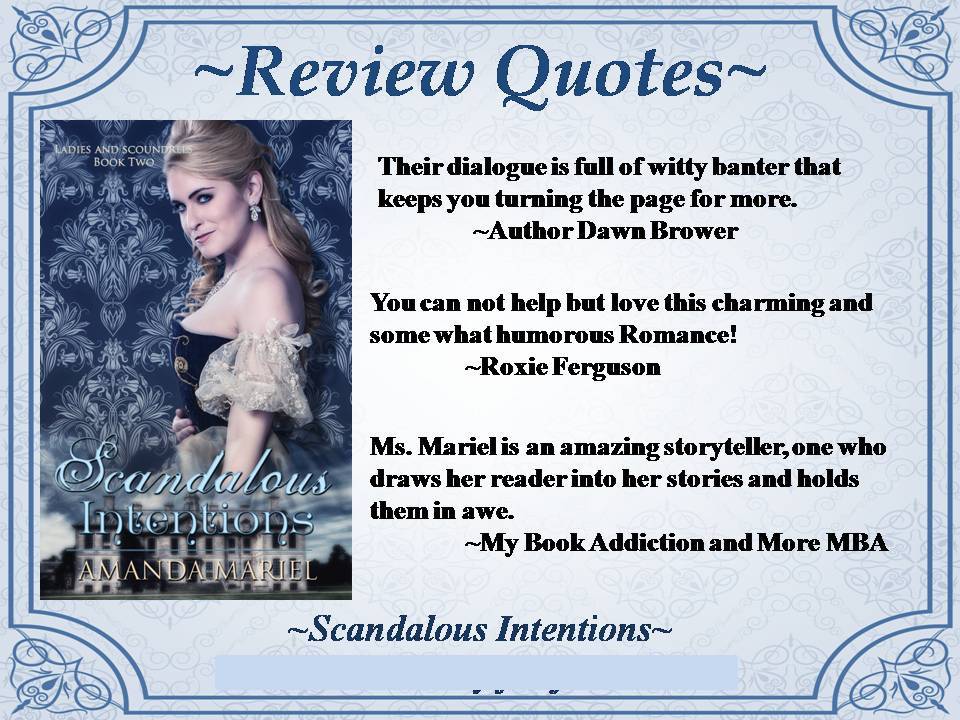
Amanda Mariel’s witty Scandalous Intentions

AM_ScandalousIntentions_Front_600x900Today, I’m pleased to welcome Amanda Mariel to the blog.

On 18 March, Amanda released Scandalous Intentions, the second book in her Ladies and Scoundrels series. Below, I introduce you to the book and its author, and give you an excerpt.

Scandalous Intentions

When faced with losing his inheritance, notorious rake Lord Julian Luvington sets his sights on Lady Sara. She’s as respectable as they come, just what his father ordered. But the lady shall not be easily won.

She’s determined to marry for love or not at all, and she’ll do anything to obtain the freedom granted to men. A blackguard like Lord Luvington could destroy her hard-won reputation, but marriage to him also offers her the opportunities she can’t achieve on her own. What’s a lady to do?

When Lord Luvington refuses to abandon his pursuit, Lady Sara proposes an arrangement. Only the price may be more than either bargained for. Lady Sara could lose more than her social standing and Julian could lose his heart.

SI RQ newExcerpt

Sarah pushed out a sigh as Lord Luvington lead her toward a stone bench nestled among the lush green hedge.

“Shall we sit for a moment? I wish to explain.” He pressed his arm against her hand then loosened it again.

She looked away. “Very well. Though I cannot imagine what you might say to change things.” Sarah hesitated for a moment, reluctant to release her grip on him before she lowered herself onto the bench. The stone’s cool exterior seeped through her skirts, a welcome contrast to the warmth radiating through her. She rested one hand on her lap and waved her fan with the other.

Lord Luvington positioned himself on the bench a smidgen closer than was proper, angling himself so that he faced her. The fresh spring scents of foliage and flowers took on a heady intensity. She stared fixedly at the hedge in front of her. Her face flamed though she could not credit it to the heat of the atmosphere.

She needed to take control of the situation before it swept her away. “Speak your piece and be done with it. I do not wish to linger here over long.” He flashed a toe-curling grin just before she glanced away.

“What I said in the park was the truth. Is the truth. But there is more to it than just my need of a respectable wife.”

“Do tell.” She lowered her fan to her lap, its ribbons trailing in the breeze, and locked her gaze with his.

“I have come to care for you, admire you, even. You’re a fascinating and attractive woman.”

She plucked at her satin skirts as the heat climbed back into her face.

“It is true that I will not inherit the duchy without a proper society wife. It is the very reason I began looking for one. I shall not deny it, but nor is it the reason I continue to pursue you.” He reached up and brushed a curl that had escaped her bonnet away from her cheek.

His fingers left a tingling trail in their wake, and something inside Sarah began to crumble. She glanced down at the path they had just walked.

“I would like the chance to make this right. Allow me to court you, Lady Sarah. Let us discover if there might be something real between us.”

Cause A ScandalthsthsfShe glanced at him, unsure how to respond. Her mind screamed no, but her heart and soul begged for him. She wanted to reach out and run her hand across his strong jaw, feel his lips pressed against hers, discover what it felt like to be in his arms.

“Spend the rest of the party in my company, Lady Sarah. Grant me one afternoon to change your mind.”

A wave of tingles ran down her and congregated in her abdomen at his smile. This was dangerous, and she knew it. And yet…

Buy Links:

Amazon * Amazon.UK * All Romance * Kobo

Meet Amanda Mariel

author poicAmanda Mariel dreams of days gone by when life moved at a slower pace. She enjoys taking pen to paper and exploring historical time periods through her imagination and the written word. Her hobbies include reading, writing, crocheting, traveling, photography, and spending time with her family. Some of Amanda Mariel’s favorite places in the continental U.S. are Harper’s Ferry West Virginia and Sea Brook New Hampshire. She loves the history that surrounds them and visits every chance she gets.

Amanda Mariel lives along the Lake Huron shore line in northern Michigan with her husband and two kids. She holds a Master of Liberal Arts Degree with a concentration in literature and has a long standing love affair with sugary junk food.

Facebook * Blog * Email * Twitter * Amazon Author Page * Goodreads * Street Team * Website:  * Newsletter