An interview with Susana Ellis

P13 copyToday, I’m welcoming another Bluestocking Belle to the blog. Susana Ellis writes sweet regency romances. She says she has always had stories in her head waiting to come out, especially when she learned to read and her imagination began to soar. Voracious reading led to a passion for writing, and her fascination with romance and people of the past landed her firmly in the field of historical romance. Susana lives in Toledo, Ohio in the summer and central Florida in the winter.

Read on to find out about the box set she is launching, with other authors, on 1 April, for a description of her story in that set, and for my interview with Susana. Her contact links are at the bottom of the post.

Beaux, Ballrooms, and Battles

The stories in Beaux, Ballrooms, and Battles are sweet Regency romances with Waterloo themes.

You are all invited to

Amazon buy link

400 x 600About Beaux, Ballrooms, and Battles

Beaux, Ballrooms, and Battles is a celebration of the bicentenary of the showdown between Wellington’s “Infamous Army” and Napoleon’s Grande Armée.

 A collection of nine sweet Regency stories of courage, hope, and the miracle of love surviving in uncertain times, brought to you by nine distinguished historical romance authors.

Jillian Chantal • Téa Cooper • Susana Ellis • Aileen Fish • Victoria Hinshaw • Heather King • Christa Paige • Sophia Strathmore • David Wilkin

 About Lost and Found Lady

 On April 24, 1794, a girl child was born to an unknown Frenchwoman in a convent in Salamanca, Spain. Alas, her mother died in childbirth, and the little girl—Catalina—was given to a childless couple to raise.

Eighteen years later…the Peninsular War between the British and the French wages on, now perilously near Catalina’s home. After an afternoon yearning for adventure in her life, Catalina comes across a wounded British soldier in need of rescue. Voilà! An adventure! The sparks between them ignite, and before he returns to his post, Rupert promises to return for her.

But will he? Catalina’s grandmother warns her that some men make promises easily, but fail to carry them out. Catalina doesn’t believe Rupert is that sort, but what does she know? All she can do is wait…and pray.

But Fate has a few surprises in store for both Catalina and Rupert. When they meet again, it will be in another place where another battle is brewing, and their circumstances have been considerably altered. Will their love stand the test of time? And how will their lives be affected by the outcome of the conflict between the Iron Duke and the Emperor of the French?

An interview with Susana Ellis

When did you begin to write, and why?

Learning to read was like a lightning bolt to my imagination. I read everything I could get my hands on from that day forward. When I was nine I used to write plays for my friends and me to act out at recess. With all that was going on in my head, it seemed natural to write them out, but in those days the chance of becoming a published author seemed remote, so I became a teacher. I’ve only begun writing seriously for publication in the past three years, since leaving teaching.

Why do you write in your chosen genre or genres?

History and the way people lived in the past has always fascinated me. I want to know how they thought, what they did everyday, what they wore/ate/read, where they traveled, who they married and why, and pretty much everything. I’m especially fascinated by the courtship ritual—how they become acquainted and fall in love and marry first before falling into bed. I find it so much more romantic that way.

Do you base any of your characters on real people?

Not usually, although the characters in my story Lost and Found Lady (in the Beaux, Ballrooms, and Battles anthology that releases April 1, 2015), are based loosely on Harry and Juana Smith. Harry was a brigade major in the Peninsular War who met Juana (a descendent of Ponce de León) after the Battle of Badajoz, and married her four days later. Like Harry, my hero is one of Wellington’s Explorer Scouts, and like Juana, my heroine is a Spanish girl. But that’s where the resemblance ends. Rupert and Catalina have their own story to tell.

Who is your favourite character in the book you’re showing us today?

Catalina, because she refuses to accept the bleak life she faces as an illegitimate peasant girl with little hope of a decent marriage. The marriages she observes in her daily life aren’t particularly appealing, and for a while, she envisions finding freedom in a convent.

 What’s your favourite scene and why?

One of my favourites is in the beginning where Catalina mentions to the priest who teaches her that she would like to emulate Sor Juana de la Cruz of 17th century Mexico, who became a nun because she couldn’t otherwise study and write as she wanted. Although 150 years have passed, she reflect sadly that the role of women hasn’t changed all that much. And while many things have changed since 1812, equality has still not been reached, and will not be in my lifetime, I fear.

What was the hardest scene to write and why?

I don’t usually write about battles, but when your hero is in the army at Waterloo, you can’t leave the readers hanging! I agonized over the scene for several days. My mother told me somebody was going to have to die, meaning one of my characters. I told her no happy ending ever had a character die in the end! But they did see the grim side of things, with all the dead and wounded after the battle, and I imagine those images won’t leave their memories any time soon.

What is the most memorable book you’ve read in the last three months, and why has it stayed with you?

I’ve been reading Georgette Heyer’s The Spanish Bride, which is largely an account of the adventures of Brigade-Major Harry Smith and his Spanish bride Juana as they traipse around the Iberian Peninsular with the British army. Believe it or not, I do a lot of my “research” from reading fiction. It’s so helpful to get a glimpse of what it was like to follow an army, which you don’t get from non-fiction sources.

What do you like doing in your spare time?

Reading, cooking, traveling, blogging, and, of course, writing.

What was your favourite book when you were a kid?

I used to read Nancy Drew books voraciously, so much so that I used to get punished for reading “too much.” My mother used to tell me one chapter a day was enough, and I always told her it was impossible to do that because the chapter always ended with a hint that something exciting was going to happen in the next one.

If you could give that kid one piece of advice, what would it be?

The sky is the limit—don’t let yourself be intimidated by the impossible.

Where do you want to be in 10 years’ time?

Alive, in good health, and still writing. If you’re asking about my plans for becoming a best-selling author, well, that would be great and I’ll still aim for that, but I won’t consider my writing career a failure if that doesn’t happen.

Meet Susana

Website • Facebook • Twitter

Susana’s Parlour • Susana’s Morning Room


Why book reviews matter

Book-review-imageWhen I published Candle’s Christmas Chair as a free Novella way back in the middle of December last year, I set myself a stretch target. 10,000 downloads by the beginning of April when Farewell to Kindness was published? Unlikely, I thought, but wouldn’t it be magical?

As readers of this blog know, my expectations have been blown out of the water by the actual figures. I was at 10,000 by halfway through January, and today’s download figures stand at just over 44,000. That’s a lot of books!

Now, Candle is a free book, and it’s impossible to know how many of those copies are languishing in a TBR dungeon on someone’s Kindle or iPad.  But let’s say that a quarter of the people who downloaded the novella have actually read it. Let’s say 13,000, just so my next piece of arithmetic is easy.

So how is it doing in the review stakes? Duplicates make it hard to get an exact figure, but between the various Amazon sites, Goodreads, and other book eretailers, Candle has around 130 to 140 reviews. (Hah! Now you know why I picked 13,000!)  It’s all very rough, of course, but I’m guesstimating that one reader in 100 has written a review.

How reviews help readers

Do you read reviews? Lots of people do. Finding out whether someone else liked or disliked a book (and, more importantly, why) can help you to choose between the huge array of books available. With over a million fiction ebooks on Amazon, some sort of filtering system is essential.

Here’s a comment from a reader I found when researching for this article:

As a reader, I tend to look at the range of ratings for a book, in the first instance. If they are wide-ranging, to me that says, ‘this could be a good book, but just doesn’t float everyone’s boat’. If they are all of a low-rating, then chances are the book might be missable! Difficult however, when there ARE only one or two reviews – it is good to see a number of reviews to get a feel for the book’s reception.  [Cathy Speight commenting on Book reviews: are they important)

How reviews help writers

Reviews offer writers a lot. Reviews (good, bad or indifferent) make a book easier to find by pushing it up through the rankings in google search and on the sites of eretailers. Good reviews encourage writers to keep writing. When someone in a review mentions something that shows they know what I was trying to do, the glow can last for days. For example, I loved the review that mentioned my favourite gift that Candle gave to Min, and said how romantic the reader found it. I thought it was romantic, too! I loved that bit. I’m so glad the reader did.

Bad reviews help writers too. I wrote about this in another blog, but suffice to say I can learn from valid criticisms, and simply accept that tastes differ and not everyone will like what I write. Bad reviews still count for search rankings, and a well written bad review that says why a reader didn’t like a book may even attract a reader who enjoys what the review writer didn’t.

How to write a review

So please, if you’ve read a book (not just mine, any book), write a review. Especially, write a review if you have strong feelings about the review. Here are some tips from Amazon on how:

  • Include the “why”: The best reviews include not only whether you liked or disliked a product, but also why. Feel free to talk about related products and how this item compares to them.
  • Be specific: Your review should focus on specific features of the product and your experience with it. For video reviews, we recommend that you write a brief introduction.
  • Not too short, not too long: The ideal length is 75 to 500 words. Video reviews have a 10-minute limit, but we recommend 2 to 5 minutes to keep your audience engaged.
  • Be sincere: We welcome your honest opinion about the product–positive or negative. We do not remove reviews because they are critical. We believe all helpful information can inform our customers’ buying decisions.

An interview with Sherry Ewing

11086780_10206606130775444_1686985195_oToday, I’m starting something new: interviews with guest authors, starting with my friend and fellow Bluestocking Belle, Sherry Ewing.

Sherry Ewing is a self-published author who writes historical and time travel romances to awaken the soul one heart at a time. Her three books are all currently on bestseller lists on Amazon, and her latest release, Only For You, is currently in the top 20 on a historical romance list.

Sherry, when did you begin to write, and why?

Although I wanted to be an author for as long as I can remember, I didn’t actually start writing until 2008 when a friend of mine asked why I hadn’t written that novel I always wanted to write. Since my children were for the most part grown, I had the time to throw myself into the manuscript. It’s a total train wreck since I’ve learned so much in the past several years on the craft of writing, but I hope to edit it in the next several months with a release in early 2016.

Today, you’re showing us Only For You. (See below for an outline and buy links.) Who is your favourite character in the book?

It’s hard to determine whether my hero or heroine is my favourite characters since I love them both. But if I must choose, then it would be Katherine. She’s a modern day woman thrown back in time who quickly adapts to her new surroundings as she begins her life with her very medieval husband.

What’s your favourite scene and why?

Katherine and Riorden share their dreams so there is one dream scene in particular, when they think that all hope is lost, that is very memorable to me towards the end of Only For You. But I’ll let your readers find it out for themselves since I don’t want to give any spoilers.

Most writers start as avid readers. What was your favourite book when you were a kid?

I’m probably dating myself when I tell you I read The Flame and the Flower by Kathleen E. Woodiwiss as a teenager. It was my first historical romance and I’ve been hooked ever since. She is most likely the reason why I write in this genre today. She was my ideal author and I wanted to write wonderful stories that carried me away to another place in time just as she did.

If you could give that kid one piece of advice, what would it be?

Just because an English teacher tells you that your writing will never amount to anything, don’t let that stop you from going after your dreams of becoming an author. Keep on writing and never give up. It may take years for those dreams to become reality, but in the end it will be worth it!

Only For You – A medieval romance with a hint of time travel, Release date March 17, 2015

One gorgeous cover!

One gorgeous cover!

Katherine de Deveraux has it all, or so she believes, when she begins her life with her husband Riorden. But as she settles into her duties at Warkworth Castle, she finds that an easy life is not only difficult but downright dangerous to her well-being.

Consumed with the haunting memories of his father, Riorden must deal with his sire’s widow who just happens to be his ex-lover. Yet how could he know just how far Marguerite is willing to go in order to have the life she feels they were truly meant to live?

Torn apart by circumstances neither Katherine nor Riorden could ever imagine, Time becomes their true enemy even while Marguerite continues her ploy to keep Riorden at her side. With all hope lost, will Katherine and Riorden find a way to save their marriage and have their happily ever after ending, or will Katherine be whisked back to where Time truly feels she belongs?

Buy Links:

Amazon; Barnes & Noble; iBooks; Kobo; Amazon Australia; Amazon Canada; Amazon UK

Find Sherry on social media:

Website & Blog: http://www.sherryewing.com

Bluestocking Belles: http://bluestockingbelles.com

Facebook: https://www.facebook.com/sherryewingauthor

Pinterest: http://www.pinterest.com/SherryLEwing

Twitter: https://www.twitter.com/sherry_ewing

Tsu: https://www.tsu.co/sherryewing

Newgate prison – a habitation of misery

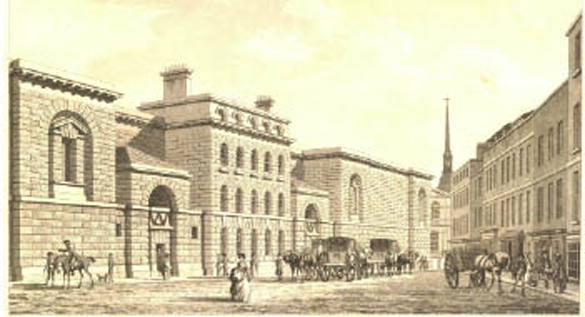
fig.1_maltonnewgate_fmtMy latest story has taken me into Newgate prison, immortalised (if the word is appropriate in the context) in Fielding’s Moll Flanders, and in 1807 still the place described by notorious highwayman   Captain Alexander Smith as a ‘dismal prison… a place of calamity… habitation of misery, a confused chaos… a bottomless pit of violence, a Tower of Babel where all are speakers and none hearers.’

newgate-prison-entry-gateAt the time, it housed around 300 women in a space intended for 50, and they often brought their children with them. Many slept on the floor, without bedding. Looking through the proceedings of the neighbouring court, the Old Bailey, I found many convicted women had two, three, or even four children under 7, and into prison with mother they would go.

Everything was for sale. The keepers weren’t paid, but lived on the bribes of prisoners and their families. So much for a bed, so much for a meal, so much for a pail of water, so much for coals to cook or to keep warm. Those who were wealthy could be housed in comfort, and could have visitors and their own reading matter, clothes, and food.

Those who were poor were thrown to the mercies of the other prisoners, and were likely to have whatever little they still owned taken from them. The prisoners ran their own affairs inside of the walls, with a tough culture of gangs who intimidated those who didn’t fit in. The keepers simply kept the prisoners from leaving.

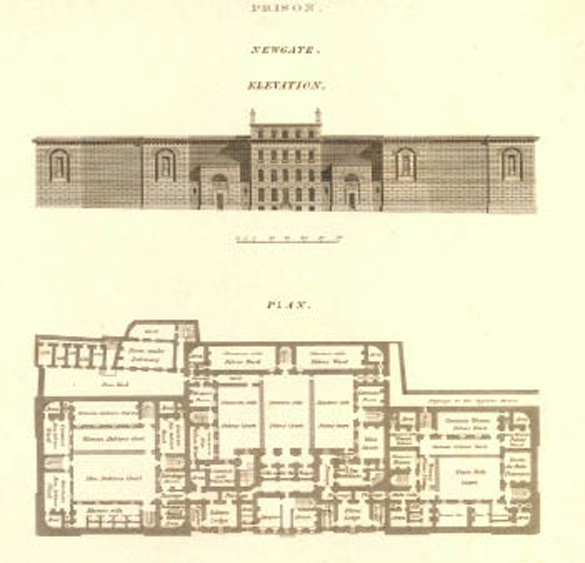
Prisoners weren’t classified beyond the general classification of debtor and felon, and people awaiting trial were imprisoned with those sentenced and awaiting transportation or execution; first time offenders with hardened criminals; the young with the old.

fig.2 newgateplanbm_fmt

Elizabeth Fry, the Quaker reformer, first visited in 1813:

The turnkeys warned them that the women were wild and savage, and they would be in physical danger. However, they went in anyway. On that and two more visits, they brought warm clothing and clean straw for the sick to lie on. Elizabeth also prayed for the prisoners.

Elizabeth said:

‘All I tell thee is a faint picture of the reality; the filth, the closeness of the rooms, the ferocious manners and expressions of the women towards each other, and the abandoned wickedness, which everything bespoke, are quite indescribable’

After several visits, family problems kept her away, but she returned several years later and began a long process of reform. (Note, though, that the painter doesn’t quite believe in the reform. At her feet, the children play with dice. And the women on the far right are passing a bottle.)

Elizabeth Fry


Dangerous Works by Caroline Warfield

Bluestocking BellesI bought Dangerous Works a few days ago so that I would be able to read it before the next in the series was published, and I devoured it in two bites (going and coming on my commuter train). It is one of those books where the writing is so good you don’t notice it. I was immersed in the story, and time flew by. I dragged myself from the world of Andrew and Georgiana with difficulty, and couldn’t wait to plunge back in.

Georgiana is a woman in her mid-30s living alone because the only man she ever wanted (and the only man who ever wanted her) left without explanation years earlier. She lives for her scholarship – translating and giving a voice to the women poets of ancient Greece. When she finds that her suitor – the only person ever to encourage her work – has returned, she seeks his help with her translation.

Andrew joined the army many years earlier because he couldn’t marry Georgiana. Scarred and still suffering from his most recent injury, he is unhappy to find that the old feelings are still there, stronger than ever.

I sympathised with Andrew, I understood Georgiana, and suffered with them both as they faced gossip, scandal, her powerful family and their own misconceptions. Thank you, Caroline, for a thoroughly satisfying read. Now for Dangerous Secrets!

Disclaimer: Caroline and I are both members of the Bluestocking Belles, a group of 8 regency writers. And I’m so glad to be associated with such a good writer!

Release party for Farewell to Kindness

11075296_437105299772375_6593635496114302649_nThe people of Longford on Nidd wish to invite all gentry, the middle sort, yeomen, and working people of all levels of society to a day of fun and frivolity at the Longford Whitsunweek fete.

Rumour has it that the new Earl of Chirbury, the wild trapper earl himself, will be in attendance, along with his handsome cousin, Major Alex Redepenning. Major Redepenning is recovering from wounds at Longford Court, his boyhood home and now the seat of his cousin the Earl.

We thank the ladies of the Women’s Altar Society for their hard work in putting together the fete. There will be something for everyone. In particular, look out for the children’s competitions, organised by lovely widow Anne Forsythe. We understand the Earl has given some rather fine prizes. Do Mrs Forsythe’s current suitors need to be jealous?

And, of course, Mrs Forsythe will be competing in the archery competition, a proud Longford tradition. We expect her to be among the finalists.

Or, if you want it in 21st Century terms, please join me on Facebook for the launch of Farewell to Kindness.

Dangerous Weakness meets Encouraging Prudence, second encounter Part 1 of 2

Last week Caroline Warfield and I posted a two-part story in which characters from their different books met in the virtual world. Today, exclusively in cyberspace, we tell the story of their second encounter in 1818. The first half is below, and the second half on Caroline’s blog.

Today’s story involves David Wakefield and The Marquess of Glenaire.

David Wakefield is the baseborn son of the Duke of Haverford. He earns his living as an enquiry agent and has acquired twenty years experience by the second encounter. (Encouraging Prudence, work in progress to be published in September 2015)

Richard Hayden, The Marquis of Glenaire, is heir to the Duke of Sudbury. He is also Castlereagh’s protégé, spymaster, diplomat, and fixer (He appears in Dangerous Secrets and will have his own story told in Dangerous Weakness, to be published next winter) He believes he can fix anything, given enough information, but is currently stumped.

Part 1

Chelsea 1818

west-view-of-chelsea-bridge 1790brit museumThe Marquess of Glenaire rarely came to Chelsea.  Duties occasionally brought him to look after the pensioners, the veterans in the Royal Hospital. The area itself, still semi-rural, held little interest.  As his carriage sped down the Brampton Road, however, signs of new development drew his eyes.  He thought the neighborhood, up and coming with the rising middle class, fit the man he sought, David Wakefield.

Fussier members of the haut ton looked down their overbred noses at David’s origins and profession. They called him a thief taker and said it as if the very word smelled of stable muck.  Glenaire knew him for an enquiry agent and a damned good one.

Kate_Greenaway_-_May_dayWhen his carriage came down a stretch of empty road, a rag tag group of children marched past laughing and singing accompanied by two women, nursery maids no doubt. He frowned with distaste. Glenaire preferred children to be few in number, quiet, and in the nursery.

Townhouses had sprung up at the end of the road, one of them the place he sought. He hadn’t waited for an answer to his message requesting an interview. He hoped he would catch the man home.

The door swung open and David himself greeted him.

“Glenaire! I just sat to pen a response to your message.  You didn’t need to come to the wilds of Chelsea; I would have attended you at the Foreign Office.”  He stepped back to welcome Glenaire to the home that also served as his office, taking his hat and gloves and placing them on a table in the foyer.

“The business is personal, Wakefield. I thought it best if I came to you.  I hope the timing isn’t inconvenient.

“Not at all. I’m flattered, Glenaire. As heir to one of the most powerful dukes in the country, you could employ any number of agents.” Wakefield’s face gave away nothing of the curiosity he must be feeling.

“You know there’s a limit to what I can ask the government to do,” Glenaire said. “I have to have someone I trust, not one of His Grace’s minions, do this job.”

“I will help if I can,” Wakefield said. He opened a door, and led the way into what was clearly his office.

Glenaire started to follow, but a slamming door and raucous laughter interrupted him.  The ragtag parade he saw earlier marched through the house and up the stairs. Several of the children stared openly (and in Glenaire’s opinion rudely) at the marquess. Two women brought up the rear.  One was clearly a nursemaid. The other—

712px-English_Townhouse_(3610701791)“Glenaire, you may remember my wife, Prudence Wakefield. Prue, this is—”

“The Marquess of Glenaire,” she finished with laughing eyes. “All of London knows of the marquess.” She didn’t call him “the marble marquess,” but Glenaire thought he could see it in her eyes.  “Let me get the children settled on their lessons and I’ll join you,” she went on.  She gave Glenaire a proper curtsey and climbed the stairs.

Glenaire sat across from Wakefield moments later and sipped a remarkably fine whiskey.  He needed the fortification.   All this exuberant family life unnerved him.  He planned to marry soon, but when he did, his wife would be a proper lady from one of the best families; one who wouldn’t disrupt his orderly life.

Wakefield eyed him with open amusement.  “I’m not sure what I can do for you, Glenaire, beyond what I’ve already reported.   Your friend Baron Ross sold his horse and a fine silver watch in Falmouth. He took ship to Naples, as I told you when we met at the Crock and Bull Inn.”

“That intelligence gave me an excuse to use government agents in Naples. We like to keep an eye on that part of the world. If I can track down a friend at the same time, it is so much the better. I’m grateful.”

Wakefield nodded, sure there was more.

“Jamie’s not the sort to shy about asking friends for help. If he’s in trouble he need only apply to me or to the Earl of Chadbourn or to my sister and her husband. He didn’t. He ran like a scared rabbit.”

“And?

“Something here in England drove him. We know the direction he took; we don’t know why. I need you to find out.”

To find out what happens next, see PART 2

Dangerous Secrets

Rome, 1820

Jamie Heyworth fled to Rome.  He can’t let Nora Haley know the secrets he has hidden from everyone, even his closest friends. Nora fears deception will destroy everything she desires and she certainly can’t trust any man who drinks. A widow, she had enough of both in her marriage. Both Jamie and Nora, however, will dare anything for the black haired, blue eyed little imp that keeps them together, even enter a sham marriage to protect her. Will love—and the truth—bind them both together?

Buy a copy:

Dangerous Secrets and Only for You

Two new releases for you to consider this week, both from fellow Bluestocking Belles.

Caroline Warfield releases Dangerous Secrets today. I’ve just finished Dangerous Works, and will review it as soon as I get a minute, but I can tell you that it was beautifully written, hard to put down, and deeply satisfying. I’m dying to know what happens to the impish Jamie, and will be buying Dangerous Secrets tonight so I can find out.

And Sherry Ewing releases Only for You, a sequel to her time travel novel For All of Ever. I haven’t managed to read For All of Ever yet, but I’m looking forward to it.


My plan for world domination

booksIn the past few weeks, I’ve neglected the blog as I worked 15 hour days to keep up with a busy time in the day job, plus publishing work for Farewell to Kindness, plus the launch of Bluestocking Belles (which included writing screeds of dialogue in what may be the world’s first Facebook event-based collaborative novel).

Normal business is about to resume. I have a post planned on working women in the 19th century, and another on coroners’ juries. And Penetrating Analysis has written several articles I’d like to link to and comment on.

First, though, a comment about where I’m going from here.

It has been six months since my first post on this blog. If you’ve been reading along with me, you know that I have since finished, and am about to publish, the book I was halfway through then. I’ve also published a free novella, and at some point today I expect downloads for that to pass the 43,000 mark. (I know! I can’t believe it either!)

I’m partway through writing the second novel, have begun the third, and have written odd scenes out of some of the ones to follow.

See, here’s the thing.

I want to write fiction full time. I have so many ideas- so many half-outlined drafts and characters in search of their happy ever after. But I need to pay the bills. I’m lucky enough to have a day job I love, so I’m not complaining. But my income from fiction so far has been under $2 (for print copies of Candle’s Christmas Chair), and the 57 pre-orders on Farewell to Kindness will net me around $10.

(I’m so excited to have preorders at all! Thank you, everyone who has put one in.)

I have a plan. According to my research, around 95% of published books sell under 50 copies a year, and under 100 copies in total. But the more books a person writes, the more likely they are to be noticed and to be read.

By the end of this year, I’ll have published two novellas (one in a boxed set with the Bluestocking Belles) and three novels, and (if we can work out the logistics) will be named as a co-author in the published version of our mystical magical inn party conversations.

By the end of next year, I’ll have doubled that output. So I’ll have nine or 10 published works out there. Six (the novels) will be earning me income, the collaborative projects will be making a contribution to the Malala Fund, and Candle’s Christmas Chair will continue to be free.

Will that be enough? I don’t know.I hope so. I have some great stories just bursting to get out of my head and on to paper.

Thank you to all the people who have downloaded Candle’s Christmas Chair. A special thank you to those who have written reviews or ratings. Thank you to those who have emailed me, direct messaged me, or commented on FaceBook. All of these things give me confidence to continue.

Whatever happens, I’m going to keep on writing. I love what I’m doing. But a writer without a reader is a sad creature indeed. Please know that you are hugely appreciated.

(Incidentally, for those who have fallen a little in love with the Marquess of Aldridge over the past few weeks at the inn, his cameo appearances start in Encouraging Prudence and will continue from time to time in future books. But his actual story is the third book in the planned series “In the Halls of the Mountain King” coded I and coloured light blue in the chart of story ideas. So it may be a while.

I’ve written the first 600 words though, and might be tempted to publish that here in due course.)