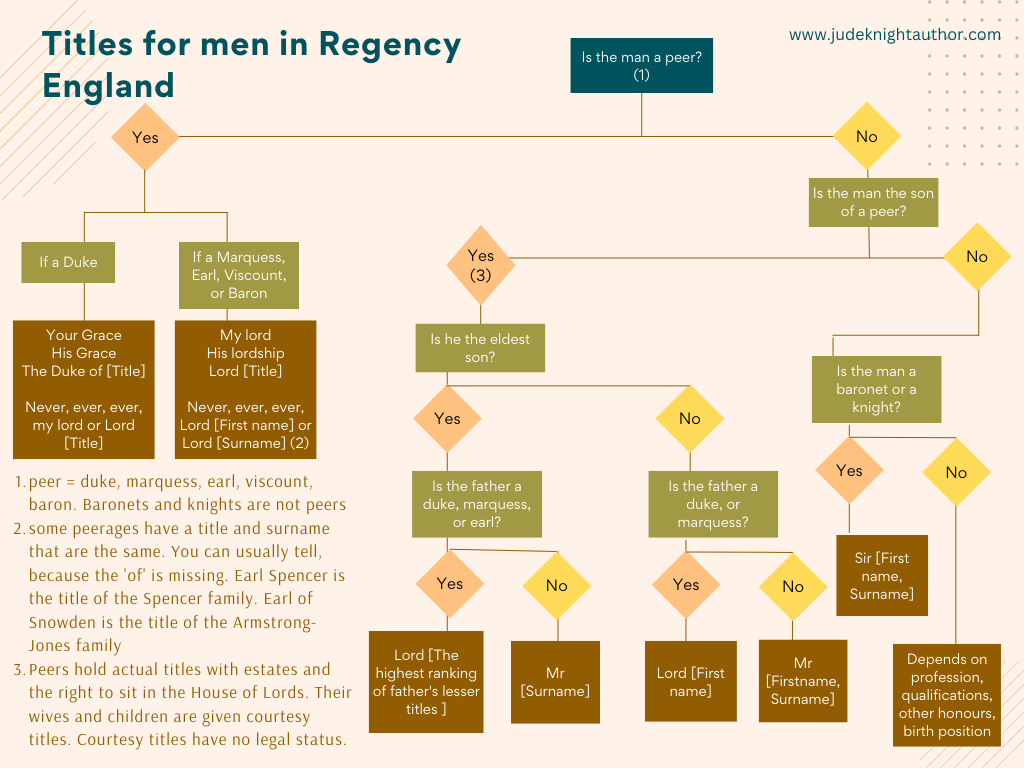
Those pesky titles!

I made a thing, for those of you who wonder about titles. Those of you who already know, tell me if you see any errors!


Except for those few rare women who inherited a title in their own right, or those with a courtesy title who married “down”, women took their husband’s title as well as his name.

Please feel free to download and share the images:

Titles for men: https://judeknightauthor.com/wp-content/uploads/2022/11/1-1.png

Titles for women: https://judeknightauthor.com/wp-content/uploads/2022/11/2-1.png


Acts of Daring on WIP Wednesday

In my current work-in-progress, my heroine is fighting a court battle to get back custody of her children from the brother of her late husband. Discovering that the brother’s wife intends to hide them away in the country, my hero hatches a plan.

Thank goodness they were in time. The drivers were not yet in their seats. Men in Frogmore livery lounged against a nearby wall. Lance had been afraid that the detour to his bank might delay them too long, but money was essential to the plan.

“Take the rig a few doors down,” Lance told the groom as he dismounted. “We don’t want Mrs Frogmore coming out and seeing it.”

“You won’t leave me out, though, my lord?” the groom asked, and drove along with Lance’s reassurance.

The other three men approached the loungers. “How would some of you like the rest of the day off and all of you like a month’s pay for keeping your mouth shut?” Lance asked.

It took a bit of negotiation, and more money than he had initially offered, but in the end Lance and his men were dressed in Frogmore livery and one of the grooms relieved of duty for the day was on his way to Lance’s stable with Lance’s cattle and phaeton.

They were just in time. The word came from the house that they were to drive to the front steps to pick up their passengers.

Lance’s groom, with Lance alongside, drove the second carriage after the first. Hal and the valet took the footmen’s seat at the rear. As his informants had predicted, Mrs Frogmore and her dresser climbed aboard the first carriage, and it trundled away.

The nursery party waited for the second. They pulled up the steps. Hal and the valet leapt down to assist the passengers to board: first the nursemaid with the baby, then the sour governess, and then the two little girls.

They took off after the first carriage, their driver using every opportunity to let the other carriage get ahead—stopping to give way to people, other vehicles, and horses, and keeping their team into a slow walk.

Thankfully, the first carriage took the Windsor Road. It was the logical direction, given that young Baron Frogmore owned a secondary estate just out of Swindon. Lance had hoped Mrs Frogmore wouldn’t risk taking the children north to the principal Frogmore estate, not just because it was obvious, but because a journey of several days would give pursuers time to catch up.

This road would suit Lance’s plans very well. He had been thinking about where to hide the children until after the custody hearing made it safe to put them in their mother’s hands. Not with any of the Verseys or their closest friends. Percy certainly had the power to refuse to release them, but Lance didn’t know how his theft of the children would influence the custody hearing.

It was best if Percy, Lady Frogmore, and Mr Forsythe knew nothing about it. Then they could swear on oath that they had not been involved. It was possible that Mrs Frogmore would not know they were missing until she arrived at her destination this evening. That would be even better, for it would take at least ten hours to get the message back to London. The custody case could be over before anyone heard that the coach with the children had been hijacked.

However, just in case, Lance planned to take them to someone whose independence would not be questioned.

Tea with Jude

Her Grace the Duchess of Haverford appears in my dream. Or do I appear in hers? Do fictional characters dream? However it is, I am on the terrace on the sheltered side of Haverford Castle, and Eleanor is pouring me a cup of tea.

Calling my duchess by her first name is a privilege afforded to me, commoner though I am, because I am her author.

“I know how you love Marcel’s cakes,” she tells me, putting two of them on a plate. “I had a box of them delivered to help us celebrate your latest book. Short stories, is it not?”

“Yes,” I agree. I take a sip of my tea, which is just the way I like it. “Chasing the Tale: Volume II. Ten short stories and novelettes, just long enough to enjoy before bed or with a cup of coffee or tea at any time of the day. I brought you a copy.” It appears in my hand as I speak, which is confirmation that I am dreaming, for it is a print copy, and print copies only came available to order, when the book went live, which should have happened a few minutes ago.

“Next month,” I say, “I have a story in Belles & Beaux, a Bluestocking Belles collection. Your husband appears in it.”

Her eyebrows go up. “Haverford?”

Oh. So this is prior to 1815, which is when Haverford died. “Your next husband, I tell her.” It’s a bit of a spoiler alert, but I won’t tell her anything more.

“You are not planning to inflict another husband on me, I hope,” she scolded. “Was the first one not enough?”

Perhaps a little bit more. “The second one is more in the way of a reward,” I assure her. To prevent her from asking any more, I take a bite from one of Marcel Fournier’s lovely little cakes. One of the benefits of meeting my characters inside my fictional world is that I’m not allergic to anything. It is delicious.

Spotlight on Chasing the Tale: Volume II

Monday sees the publication of my second volume of newsletter subscriber and made-to-order stories, Chasing the Tale: Volume II

Read more about it and order at the link! Early reviews are up on Bookbub and Goodreads, mostly 5 star with a smattering of 4. Here’s what one of those reviewers had to say:

Ten entertaining bite-sized tales

Ten wonderful short stories! Some even include characters previously introduced in other books. Some are just entertaining little ditties; but each story contains a snippet of a pivotal event in the main character’s life. These are diverse, clever, and well written bite-sized tales designed to bring you respite and enjoyment!

Christmas at Hollystone Hall A reconcilliation between an interfering mother and her Duke of a son. This story gathers the gang together, reminding of of pairings and offspring.

Lady Cicely’s Forfeit Cicely and Mr. Carelton An unconventional lady; a holiday house party; an ice skating challenge and a man determined to win.

Lord Dependable to the Rescue Millicent and George A Lord in debt; a broken engagement; imprisonment; flood waters rising; a daring rescue and a charming reward.

Miss Winston’s Honor Lily and Ralph A lecherous lord’s illegitimate child; an ex-governess on the run; a secretary enroute to his new position and a Marquis with a bad reputation and a kind heart, all come together to create an unexpected family.

Only a Kiss Cecily and Andrew Five young ladies, nicknamed the alphabet girls, made a game out of kissing selected men. Each girl would kiss him and then rate those kisses. However, when Cecily kissed Andrew, it was a revelation….and things changed.

The Abduction of Miss Amaryllis Fernhill Laudanum used to compromise her, and an Elf King used to free her. Rilla was saved from being forced by her uncle to marry his horrible friend…. and it was performed in such a way that it became a village legend.

The Easter Bonnet Lady Paula wanted a special Easter bonnet made, hoping it would help her catch the eye of Lord Raines. …. and thanks to a kitten and puppy, it did.

The Major’s Homecoming Magda and Luke An earl; his brother returning from war; a witch’s by-blow; two childhood friends and a physician’s daughter work together to thwart two conniving cousins intent upon taking the earldom.

The Kindest Gentleman Audrey and Tristam Tristam acted as the vet for the people in his community. Audrey was the neice-by-marriage companion (slave) to one of his neighbors. They both secretly admired each other, but he took no action until one night when she came to him with a kitten needing tending.

The Truant Lord Clairmont Serafina (Seffie) and Clairmont Because her father was expected to die, Serafina was married, at the age of twelve, to the son of her father’s best friend. Three years later, when her father actually did die, she went to live with her father-in-law, but her husband was out of the country on business. Now, six years after the death of his father, her husband has been spotted in England and she intends to bring him up to snuff. So much anger and heartache could have been avoided, but circumstances and secrets interfered. Their reunion is unconventional and exciting, and the healing begins.

And if you don’t normally read short stories, how about this review?

I usually don’t read short stories because I enjoy getting involved in a plot and reading its developments. But since I enjoy this author’s works, I decided to give it a trial. I wasn’t disappointed. Some stories are more entertaining and I especially liked Lady Cicely’s Forfeit and The Abduction of Miss Amaryllis Fernhill but all of them were exciting and endearingly romantic. I highly recommend this book!

Travel times


Once upon a time, in the UK and Europe, villages used to be about three or four miles apart. That meant a villager could walk to the next village in about an hour, see to business or a friendly visit, and walk home again, all in half a day. Market towns tended to be about nine to twelve miles apart. Someone on foot could reach the nearest market town from their village in about an hour and a half, making it possible to set out before dawn to sell produce, and still get home before dark. Or, if shopping was the goal, the round trip could still be done in three hours.

A person with a horse and cart wouldn’t get there any faster, but would take a bit longer.

For the rich, carriages and riding horseback or in horselitters might shorten travel times, but the state of the roads meant that thirty miles a day was an excellent speed, and only possible in flat country. Goods and people were commonly transported by river or sea if they had to go any further than a few miles, but most people didn’t travel more than ten miles from their home in their lifetimes.

The stage coach was introduced to Britain in the 17th Century. Over time, better road technology, a larger road network and better carriages brought about a huge reduction in travel times. By 1750, it was possible to travel from London to York in three to four days. By the 1820s, the same trip would take a little over a day. Ordinary people still didn’t travel all that much, unless they were wealthy or it was part of their job, or they were seeking work. It was expensive, uncomfortable, and time consuming. Until the next technological development.

Then came the railways

The growth of the railway network, after the first successful passenger line in 1826, was remarkable. And all of a sudden, third class rail carriage put a once-in-a-lifetime trip at the seaside into the reach of even working-class people, while those with slightly more means might even take an annual holiday. Take a look at the growth of the network in just twelve years, between 1840 and 1852.

And here’s what it did to travel times, even with slow mid-19th century steam trains.

Cars and planes

With the coming of the automobile, the focus turned back to roads, with travel times shrinking again, and still more with airplanes. Here in the 21st century, it’s hard to put ourselves into the footsteps of our ancestors, for whom a trip to the shops meant a three hour walk.


Weddings on WIP Wednesday

I’ve somehow managed to find myself writing three weddings in three different works-in-progress all in the same month. Here’s the first one.

Pauline had never believed this day would come. The morning had passed in a flurry of excitement, with Tante Marie, the modiste, and two of the maids fussing over her, and Jane and Mrs Thorne providing a running commentary.

Pauline kept expecting someone to stop her, and tell her it was all a mistake. But here she was, walking towards John and the altar on Noncle Pierre’s arm, in a gown of the softest silk in a warm buttery cream, carrying a huge golden yellow bunch of Noncle Pierre’s prize roses, and wearing John’s gifts around her neck, in her ears, and on her wrist.

It was real. There he was, smiling at her, his eyes warm and welcoming. She fought against submitting to the fantasy. This was not a love match. He had been very clear. He liked her. He desired her. He wanted her as a mother for Jane. She should not expect anything more.

As she moved towards him down the aisle, she balled up those sensible thoughts and locked them away in the deepest recesses of her brain. Today was a dream. She was wedding the man she loved, and she was going to enjoy every moment. When she reached his side and Noncle Pierre released her into his hands she gave herself over to the fantasy.

She was determined to memorise every moment, but afterwards, she mostly remembered John’s voice, strong and confident, vowing to love her above all others, placing a ring on her finger and then not releasing her hand, John sneaking glances at her throughout the ceremony, glances that hinted at his own wonder and delight as they bound themselves to one another for life.

Tea with a knight on a quest

Lord Lancelot Versey was one of the Duchess of Winshire’s godchildren. That didn’t make him special. While the rumour she was godmother to half the ton was probably an exaggeration, she certainly had a vast army of godsons and goddaughters, each of whom she favoured with a personal note and a small gift on the anniversary of their christening.

Still, the relationship was close enough that Lance felt comfortable asking her for a favour. He would have approached her anyway, he hoped. He was on a quest to reestablish the reputation of a fair lady–not a damsel in distress, exactly, but a widow, and certainly in distress. Lance wanted the duchess’s help for his lady, and also an introduction to David Wakefield, the enquiry agent who was the duchess’s protege, and also the base-born son of her first husband, the Duke of Haverford.

He would, he decided, as he bowed over the duchess’s hand, took the seat she waved him to, and answered his comments about the weather, have to introduce the subject carefully. After all, the brother-in-law of his lady fair had spread dreadful rumours about her. If the duchess had heard them, she might dismiss him out of hand.

He would describe her situation without naming her. “Your Grace, I wondered if I might bring a lady I know to meet you. She has been woefully mistreated, and she needs your help.” That was a good start. Her Grace was known to be sympathetic to women in dreadful circumstances.

The duchess smiled and nodded. “Yes, Lancelot. You may certainly bring Lady Frogmore to me, and I will help however I can. I am very distressed that I did not seek her out when that dreadful man first started spreading his lies.”

Lance’s jaw dropped. There was only one explanation. Percy, his brother the Duke of Dellborough, had always claimed that the duchess was a witch, and he must be right. How else could she know exactly what he wanted?

Spotlight on Wounded Hearts

WOUNDED HEARTS

By Caroline Warfield

Wounded bodies mend; wounded hearts take longer.Three warriors return from the Napoleonic wars with damaged bodies, ugly memories, and regrets to futures they are ill prepared to face. But love can heal the most damaged heart bringing with it hope for better days. Three ladies with strength and courage of their own are just what they need.

PREORDER for 99 cents. It reverts to retail after launch on November 8. https://www.amazon.com/gp/product/B0BBSGBL4R/

Candles in the Dark—Douglas Marsh came home to an unexpected inheritance, a factory he has no idea how to run. With many dependent on him, he does his best in spite of pain from his battered legs. He has no time for self-pity especially after he meets a woman on the streets with far bigger problems.

Lord Ethan’s Courage—Lord Ethan Alcott left his right hand and his soul in Spain. He lives on the streets during the worst winter in decades, wishing for death, ashamed to go home. But a stubborn lady and her equally determined brother won’t give up on him.

The Tender Flood—Zach Newell manages well enough with a prosthetic leg. He even drives a carriage for his uncle, but he’s desperately lonely, missing the comradery of the army. In the midst of the storm of the century he meets the woman who makes his heart sing, one too far above his touch. If he won’t approach, she will have to.

Not just Bow Street — the other police offices

There’s a bit of a fashion for Bow Street runners in Regency romance. I thought I’d have one myself, come to arrest my hero on a false charge of murder. Except when I looked into it, I found out they weren’t necessarily from Bow Street, and they weren’t called runners.

Bow Street Magistrate’s Court was the prototype, of course. Henry Fielding and his brother established the Runners. (They preferred to be called Principal Officers, since they thought ‘runners’ made them sound like servants.)

The model was successful, and in 1792, more than forty years after Fielding started his experiment, the government passed the Middlesex Justices Act. This established seven more police offices. Each had three paid magistrates and up to six paid officers or constables.

So in Westminster, there were Bow Street, Great Marlborough Street, and Queen’s Square. I picked Great Marlborough Street, which was closest to the townhouse where my hero was staying. Police offices in the rest of London were Worship Street in Shorditch, Lambeth Street in Whitchapel, Union Hall in Southwark, and also Shadwell and Hatton Garden. In 1798, the Thames Police Office (the river police) was opened in Wapping. There had been a couple of changes by the time of my story, in 1813, but good to know!

My hero’s powerful friends payed for him to have a private room instead of being in the police cells, where he countered two attempts to murder him. Corruption was a significant issue with some police offices, so a bribe to look the other way was not unlikely. He appeared before the three magistrates in a preliminary hearing a few days after he was arrested, and the case was dismissed when the person he was meant to have murdered stood up in court, alive and well. Other cases heard that day might have received an immediate judgement and penalty for a minor crime, or been bound over to appear at a full court hearing before a judge and possibly a jury.

They were different times, but already shifting in a direction that is more familiar to us today.

Note: when the Great Marlborough police office closed in 1839, as the Metropolitan Police took over all policing duties, the building continued in service as a Magistrate’s Court. A case against John Lennon for exhibiting sexually explicit material was heard in this court in the 1970s. It is now a boutique hotel, and the courtroom itself is an Asian Fusion restaurant.

The virgin hero on WIP Wednesday

This is an excerpt from The Flavour of Our Deeds (Book 5 in The Golden Redepennings). My hero has been resisting the heroine for six years. She is a lady born, daughter and sister of an earl, wealthy and beautiful, with the world at her feet. He is base born, a commoner, a working man, too old for her, and in danger. She has finally got him to concede that he loves her, and wants to marry her. Some time. When the danger is over. In this scene, she demands that he thinks again.

In the next moment she was in his arms, and he was kissing her. “You will be the death of me, stubborn female,” he muttered against her lips, before covering her mouth again, one hand on her lower back pressing her against him, the other gently cradling the back of her head as he ravaged her with his lips and his tongue. This time, he was the one to draw back. “We have to stop.” His body belied his words. He was flushed and trembling, and the thin layers of their robes had not in the least disguised his arousal.

“Must we?” Kitty wondered, “If we are to marry within the week?” She had a theoretical knowledge of what came next. His kisses left her eager to put theory into practice.

She thought he would deny them both because she was young and innocent, and he would be taking advantage of her. What he said instead was unexpected.

“I am a bastard, Kitty. Got by my father on the pretty daughter of his gamekeeper. My only memory of my mother—or memories, because I think it happened many times—is of her crying after one of his visits.”

Kitty didn’t see the relevance. “You are not your father, Luke. And I am not your mother.”

He shook his head. “That’s not what I meant. I made a promise to my grandfather, Kitty. When he lay dying, he begged me not to be like my father—careless with women and ruled by my pri— my lust.”

Still not relevant, Kitty thought, but Luke hadn’t finished.

“I promised that I would wait until marriage to experience physical intimacy with a woman, and would be faithful to my wedding vows once I’d made them. I swore it on the family bible.”

She couldn’t argue with that. Wait. Did that mean he had never...?

Luke was looking into some mental landscape—the past perhaps? “I’ve never found it hard to keep that promise, because I have seen so much misery arising from the behaviour my grandfather decried. My mother, and so many other woman. Even the ones who were eager risked being left broken hearted. Or they gave themselves to a man who died before he could put a ring on their finger, and his good intentions didn’t protect them or their baby from the consequences.”

He was right, of course. Kitty had seen it herself. Indeed, if not for Anne’s masquerade as a widow, she would have lived it, at least by association.

“Then along came you, Kitty. I have always struggled to resist you, and with each kiss it becomes harder and harder.” He chuckled suddenly, and his voice dropped to a low growl that vibrated in the places that ached for him most. “In more ways than one.” She caught the salacious reference, and her face heated. She licked her lips, which had gone suddenly dry.

Luke gulped and looked away. “Help me keep my promise, Kitty,” he begged.

Botheration. An appeal to her honour. “Yes, of course.” She turned her back on him to straighten the robe he had brushed aside during their kiss, drawing it closed high up her chest and belting it firmly. “Thank you for explaining.”

Luke had tidied himself while she was rearranging her robe. He offered her another brandy, but she refused. “If I must be good, another would be a bad idea,” she said. She returned to her chair, more determined than ever. “Luke, will you marry me and take me to Cumberland with you?” A special license was sounding more and more appealing.

Luke sat, too, smiling at her. “Are you going to argue with me for the rest of our lives together, heart of my heart?” His tone was one of enquiry rather than criticism.

“Only when you are wrong,” she retorted, then amended the statement. “No, for sometimes I might be wrong, but believe myself to be right, as when I saw no reason why you should not bed me, tonight. When you explained, I changed my mind. I would hope, Luke, that we can disagree in a civilized manner, discuss things, and reach agreement.”

“I beg you not to speak of bedding, my love,” he groaned.

“A special license?” she suggested, hopefully.

“A common license. In the morning, I shall speak with Rede, and with Uncle Baldwin about waiting a few days longer. Now go to bed, Kitty. You have won.”

Kitty widened her eyes. “I have won? That is not reaching agreement, Luke.”

“I misspoke. We have both won. You are correct that it is not my right to decide to keep you from my life in order to protect you from a threat that might not even exist. But Kitty, if you are in immediate peril and we do not have time for a discussion, I want your promise that you will obey me in that moment. We can talk it over when we are safe.”

That was fair, and quite a large concession. “I promise, Luke, unless you are the one in danger and I can do something to save you.”

Luke heaved a sigh. “I imagine that we will have many more vigorous discussions in our future, my love.”

Kitty blew him a kiss as she made her way to the door. “But imagine the fun we will have making up!” she told him, then slipped out the door, closing it behind her, delighted with her exit line.