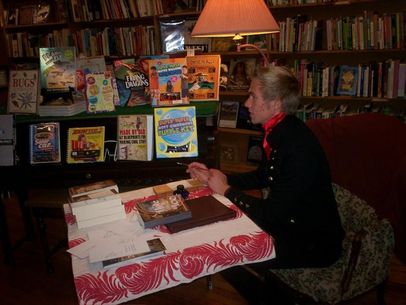
Tea with Jude, one day late

I was not surprised to see her. She was sitting on the chair at the end of my bed, her favourite tea set on the butler’s tray my son-in-law made for my birthday years back. Her Grace is, of course, far too well bred to allow her irritation to show, apart from a slight flare to the aristocratic nostrils. Her every movement as she prepared a cup of tea, just the way I like it, was completely controlled, with a trained elegance that she had learned from the cradle.

I’d thought about her often during the day, wondering what her reaction would be to missing one of her Monday’s for Tea. And now I knew. She was here for an explanation.

She looked up from her task and met my eyes. “Tea, Jude?” A glance around the room, more habit than expectation. No, Eleanor, the Knight household does not run to servants, except the mechanical and electronic kind, two centuries away from your experience.

Beside me, my personal romantic hero slumbered on, as Eleanor, the Duchess of Haverford carried the tea to my beside table with her own aristocratic hands before resuming her seat and pouring a cup for herself.

”I trust your indisposition is minor,” she hinted, sweetly. I suppressed a smile at her assumption that only an illness or injury could have prevented me from making a priority of writing her regular weekly engagement with the denizens of the fictionsphere. It was not untrue, but I was pleased to reassure her.

”Indeed. I am almost fully recovered. The usual problem complicated by a fall and the demands of a busy season. I lost Sunday to bed rest, and have been trying to catch up without overdoing things.”

She nodded, once, and the slight stiffness eased. “I am relieved you were not badly hurt, and are feeling better. Of course, you have other matters that need your attention.”

”A major project at the day job, Christmas crafts with my grandchildren (that was Saturday gone), a new book with a deadline for final loading of tomorrow and last minute changes to the cover and the interior. Yes, you could say that.” I offered a palm branch. “You will be pleased with the book, I think, Eleanor.  It is about a granddaughter of yours and her suitor.”

”Truly? The name on the invitation for yesterday was Sarah Grenford. One of my descendants, I thought, perhaps.”

”Next week, Eleanor, I promise. God Help Ye, Merry Gentleman will be published over the weekend, and Sally and David will visit you on Christmas Day.”

“That will be very pleasant,” her Grace agreed.

”I am on holiday from Friday, and during my three weeks off I plan to set up the schedule for next year and send out invitations for other authors to send their characters to visit you.” I sipped my tea, appreciating the fine bouquet, though I usually drink decaffeinated in the night. Not something I could expect Eleanor to know about.

She favoured me with her warm smile. ”Thank you, dear. I know my social calendar is only one of your jobs, but I do so enjoy my Monday afternoons.”

“I do, too, Eleanor,” I assured her.

Sunday Spotlight on box sets

Lots of quality reading at a bargain price

Do you like box sets? I do. They’re usually a great value way to acquire a lot of reading. Tell me what you like about them, and what you don’t. I’m planning to be in at least five, and possibly seven, in 2018, so it would be a great help to know what to avoid.

Box sets of the first few books in a series are wonderful. I’ve bought them both to go back to earlier books I’ve missed when I come across a new-to-me author in book 4 or 5 of a series, and also when I’ve followed the series from the beginning through my library, and yearn to own it. The Mary Jo Putney Lost Lords set was one such book. I also have the Lucinda Brant Alec Halsey Mysteries, books 1 to 3. Among others.

I’m less inclined to purchase multi-author box sets of novels, unless the authors are mostly writing heroines of mine. It’s the librarian training I had as an adolescent. I want to shelve all the books by a particular author together.  (And yes, I can do that with electronic books; shelve them in several places all at the same time. But what can I say? I have my obsessive moments.) Still, I have a few, because what can you do but grab a bargain when you see one?

On the other hand, multi-author box sets of novellas are catnip to me. I’ve discovered many new favourite authors that way. Particularly at this time of year, when holiday box sets abound. I love seeing how authors combine the magic of Christmas and the magic of romance.

I have just read Christmas in Duke Street, every story of which is a gem. Waiting in my TBR unread books collection on Kindle, I have 7 Rogues for Christmas, The Dukes of Vauxhall, How to Find a Duke in Ten Days, Romance on the High Seas, Lords of Love, A Regency Collection, An Encounter at Hyde Park, Historical Hellions and more. Joy!

I have, as you know, published my own Christmas box set this year: all my holiday romances between one set of covers. If Mistletoe Could Tell Tales is available now, so if you don’t have my four holiday novellas, grab it and the two bonus novelettes.

I’ve also co-written a holiday story in the world of Sally and Toad, from Never Kiss a Toad. God Help Ye, Merry Gentleman is a prequel short story to Never Kiss a Toad, and also has a number of other shorts and excerpts from the world of Sally, Toad, their families, and their friends. It it is up for presale on Amazon, and will be published on 23rd December. (At the moment, it is free to my Wattpad and newsletter subscribers, who have a link to the unproofed version on a password protected page on my website, but I plan to take that down later this week. And put up a page for the presale links on my book tab.)

And, of course, I have novellas in three multi-author box sets: Never Too Late, with the Bluestocking Belles; Rejoice and Resist, with the Speakeasy Scribes; and Christmas Babies on Main Street, with the Authors of Main Street.

Getting to know your character on WIP Wednesday

As I near the end of the first draft of The Realm of Silence, I’m well into planning for the next book, House of Thorns. For me, the first step is usually a scene, and the scene that sparked this story came to me years ago. A woman in her early twenties, on a rickety ladder reaching for an early rose blooming on the side of a house. A late snow is beginning to fall, and below in the garden a large and angry man shouts at this intrusion, startling the woman so that she falls.

I have most of the rest of the plot now, but I’m working on character, and this week I’m inviting you other authors to share with me about one of your characters. I find out a lot about my characters before I start writing. I answer character questionnaires. I give them backstories and birthdays and hobbies. I interview them. I explore their greatest longings and their deepest wounds. I find out more when I start to write, but I’m not at that stage yet in House of Thorns.

Here’s some of what I know about Hugh Gavenor, the large shouting man, who is known as Bear.

Bear has always been big for his age. As a small child, he had a sister eleven months older, who was dainty, very clever, charming, and the apple of their parents’ eyes. She, it was, who gave Bear the nickname that has stuck to him throughout his life. His parents thought it was cute, because he was large, clumsy, and slow at his lessons (he has mild dyslexia).

The family were minor gentry: effectively farmers, but with pretensions.

When Bear was ten, his mother and sister died of an infection he brought home from the nearby village. Afterwards, his father sent him to school and pretty much became a recluse. He neglected the estate, and when he died the property sold for enough to buy Bear his colours. Bear served in the army until after Waterloo.

From early in his school career, Bear displayed a talent for trading, buying things other people didn’t want, fixing them, and selling them for a profit. This is now how he makes his living. He buys broken-down estates, does them up, and sells them to mill-owners and other newly rich so they can make believe they have moved up the classes. Bear is successful and rich, and always waiting for people to discover that he is still the large, clumsy, slow boy who was mocked at home and thrashed at school because of his mistakes in reading.

In particular, he is nervous of women, particularly clever or beautiful women, and even more if they are daintily built, as his mother and sister had been.

Naturally, my heroine is a pocket-sized Venus and as smart as can be.

Watch for a marriage of inconvenience that suits neither of them. Or so they think.

Your turn. How do you get to know your characters, and what do you know about them? An excerpt is fine, or a snippet of an interview, or just a bit of exposition.

Tea with Mistletoe and Friends

The Duchess of Haverford looked around her drawing room with some satisfaction. Six lovely couples, and — while she could not claim to have matched them all — she had certainly had a part to play in most of their romances.

Her regular Mondays for Tea usually saw her in a more intimate setting with one, or perhaps two, guests: in her private sitting room, or on a pleasant day, a sheltered terrace. She never knew from just where or when those guests would come; not until she saw the mysterious invitations that rested for an hour on her little lap desk before departing by unknown means, presumably to the hands of those invited.

But the invitations this week had been rather special. Today, she was hostess to five couples she already knew from her own time, and one from the other side of the world and fifty years in the future.

“So why these six couples?” she murmured to her temporary secretary, the lovely Gwynneth Santalacaea, who had likewise appeared without warning. Or, indeed, references, beyond Her Grace’s strong sense that Gwynneth was just what the duchess needed for this holiday season.

“Christmas and mistletoe,” Gwynneth answered, obliquely, passing the cup of tea she had just poured to Lord Avery to convey to his wife, who sat with Mary Redepenning and Cedrica Fournier, comparing recipes for gingerbread and other Christmas sweet treats.

What a mixed group they were. And diverse couples, some of whom seemed destined for one another and some of whom should (in Society’s terms) never have met. A naval officer and an admiral’s daughter. A viscount and the maker of invalid chairs. An earl and the child of jewel merchants. Another earl (this one with barbaric tattoos spiraling across half his face) and his childhood sweetheart. A French chef and her own dear cousin. And from the future, an Irish-Canadian merchant and his Scots Presbyterian wife.

Lady Calne and Lady Halwick were talking to the woman from the 1860s, Rose O’Bryan, asking eager questions about the Otago goldfields in far away New Zealand, where Rose and her husband Thomas ran a chain of general stores.

Thomas was with Cedrica’s husband, Marcel Fournier, discussing shipping times with Captan Rick Redepenning, while Candle Avery collected cups from Gwynneth and handed them around, and Lord Calne and Lord Halwick argued about the best methods of crop rotation.

Yes, the duchess had every reason to be satisfied. She had played a part in the courtship of Cedrica and Marcel, had hosted the ball at which Lord and Lady Calne met, had supported Lord and Lady Halwick in their return to Society after the shocking scandal of his reappearance from the dead just in time to stop her wedding to another man. She was friends with Lord Avery’s mother and Captain Redepenning’s father, and was Lord Halwick’s godmother.

Gwynneth, she noted, bore a similar smile to the one she sensed on her own face. Did she, too, feel a sense of pride in a job well done? And if so, what exactly was that job?

Her Grace’s guests today are from the stories in my new release, If Mistletoe Could Tell Tales. Read this week’s Teatime Tattler to discover what part Gwynneth plays in their stories.

The book comes out on Friday and is a collection of already published novellas (four) and novelettes (two), at a discounted price over buying each book separately. And the print book is already available. At USD12.50 as a print book of 320 pages, it would make a great Christmas present for someone who loves the magic of romance in this special holiday season. Click on the book name above for blurb, details of the books, and buy links.

Sunday spotlight on the past three years

The two on the far right are from a previous career. The rest have been published in the past three years. The collections bulk it out, with stories by other writers. On the other hand, I don’t yet have print copies of two of the anthologies I was in this holiday season.

As I race toward the release of my third story collection (If Mistletoe Could Tell Tales), I’ve been thinking about my brief (so far) career as an independently published historical romance writer.

My first post on my blog was three years and three months ago, on 16 September 2014. ‘Tentative first steps’, I called it. At that point, I was still writing Farewell to Kindness, my first novel. Candle and Min Avery had not yet wandered into the Assembly at Chipping Nidwick, and I had no idea that a month later I’d be consumed by their story, that two months’ later I’d be writing it, and that three months’ later the novella Candle’s Christmas Chair would be my first published historical romance.

Things have not turned out the way I planned at the beginning. Based on those two books, I figured I could manage three novels a year, while working full-time in the day job. I didn’t allow for the sheer volume of work required of an indie publisher and all the marketing needed in the bazillion-book marketplace. I didn’t factor in the changing needs of family, or the ill health that was about to dog my PEH (personal romantic hero) and I.

In the event, I’ve managed to write and publish four novels in three years, and I’m nearing the end of the fifth. I’ve also written and published eight novellas and a dozen or so novelettes or longish short stories.

And I’ve blogged. I’m a bit more structured today than I was in the beginning, with four regular weekly features. But they cover the same ground.

I’ve also talked about the writing process, about my books, and occasionally about the philosophy that underpins the kind of stories I chose to write.

I’ve written to you, and you’ve written back to me, in the comments and in emails. I’m grateful to have you with me on this journey.

So what is in store for 2018? Better health, I hope. I have committed to a book for Scarsdale publishing and four (count them, four!) anthologies. The Realm of Silence will be completed before Christmas and in editing in January. I’d love to think I could finish the next in the series, Unkept Promises, as well as Concealed in Shadow, the sequel to Revealed in Mist. So many plots. So little time.

As I said in my very first post way back in 2014: watch this space!

The history of mistletoe at Christmas

It’s the season for mistletoe, or at least so it would have been back in England during the 18th and 19th century. The little plant with its golden boughs, yellow-green oval leaves and sticky white berries had an important role to play in Christmas celebrations, forming the crucial part of the Kissing Bough or being hung in bunches in strategic places around the household.

Any woman standing under the tree could be asked for a kiss, and courted bad luck if she refused. In one version of the tradition, every kiss was paid for by plucking a berry from the hanging stems, and when the berries were gone, so were the kisses.

So how did a little parasite come to be a magical harbinger of romance?

There are a few stories; some from Norse tradition, some Greek, some from the druids of ancient Britain, and some with strong Christian traditions.

The plant that killed the favourite

In Norse mythology, one god was the favourite of all the others. Everyone loved Baldur. Everyone, that is, but Loki, the god of mischief. Frigga, Baldur’s mother, protected her beloved boy by travelling all the world, and asking everything that grew on land and under it to promise never to hurt Baldur.

As a result, Baldur became invulnerable to anything thrown or thrust at him, provided it was plant-based. Of course, poking Baldur with plant-based weapons became a favourite game, because boys are like that. But Frigga had forgotten one important fact.

Mistletoe doesn’t grow on land or under it. It grows on the branches of another plant — including, willow, oak, and apple trees. Loki made a dart from mistletoe wood and gave it to the blind god, Hoder, so he could join in the game. And Baldur died.

Everything in heaven and earth wept, and Frigga tried for three days to restore her son. In the end, her tears became the mistletoe berries, and Baldur woke from death. In her joy, Frigga made the mistletoe her sacred plant, and decreed that anyone standing under it would never come to harm, but would only be kissed.

Power over hell

In Greek myth, mistletoe had power even over hell. Two doves bought a golden bough of mistletoe to Aenas to light his way through the forest that blocked the way into Hades. When he showed the bough to the ferryman at the River Styx, he and the bough were instantly transported alive across the river.

The sign of peace

To the druids, mistletoe was very special. They believed it could heal just about anything. They cut it from oak trees with sickles of gold, and gathered it without letting it touch the ground. And they hung it in bunches in houses to keep away sickness and war, protect the household from sickness and ghosts, and bring happiness and fertility.

Anyone passing under mistletoe had to lay down their arms and desist from fighting until the next day, even in a forest. Even more so in a house, where guests would stand under the mistletoe to greet their hosts with a kiss of friendship.

Love conquers death

No wonder, with this history, the mistletoe was adopted by the new Christians of Northern Europe, who easily made the transition to seeing this plant of healing and peace as a symbol of Christ, who lay down his life to bring peace to the world, and who came alive out of death. Mistletoe became particularly associated with the birth of Christ, which was now being celebrated in midwinter, when mistletoe had been a traditional part of pre-Christian ceremonies.

Friendship kisses under the mistletoe translated nicely into the new Christian celebrations.

Kissing for luck

Exactly how kisses of peace became the romantic kisses we think of today, we can only guess. But the idea that mistletoe will bring prosperity and fertility might have something to do with it. Prosperity for a woman meant marriage, and by the sixteenth century, kissing under the mistletoe was wildly popular among the working classes.

By the nineteenth century, the custom had often been adopted above stairs as well as below, though not by all. Some regarded it as licentious and improper. But only the most rigid of moralists would refuse a kissing bough to the servants’ hall, even if his or her own daughters could safely pass through the family’s parlours safe in the knowledge that no errant white berry posed a risk to the sanctity of their fair lips. Poor girls.

A week today, I’m publishing the ebook version of If Mistletoe Could Tell Tales, a collection of my Christmas novellas and novelettes. The print version is already available. At 92,000 words, or 320 print pages, of stories about the magic of romance during the magic of Christmas. At $2.99 for the ebook, it represents a 40% discount over the cost of the individual books. And the print cost of $12.50 makes it a great stocking stuffer. Follow the link in the name above for blurb and buy links.

Bit parts in WIP Wednesday

I have a tendency to become absorbed in the lives of my bit parts — those minor characters who walk on stage and walk off again. Enter, messenger, stage left. Exit, messenger, stage right. But I want to know! Who are they? What are they like? Why are they that way?

I’d like to think it adds texture, even if little of it reaches the page. But whether or not, I can’t help but dream up little backstories for the street sweeper and the third footman and the serving girl in the tobacco shop.

What do other authors do? Why not show me in the comments. An excerpt with a walk-on part, please, and I’ll show you mine. This is from The Realm of Silence, and my hero and heroine are meeting with an anxious innkeeper. In my mind, Mr Withers has children of his own, all grown now. His dear departed wife would have insisted that he help this worried mother as if the missing child was one of their own grandchildren.

At Doncaster, the Ship and Anchor rewarded Susan with the information she and Gil sought. It was possible that a French governess and her charges had stayed the night, and did Madam by any chance know the name of those charges?

“Why do you ask?” Susan wondered.

The clerk, an earnest young man with thinning hair and a face set in lines of anxiety cast his gaze around the room, as if for inspiration, and an older man cut short his conversation with an aproned maid and limped over to speak to them. This man was altogether more prosperous looking; no less neat and his equally subdued clothing of higher quality cut, fabric, and stitching.

“Is there a problem, Clemowes? May I be of service, madam? I am the proprietor, Mr Withers.”

“I am seeking some information, Mr Withers,” Susan explained.

“This lady was asking after the French lady, sir, and the young lady and gentleman.”

Withers pulled his spectacles down his nose to regard her over the top, then appeared to make up his mind. “Clemowes, you have the helm. Madam, would you be so good as to step into my office.

Gil came in from ordering the next change of horses, and followed them as she and Withers crossed the inn’s entry hall through a door hidden in the panelling.

The office was small, with barely enough room for the desk, shelves neatly stacked with file boxes and books, and three upright chairs; one behind the desk and two in front. “If you would be kind enough to be seated, Mrs— Er—, I will explain.” Withers squeezed between the desk and wall of shelves, and faced them with his hands on his own chair, standing until Susan had selected her chair and lowered herself into it. Like the man himself, it was serviceable but not ostentatious.

Gil ignored the remaining seat to stand behind her, his silent presence an unaccountable comfort.

Withers tidied an already neat stack of papers then more perfectly aligned an ink pot on its tray.

If he would not begin the conversation, Susan would. “I asked your clerk about the French woman and her two charges, Mr Withers. In return, he asked me an impertinent question. I trust you do not intend to follow that example.”

Mr Withers grimaced. “It is an odd circumstance, madam, but I could not be easy in my mind if I did not follow the instructions I was given, as Mr Clemowes has followed mine.”

“And those instructions are?”

“First, madam, would you indulge me by naming at least one of the young people? Even just a first name? I would not insist, but yours is not the first enquiry, and the previous fellow did not appear to be aware of… But never mind.”

Susan glanced up over her shoulder, and Gil nodded his agreement. “I am seeking Amelia, known as Amy, and Patrice, known as Pat. Pat is travelling as a male.”

Mr Withers let out his breath in a sigh, and opened a drawer to his right. “Then you are the rightful recipient of this note, madam, left for me by one of the young ladies. I might add that the note was wrapped in another, addressed to me as innkeeper. Before I hand it over, I must ask for the full name of one or both of the young ladies.”

“Amelia Susanna Elizabeth Cunningham and Patrice Grahame,” Susan told him, and Mr Withers passed her the folded piece of paper, and another that he said was the note to him. Gil reached over her shoulder to abstract that one from the innkeeper’s hand.

Susan recognised her daughter’s neat schoolgirl hand on the single sheet, clearly torn from a lined notebook, with some commonplace about the weather written in ink at the top and crossed out in pencil, and a pencil-written message taking the rest of both sides of the paper.

“To our rescuer,” she read. “We suspect Mlle Cornilac of being a French spy. She caught us following her and has forced us to go with her. We don’t know our destination, but the post-chaise is booked for Newcastle, and she has inquired about accommodation in York. We will be staying at The White Rose. Ask there for a further message.

“Look for a lady with a French accent accompanied by a girl in the costume of our school, and a boy. Amy is the girl and Pat is the boy.

“Please let Amy’s mama and Pat’s aunt know that Mlle has not hurt us, and we are both quite safe. But she is very clever, so when we seek help, she turns it so people do not believe us. If we get the chance, we will escape.

“Yours faithfully, Amelia Cunningham and Patrice Grahame.”

Susan handed Gil the letter and read the note to Mr Withers. “To the innkeeper. Please keep the enclosed note safe and give it only to someone who asks after us and who knows our names. This is not a game. Our lives could be forfeit if you fail.”

Like the other note, it was signed with both girls’ names.

“Clever girls,” Gil murmured, making Susan smile.

“It is true, then?” Mr Withers flushed a little. “I must beg your pardon, Mrs Cunningham. I took the liberty of reading the enclosure in order to be certain I was not caught up in some child’s prank. It is Mrs Cunningham, is it not? The eyes. One cannot mistake the relationship. And you would be Mr Cunningham, sir, I take it.” He bowed to Gil, as well as he could while still seated.

Gil accepted the name without demur. “Why York? It is but four or five hours away.”

“A delay with the post chaise.” Mr Withers colour deepened as he explained that the post chaise lost a wheel not thirty minutes after leaving Doncaster, and that the passengers had been left in a farm cottage while the post boy rode back for an alternative equipage. With nothing available but Mr Withers’ own gig, he had himself fetched them and brought them back to the Ship and Anchor to wait for either the repair of the broken wheel or the next post chaise to return from its travels. The note had been discovered after the party’s second departure from the inn.

Gil nodded at the conclusion of the saga. “So they did not leave until early afternoon. Good. That helps us, Susan. Now, Mr Withers, we cannot delay. We have but another three hours of daylight and I wish to be as close to York as I can before we stop for the night. We will take some refreshment, and will you join us, sir, to answer some further questions?”

Within thirty minutes, they were on their way, warmed as much by the news of the girls as by the warm stew and the pint of ale inside them. Thanks to the accident with the post chaise, they were catching up faster than they’d hoped.

Tea with Lalamani and Philip

Haverford House was built to impress, every room at more than human scale, every surface glittering with evidence of wealth and power. As Lalamani and Philip followed the butler up staircases and down halls, the ducal ancestors frowned down from painted and sculpted portraits, and even the occasional landscape appeared to disapprove of the intruder who had infiltrated these august surroundings.

Lalamani clung tighter to Philip’s arm, and resisted the urge to inform a particularly contemptuous portrait of some duke’s favourite horse that she had been invited.

At long last, the butler opened a door to a comfortable sitting room, still built on the grand scale but somehow transformed by the placement and choice of furnishings into a welcoming place that was a fit setting for the lady who awaited them.

“Lord and Lady Calne, Your Grace,” the butler announced.

Lalamani had been presented to the Duchess of Haverford once, at one of her balls — the same ball at which Lalamani had met the Earl of Calne. Three minutes in a receiving line, with a long queue of people waiting behind, but in those few moments, Her Grace had given Lalamani her complete attention and made the rank outsider, the merchant’s daughter, feel welcome.

And now the duchess’s smile of welcome was repairing the wounds to Lalamani’s self-respect inflicted by the house. “My dears, do come and take a seat. How did you find the walk through this dreadful house? Such a long way, and so much clutter. Tea, Lady Calne?”

She spooned leaves from a small tea chest into a waiting tea pot and handed it to the hovering maid to be filled from an urn.

“Thank you.” Lalamani settled herself on a small sofa, sweeping her skirts to one side so that Philip could sit comfortingly close. Though he had grown in this world no more than she, still he was born to it and had spent more time there, besides.

The duchess beamed. “I was delighted when my friend, Lord Henry Redepenning, mentioned that you and your husband first met at one of my balls, Lady Calne. Lord Henry will tell you that I like nothing better than a love match, and if I did not have a hand in this one, I am at least pleased to have provided the venue for its inception.”

“It is a love match,” Philip assured her, gravely, and she smiled.

“Yes, and it annoys you, I think, that Society is calling you a fortune hunter and your lady a social climber. It would annoy me, too, even were it true. And I can see for myself, now that I see you together, that the two of you are deeply in love, as Lord Henry assured me.”

The great lady’s frankness steadied Lalamani. It seemed the duchess had a mind to support them. What could she do, though? Lalamani repeated the wisdom of her Aunt Hannah. “Nothing can be done about gossip and scandal, except to live it down.”

Her Grace laughed. “I would not say ‘nothing’, my dear. Milk and sugar?” She added a little of both to the cup the maid handed her, then gestured for it to be brought to Lalamani.

“I am not without resources to replace one set of stories with another, Lady Calne. I invited you here to discuss what gossip about your courtship you would find most pleasing. The discovery of the hidden Calne treasure? The rescue of a beleaguered widow? A true romance that seemed fated to be unfulfilled, because of the poverty of the hero and the class of the heroine? You shall decide, and I shall make sure that Society takes you into their hearts.”

Lord Calne’s Christmas Ruby is a Christmas novella, released last month. Follow the link for blurb and buy links.

Sunday Spotlight on the Hellions of Haversham

Somehow, I managed to miss this series from one of my favourite authors, Lorraine Heath, until last month, though the third book came out over a year ago, and the little novella that rounds things off was published in March.

I’m so glad I discovered it!

The Hellions are four boys raised at Haversham Hall by a Marquess who is sunk in a grief so deep that the world calls him mad. One is the son whose mother died giving birth to him; three the children of the Marquess’s best friends who died in a train crash.

I say ‘raised’, but for the most part they bring themselves and one another up, reaching adulthood to travel the world and conquer Society, which will forgive them anything for their charm and their tragic pasts.

Each of the three novels tells the story of one of the Hellions.

An unconventionial heiress, a rakish duke

In Falling Into Bed with a Duke, Minerva Dodger is an unconventional heiress whose fortune has been courted but who never expects to be loved for herself decides to attend the Nightingale Club, where women can maintain anonymity while choosing a lover. Spinsterhood is better than a marriage of convenience, but she would like at least one night of passion.

The Duke of Ashebury has one inflexible rule: never more than one night with a woman. He will not risk love, and when he meets Minerva wants nothing more than a photograph of perfection to add to his collection. It will be one more item in the wall of loveliness he builds to keep away the thoughts that haunt him. But he is soon intrigued, and  sets out to find her identity and woo her in earnest.

She has no reason to trust. He has every reason to be afraid. Heath deftly manages the reveal of his secret and Minerva’s hurt and repudiation of her deceitful betrothed without me losing sympathy for either of them. And Ashe’s response is just perfect.

On a side note, Minerva’s father is a delightful character.

The substitute

The Earl Takes All is my favourite of the books, mainly because of the character of the hero. He’s a better man than he realises.

Edward Alcott, twin of the Earl of Greyling, returns from his last adventure with his brother to bring the tragic news of his brother’s death. But to honour the vow he made to his dying brother, he must masquerade as Greyling until his brother’s wife has her baby.

It’s complicated. Edward has been in love with Julia since he kissed her in a dark garden, a kiss she accepted thinking he was Grey. Since that night, Julia has despised Edward, and Edward has acted to widen the breach to keep a distance between them.

Now Julia finds that her husband has changed, and is appealing in an entirely different way. But what will happen when she discovers the truth?

This could all have gone horribly wrong in the hands of a lesser writer. If Edward’s internal decency had not been so well drawn — the conflict between his desires and the differing calls on his honour — I would not have been nearly so invested in the outcome. And I loved Julia, too. A worthy heroine, truly in love with her husband, and capable of loving again, a different man in a different way.

I couldn’t see how this was going to work out. A man cannot marry his brother’s wife; that’s the Anglican rule. But Heath had a surprise up her sleeve, and I couldn’t have been happier.

One of the best marriage of (in)convenience stories I’ve read

The Viscount and the Vixen is about the fourth of the Hellions. Viscount Locksley is never going to fall into the trap of love. He knows that way lies madness, as happened to his father, the Marquess of Marsden.

But when his father advertises for a bride and Portia Gadstone arrives, Locke reads the contract and realises she just might be the answer to his need. She has been guaranteed a marriage. He wants a bride he can feel nothing for: and a fortune hunting vixen prepared to marry an elderly man for his title should be perfect.

But Portia is there out of desperation, not greed, and her secrets may ruin them both.

Portia is a wonderful heroine. I occasionally wanted to shake Locke, but his actions were totally in keeping with his character and the times, and he came through in the end. Another amazing novel to round off a superb series.

Not sorry I read it

When the Marquess Falls is a novella telling the love story of Locke’s mother and father, the doomed Linnie Connor and Marquess of Marsden.

The story is charming. He always follows the rules set by his inflexible mother. She is the baker’s daughter, and therefore completely unsuitable. And I liked both the main characters.

I thought Heath had set herself an enormous challenge in writing a novella for which readers of the series know the end, since we know that Marsden spent most of his lifetime sunk in grief.

I tell you, people, she just about pulls it off. The last three chapters are beautifully evocative. For me, the paranormal elements grate, but that’s me.

And let there be light

Waking up to a town-wide power cut this morning set me thinking about how recently in history we lit up the night. As a person writing mostly stories set at the very beginning of the revolution in lighting, it’s something I need to keep very much in mind.

Fire, fire burning bright

Fire came first, of course. Humans had brought fire into their campsites (for protection, warmth, and light) long before recorded history. The first portable light would have been a piece of firewood, with experimentation leading to better and better torches for lighting the winter evenings or winter marches. In essence, a torch is a pole (of wood or metal) with something at the end that burns easily: perhaps moss or fibre soaked in fuel plants (oil pressed from nuts or seeds) or from animal fats.

A lamp to drive away darkness

The first lamps comprised moss or something similar soaked in animal fat, and held in a hollow rock or shell. Oil lamps start popping up in dig sites of around 6,500 years. Made from metal, stone or clay, they have a fuel chamber that contains the oil, one or more pouring holes through which to fill the fuel chamber, and a wick hole or nozzle for the wick, which was a twist of some flammable material.

Because only the wick and the oil it it soaks up is aflame, oil lamps give light for longer for the same amount of oil.

Light a penny candle

Candles came along around 3,000 BC. They didn’t spill, like oil lamps, and there was no need to advance the wick by hand. On the other hand, they were tedious to make. Beeswax candles were the best, but very expensive. Smelly tallow candles were the most common until the sperm whale industry of the 18th century introduced candles made of spermaceti. Even after advances in lamp making in the 19th century, candles continued to be improved, with paraffin wax arriving in the 1850s, along with plaited wicks that self-consumed and didn’t need trimming.

Recently in history…

The explosion of technological innovation that began in the late 18th century had, by the end of the 19th century, brought us the central draught fixed oil lamp, the kerosene lamp,  gas lighting, and electric lighting with incandescent bulbs.

The first house was lit by electricity in Northumberland in 1878 (or, at least, the picture gallery was), with the first street (in Newcastle) following a year later.

And 142 years later, the electricity has returned in time for me to write this post.