Books I must have

darlingbeastThis is my ‘to buy’ list. Not the only books I want to get before the end of December, but the ones I’ve been waiting for the writers to publish (release date on right). Must. Finish. First. Draft.

A Notorious Ruin: Sinclair Sisters Carolyn Jewel 23 September 2014
The Governess Club: Louisa Ellie Macdonald 7 October 2014
What a Lady needs for Christmas Grace Burrowes 7 October 2014
The Counterfeit Heiress Tasha Alexander 14 October 2014
Untitled rhymes with love novella Elizabeth Boyle 15 October 2014
Darling beast Elizabeth Hoyt 28 October 2014
The Viscount who lived down the lane Elizabeth Boyle 28 October 2014
By Winter’s Light Stephanie Laurens 28 October 2014
Only enchanting Mary Balogh 28 October 2014
The shocking secret of a guest at the wedding Victoria Alexander  4 November 2014
When sparks fly Sabrina Jeffries 17 November 2014
Never judge a lady by her cover Sarah MacLean 25 November 2014
An improper arrangement Kasey Michaels 25 November 2014
Tall, dark, and royal Vanessa Kelly 25 November 2014
Never judge a lady by her cover Sarah MacLean 25 November 2014
Silver deceptions Sabrina Jeffries 30 December 2014
Four nights with the Duke Eloisa James 31 December 2014
Say yes to the Marquess Tessa Dare 31 December 2014

Ewww, just ewww: or the cautionary tale of the perils of naming characters in a whole lot of books at once and then starting one without reference to the real world

Cover showing woman archer on village green

The heroine also known as Anne

Let me start by saying I didn’t do it on purpose.

It’s like this. In the past two years, I’ve created more than 50 plots, detailing more than 30 of them. For most of the plots, the hero and heroine, and a few of the key secondary characters, have names, personal histories, and characters. I’ve also researched my period extensively. And since I’m a tad obsessive, that means a database, charts, sketches, photos, tables, and spreadsheets. Lots of spreadsheets.

When it comes to forenames, I’ve got two tables showing the most popular names in late Georgian England (one for male and one for female names), a spreadsheet of allocated names and titles, a list of possible other character names… okay, maybe more than a tad.

Now I come from a large family, and my own children have made an extensive contribution to the numbers. And we tend to pick traditional names for our babies. Perhaps you can see where this is going.

I eventually twigged that my research and planning was another way to practice avoidance. So I picked the first story in time – the one that happened in 1807, and began to write.

It didn’t even occur to me that the heroine having the same name as one of my granddaughters might be an issue. They were two different people who just happened to have the same name.

The thing is, this is my first book. I hope to be published in April, and – all going well – people will actually read it.

And my granddaughter, who I adore, whose umbilicus I cut 14 years ago, who I helped raise through her early childhood; my granddaughter had the same name as the heroine.

And on Monday I finally reached the hot scene.

Up till now, they’ve been attracted, there have been a couple of close calls and some fairly steamy kisses. But now I had them stranded for the night, alone, in a cottage far from everyone they knew.

And as the hero and heroine began to explore the possibilities that this opened, I began to experience dissonance. Each time the hero said her name in a voice growing huskier and huskier with passion, my dissonance grew.

I know, right?

It was creepy. and I don’t mean Halloween creepy. I mean scruffy man on the corner in nothing but a raincoat creepy.

Ewww. Just. Ewww.

So, thanks to search and replace, my heroine is now called Anne. She always has been called Anne. She always will be called Anne. And when Rede whispers endearments to her in the intimacy of the quiet cottage, he whispers a name that doesn’t belong to any of my granddaughters.

I don’t promise that I will never have a heroine up to steamy stuff who happens to have the same name as one of my nearest and dearest. But it won’t be my first book. And the person won’t be a teenager.

Okay, Debs?

Secrets, passion, and a nasty villain or two

Cover_LadyBeauchampsProposalLady Beauchamp’s Proposal, by Amy Rose Bennett, had me from the first page. The author beautifully captures Beth’s desperate courage, and when her sleazy husband enters (on the next page) the atmosphere ratchets up another notch.

Elizabeth is the neglected and ignored wife of the dissolute Lord Beauchamp. When she escaped from him before he can infect her with syphilis, she runs as far as she can, applying for a job as governess in a remote castle in Scotland. There, she meets James, the Marquess of Rothsburgh, and the attraction between them is immediate.

Both James and Beth are decent people, tormented by the events of their pasts, guilty about their growing attraction, and troubled by self-doubt. It isn’t hard to care about what happens to them. As the author turns up the heat on their sensual awareness of one another, we want them to be together despite the fact that Beth is still married.

In those days marriage really was till death. That Beth’s husband is a selfish, hedonistic rat oozing a particularly nasty infection doesn’t change his legal rights to insist on keeping his wife. Beth and James can’t see any path to a happy ending except to wait, perhaps for years, and the last chapters turn the gothic screws tighter still, with Beth facing something worse than she can imagine (no spoilers – you’ll have to read it for yourself).

I loved this book, and I found the ending very satisfying.

I have two tiny niggles.

One is the speed of the ending – ten months passes between the end of one chapter and the end of the book. It worked, but it seemed rushed to me. I’d have at least liked to see a scene played out between Beth and the two sleazes, where they make their threats to her, rather than just hear about them later when she is thinking over what they said.

The other is a continuity problem; early in the book, we’re told that Beth heard about the governess job a month before the day she arrives at the castle. The person she hears talking about the job mentions that the Marquis is a recent widower. More than a fortnight after she arrives – so close to seven weeks after someone in London mentioned the death, the Marquis tells Beth his wife has been dead for eight weeks. So how did the news arrive in London so fast?

As I say; tiny.

I still loved the book. I recommend it, and I’ll be looking forward to seeing more from Amy Rose Bennett.

The sum total of human happiness is one minus part of my neighbour’s sorrow

IndustrialRevolutionOne of the reasons I love learning about the Georgian era is that I find so many parallels to our own time. It was a time of rapid change, not just because of the industrial revolution, but because of the ideas that were beginning to gain foothold: ideas about individual human rights, about economic theory and the use of capital, about class and religion. It was a time of great and growing rifts between the rich and the poor, and of sudden changes in the ways that people lived. It was, of course, a time when ideas became manifest in a raft of inventions – from gas lighting to better road surfacing to flushing indoor toilets. It was a watershed time, when the old ways lingered side by side with thinking that is recognisably modern.

Today, we teeter on the brink of another great sea change in human thinking and endeavour, and the direction we may travel is by no means clear. Perhaps, by thinking about the past, we can be clearer about the present?

Thanks to a conversation on Goodreads, I’ve been thinking about the differences between standard of living and quality of living, and whether we can fairly say that our standard of living is better than that of past eras. The problem lies with what we mean by ‘our’ and who we’re comparing ourselves to in past eras.

Are we comparing a top movie or sports star  with the peasant of Medieval Germancy? Or a shanty-town dweller in Rio de Janeiro  with the very rich of Georgian England? Either would be a nonsense, of course. But it is common enough to compare the average middle-class Westerner with a slum dweller from the worst cribs in St Giles, the poorest part of Georgian London.

If we want to compare apples with apples, we can. According to some economic historians, around 80% of the world’s population lived in poverty in 1820. According to OECD figures, around 80% of the world’s population lives on less than $10 a day today. So not much change then.

Continue reading

Criminal injustice

I’ve been researching the justice system of the late 18th and early 19th century, It’s a fascinating period – a time of change in attitudes to crime and legal remedies for crime, as in so much else.

Our modern view is that one law should apply to all. It doesn’t always work. Money buys better lawyers, for a start. But the basic principle is that we have laws that lay down the crime and the range of punishments, and judges who look at the circumstances and apply penalties without fear or favour.

imageThe pre-19th century situation in England was far, far different.

One of the major plot lines in Farewell to Kindness is the hero’s hunt for his family’s killers. In the course of the book, I reach a point where I want to get some of the minor players out of the way, and I hit on the idea of having them caught with contraband goods, arrested, and incarcerated.

I figured they’d be ripe for a little bit of pressure to make them give up some information about the real villain.

Ooops. 21st century blinkers on.

While my characters were having some money troubles (caused by my hero working behind the scenes), they were still wealthy merchants with powerful connections. And even poor peasants, as long as they had influence behind them (such as the local squire) could often slide gently out from under the attentions of the law in the system as it was then. Wealthy merchants? No problem.

So when the Excise or Customs officers (or maybe both) and the local representatives of the law (probably retainers of the local Justice of the Peace, but possibly part-time or full-time night watchmen appointed by the local City Council – no central police force yet) turned up at the door, the conversation would have gone something like this:

“What do you lot want? I’m about to have my dinner.”

“Now look here, Mr XX. Your warehouse down on the wharf is full of stolen and smuggled goods.”

“My goodness, I wonder how that happened.”

“You knew all about it. We have evidence, and a deposition from a real Earl. And we have to listen to real Earls, because they’re important.”

“Bother. You’ve got me there.”

“Yes, it’s a fair cop. So consider yourself arrested.”

“Really? How about if I just give you the goods?”

“Excellent idea. The sale of those goods should fetch a pretty penny.”

“I’ll even loan you a cart to take it all away.”

“Thank you, Mr XX. Have a nice dinner.”

Here’s a neat summary of the way the system worked. Here’s part of what the writer says about the change that was happening.

The key issue was the transition from (to use Foucault’s distinction) sovereignty to government: from a world in which crime was simply a wrong, a personal interaction between individuals or individuals and their superiors, to one in which crime was disruption, in which an offence against the criminal law was a disruption of the public peace and of the effective working of society. This meant a shift from the centrality of the court (as the place where disputants would confront one another) with no implications for the working of society, to the centrality of police and crime detection (as minimising disruption to the working of society).

To the mind of the law enforcers of the time I’m writing about, contraband goods offended those from whom the goods were stolen, and repaying those people (with smuggled goods, the offence was against the King) set the balance right. And if a little of the payment stuck to the hands of those enforcing the law, that was only fair, since they’d done the work.

So I need to go back to those scenes and rewrite them. But I have an idea!

All the news you can use

SlaveTradeHere’s another great author resource for those with stories set in in the United Kingdom (or anywhere United Kingdom newspapers had correspondents) in the 250 years between 1710 and 1959. The British Newspaper Archive is scanning the British Library’s collection of newspapers. The goal is 40 milli0n pages, and they’re not quite quarter of the way through, but they already have 237 titles from all parts of the UK and Ireland, and from the entire time period.

For a payment (a one off payment for 40 pages in 365 days, or as many pages as you can devour on a  monthly or annual subscription), you can search hundreds of millions of articles by keyword, name, location, date or title, and get the results and then the page where the article appears on your screen in an instant.

I haven’t subscribed yet, but it’s in next month’s budget. Leaf through their blog to see some great examples of stories (and newspaper pages), and of how people are using the resource. (The image to the right – of a page reporting the success of the Slave Trade Bill – was taken from their blog. Click on it to make it large enough to read.)

Let’s roll them! – a history of chairs for invalids

Wheels on chairs for invalids go back a very long way. We have documentary evidence of them in a Chinese print reliably dated to AD525, but human ingenuity quite possibly put chairs and wheels together long before that.

It’s likely, though, that only the rich had such chairs. Certainly, once wheeled chairs for invalids begin to regularly pop up in the documentary record, the posteriors seated in them belonged to the rich and the noble.

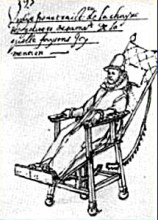
king-phillipIn 1595, King Philip II of Spain was sketched sitting in a reclining chair with wheels on each leg. It was clunky and heavy, and he needed to be pushed around by a servant, but – hey – king, right?

Self-propelling chairs arrived remarkably quickly after that, unsurprisingly developed by someone who was himself in need of a chair. In 1655, Stephen Farfler, a paraplegic watchmaker, moved himself around in a chair with three wheels. He moved around by turning handles that worked on the geared front wheel.

resized_image2_85fb99c4cad443bb0bf7a55a8aefe5fcMost of the sites I looked at when researching wheelchairs jump from Farfler to John Dawson of Bath. But wheelchairs – both ordinary chairs with wheels and more advanced chairs designed specifically to have wheels – continued right through.

And, in any case,  the Bath chair was invented around 1750 by James Heath.  Bath was becoming popular as a spa town, but it was not designed to easily get around in a carriage, and ordinary wheelchairs really only worked well on a flat surface such as inside the house.180px-Im1847SiBath-Heath

The Bath Chair was designed to take invalids out and about; primarily down to the Roman Baths for the treatment, and then back home again. Until then, invalids used the sedan chair, which required two attendants to carry. The Bath Chair just needed one person at the back pushing. Furthermore, the occupant of the chair had the steering stick and could therefore directly control the direction of travel. I can see that would be appealing to the average wealthy dowager!

You can see from the advertisement that Heath also sold wheelchairs. The example shown appears to have wheels at the front and stabilising legs at the rear, so no doubt the attendant lifted slightly when he pushed.

But the self-propelling chair had not gone away. John Joseph Merlin, a Belgian inventor and watchmaker (and, perhaps not incidentally the inventor of the in-line skate) created a successful chair that became the model for others. Keith Armstrong, in A very short history of the bicycle and wheelchair, says:

merlin-s-wheelchairIn the mid 1770’s he invented roller-skates and presented his new creation by arriving at a London party playing his violin whilst gliding around the room. Merlin received rapacious applause and an encore, the party-goers demanded that he repeated his act, during the second attempt, he quickly discovered that he didn’t known how to stop and he had a major accident. The next we read about him is of the invention of a new type of self-propelled wheelchair… His design was so successful that 120 years later, a London catalogue of medical equipment was able to boast nine different ‘Merlin’ wheelchairs available on their books. Merlin died in 1803.

As far as I can tell, the Merlin chair had small handles on its arms. But the name ‘Merlin chair’ was retained for later chairs where the occupant was able to turn the large rear wheels to get around, and – by the late 19th century – the smaller propelling wheel had arrived, to help people keep their hands clean.

Meanwhile, back at the end of the 18th century, let’s not forget John Dawson. The most prominent Bath chair maker of his time, his chairs outsold everyone else’s. Since, by all accounts, they were not very comfortable, we must assume that the others were worse!

There’s still a long way to go till we get to the sort of chair I’ve shown below, but the rest of the journey can wait for another post.

Wheelchair athlete Paul Nunnari.

Letting the imagination free wheel

Bath chairSome of my friends have said “Where do you get your ideas?” No doubt it differs from writer to writer, but if you’re interested in the way my mind works, here’s an example.

I’ve found that not writing on my novel on Sunday is having unexpected side effects. My imagination, which continues producing plot lines and snippets of dialogue, goes off at tangents while I’m paying attention to 2014. Snarls in Farewell to Kindness untangle themselves. New ideas for the next three books slip into those evolving plots. And whole new sets of characters and story ideas beg for a wee bit of brain time.

The weekend before last, two characters with cameo spots in Farewell to Kindness demanded their own story.And they’re going to get it. Look before Christmas for a free short story or novella (not sure yet) about how Viscount Avery (also known as Candle because he is tall and thin and has red hair) meets Minerva Bradshaw, who makes wheeled chairs for invalids.

The first seeds were planted when I was populating the village where Elizabeth, my heroine, lives. I had a block of land in behind the row of workers’ cottages that Elizabeth and her family live in. I decided to make it one estate; a comfortable gentleman’s detached house and garden belonging to a retired manufactory owner, called Bradshaw.

But why would the Bradshaws move to a tiny village on the edge of the Cotswolds? I decided that they wanted to be nearer to their daughter, who had married a peer. And, because he was a peer, they didn’t want to be too close, in case they embarrassed the Viscount and his new wife. The manufacturer’s daughter, Lady Avery, was now waiting in the wings, ready for her entrance.

A couple of months later, my hero and heroine went to an assembly in a nearby country town. The assembly has been organised by a group of local women, including the social climbing doctor’s wife and the local Baroness who is my villainess and a complete snob.

I needed a target for the Baroness’s snobbery, and fortunately Lady Avery was right there. So I put her on the committee of patronesses.

I also realised that I needed my secondary lead, Alex, who had been sent home to recuperate after breaking one leg and being shot in the other, to be mobile for a later scene, so I took the opportunity while he was having dinner at the doctor’s house to let him borrow a Bath Chair. In a prescient move, I explained that the chair had belonged to Lord Avery’s mother, and Lady Avery had donated it to the doctor when her mother-in-law died.

Which brings us to the Sunday in question. On Saturday evening, I’d been writing about what happened at the assembly, and the villain, feeling insulted by Alex, had sabotaged the chair.

It occurred to me that Bradshaw could be a retired carriage maker, and so he could diagnose that the collapse was foul play, and not fair wear and tear. Then I thought how much more fun it would be if his daughter provided the diagnosis, which would make her, as a tradesperson herself, even more of a target for the Baroness’s scorn.

By the end of the day, she was fully formed in my mind – an only daughter, born to older parents and their dear delight. With a bluestocking mother and a highly successful father, she is given the education of a lady, but loves best to follow her father around the manufactory. He does mainly design, but he teaches her to handle tools, and she turns her skills to designing and producing chairs for invalids.

In the real world, John Dawson invented the Bath Chair in 1783. [Or did he? See my post on the history of wheelchairs.] In my putative short story, Bradshaw Coaches is giving him a run for his money by 1805, when young Randall Avery comes looking for something a bit special in the way of chairs for his invalid mother.

And is directed to a workshop to consult with ‘Min Bradshaw’. Benjamin or Dominic, he wonders? Minerva is working on the undercarriage of a nearly completed chair.

The overalls were filled by a delightfully female rear. His stunned brain, impaired by the sudden loss of blood to other regions, could only think “definitely not a Benjamin or a Dominic.”

“Hand me that wrench.” The voice was undeniably female, too, with husky overtones that made him think… all sorts of things he shouldn’t think about an innocent, even if she was a tradesman’s daughter.

I’ve been researching the history of wheelchairs, which is meat for another blog post.

Why do I blog? And how?

On the Facebook group English Historical Fiction Writers, one of the members said that she’d been told she needed a blog, and asked for recommendations for a good blogging tool. The discussion segued, in the wonderful way that conversations do, into questions about whether ‘need’ was the right word.

Should writers blog? And if so, why?

As you will quickly realise if you look through my posts so far, I’ve been blogging for less than four weeks. At least as Jude Knight. But I’ve been blogging for a lot longer under my commercial writing identity, and I didn’t even think about whether or not to blog until Lynn’s respondents raised the question.

Key point number one: write a great book

Another discussion on Facebook a few days ago asked whether we write because we enjoy it, or whether we write to make money. Now, not being a fool, I don’t expect to make a fortune as a novelist. Would I like to? Too right! I’d love to write fiction full-time, and for that to happen, it needs to generate enough income to pay the bills.

To sell, though, I need a few things.

  1. First, I need to write a book that is worth reading. Nothing else I need to do even comes close to this in importance.
  2. Second, I need to let people know that the book exists. The kinds of people who read my kind of book. Lots and lots of people. They can’t buy it if they don’t know about it.
  3. And then there are a heap of other practical things that I’m not going to talk about in this post.

My to-do list

Continue reading

A proposal mixed up in a proposition

Here’s the scene I’ve been working on; the one where my hero and heroine confront their differences and realise that they do not have a future. I was trying for an irresistible force and immovable object thing. Disclaimer: this is first draft, unedited, and not proofread.

Just to set the scene, it starts as Rede and Elizabeth leave church on Sunday morning. Rain has stopped the birthday picnic, and so Rede has been commissioned to keep Elizabeth away from the house while the other members of the house party prepare a party for her.

Edmund_Blair_Leighton_-_A_Wet_Sunday_Morning

A grinning Willie Bush had the chaise ready for them in the lane, and Rede handed her up into it. He slid in beside her, took up the reins, and told Willie, “Stand away, Bush, and thank you.”

Anne was silent while he guided the horses through the home-going crowd. They passed the gates to the Squire’s house, and turned right into River Road.

Rede had planned this. She should have realised earlier that morning, when she saw his two prize bays hitched to the chaise for the under groom to drive. She was torn between annoyance and a certain pleasure at his persistence.

He broke the silence. “You have been avoiding me, Anne.”

“I have,” she acknowledged, deciding that confrontation was safer than conciliation. “You do not seem to have taken the meaning I intended, however.”

He let out an impatient huff of air. “Should I take silence as an answer? No. I need you to say the words.”

They were silent as he coaxed the horses onto the bridge, then turned to pass the mill.

“I have been told to keep you from the house for one hour,” he said, “so I thought we would drive past the Roman fort, and then back across the bridge at the far end of the estate.”

An hour! How could she bear it, with his long warm thigh pressing against hers under the waterproof cover. She shifted, moving slightly to the left.

“You don’t need to be afraid of me,” Rede told her. “I will never do anything you did not want.”

“And yet, here I am,” she replied, tartly.

He shifted too, withdrawing slightly so that they no longer touched. Perversely, she missed the comfort, and had to fight the urge to follow.

“I won’t deny that I want you,” he said. “I think about you constantly. I dream of you at night. I imagine caressing every inch of you, kissing you, tasting you, completing what we began the other night. If you are honest, Anne, you will acknowledge that you want me, too.”

“What I want or do not want does not matter.” Anne sat up straighter. “All that matters is what my family needs.”

“Can you not have both?” he coaxed. “Can you not meet your family’s needs and your own?”

Continue reading