Image quilts

Someone on Twitter introduced me to Image Quilts, an app for Chrome invented by Edward Tufte, a statistician, to help people visualise data. It captures any images produced by an image search, and then lets you move them around, delete them, introduce others, turn them into black and white, and change their size.

And what beautiful results it makes. Here’s one I produced showing landscape paintings from the Georgian era:

ImageQuilt 2014-02-10 at 4.15.00 PM

And here’s one of book covers. My search term was “Historical romance cover best seller”.

ImageQuilt 2014-03-10 at 11.54.47 AM


Too many dukes?

Only a Duke will Do

Image used in Czechoslovakia for Sabrina Jeffries’ book Only a Duke will Do. And he would, wouldn’t he?

Because I’m trying to write historicals that are historically plausible, I do a lot of research. And one thing I found early on is that the trios (and more) of sexy young or youngish dukes that pop up in some books are just not historically plausible.  In 1814, Great Britain had 28 ducal titles, held by 25 people. (Not counting the royal dukedoms given to the sons of the reigning monarch.)

These dukes all tended to marry within the upper peerage. The chances of a herd pack of them descending on an unsuspecting village and carrying off the local dressmaker, the cook, and the retired courtesan were pretty slender.

This doesn’t prevent me from enjoying a good series with more than one gorgeous eligible duke in it. Let’s face it. Dukes are sexy. As this article in the Huffington Post points out:

…duke is shorthand for the type of hero they can expect to read about and the kind of hero readers love: the powerful, alpha male who bows down to no one (except the heroine).

What’s not to love?

But I’m trying to keep my own duke heroes down to an acceptable level. I have none in the current book, but three, all of different ages, over the 50 or so books I have planned.

GB populationThe picture shows a map of society in 1814, and here’s a summary of my research on the nobility at the time.

Nobility = 2,880 people with 576 heads of family (includes royalty and bishops as well as nobility)

The numbers below do not include secondary titles. The dates mark states of union. Until 1707, England, Ireland and Scotland were separate countries. In 1707, Great Britain was formed through the union of England and Scotland. Between 1707 and 1801, Great Britain and Ireland were separate countries under one ruler. From 1801, the state became the United Kingdom of Great Britain and Ireland – one country. In 1922, the Irish Free State seceded, but that’s outside of our period.

Dukes: 28 titles held by 25 people: Title comes from shire

  • 11 titles in peerage of England to 1707
  • 9 in peerage of Scotland to 1707 (including two doubles with England and one double within Scotland)
  • 7 in peerage of Great Britain and Ireland 1707 to 1801 (6 GB and 1 Irish)
  • 1 in peerage of UK and Ireland 1801 onwards (the Duke of Wellington)

So  17 English, 7 Scots only, 1 Irish duke.

All Dukes are also Marquesses as secondary titles.

Marquesses/Marquises:  32 titles: Titles come from place names, originally border marshes (chiefly with Wales)

  • 1 in peerage of England to 1707
  • 3 in peerage of Scotland to 1707
  • 19 in peerage of Great Britain and Ireland 1707 to 1801 (10 GB and 9 Irish)
  • 9 in peerage of UK and Ireland 1801 onwards (6 UK and 3 Irish)

So 16 English, 3 Scots, and 12 Irish marquesses.

Earls: 210 titles, including 11 doubles – 6 held by women: 70% of titles come from place names and use ‘of’; remaining 30% come from surnames

  • 25 in peerage of England to 1707
  • 41 in peerage of Scotland to 1707 (4 held by women)
  • 12 in peerage of Ireland
  • 97 in peerage of Great Britain and Ireland 1707 to 1801 (38 GB and 59 Irish – 1 of the Irish titles held by a woman)
  • 35 in peerage of UK and Ireland 1801 onwards (24 UK – 1 of which was held by a woman – and 11 Irish)

So 87 English, 41 Scots, and 82 Irish earls.

Viscounts: 66 titles, includes 2 held by women, includes 1 double; ancient title for sherrif – usually the title name is the same as the surname

  • 1 in peerage of England to 1707
  • 2 in peerage of Scotland to 1707 (uses ‘of’)
  • 11 in peerage of Ireland (1 held by a woman)
  • 36 in peerage of Great Britain and Ireland 1707 to 1801 (9 GB and 27 Irish – 1 of the Irish titles held by a woman)
  • 16 in peerage of UK and Ireland 1801 onwards (8 UK and 8 Irish)

So 18 English, 2 Scots, and 46 Irish viscounts.

Barons: 172 titles; title name is usually the same as surname

  • 17 in peerage of England to 1707 (4 held by women) plus 16 vacant
  • 16 in peerage of Scotland to 1707 (1 held by women)
  • 5 in peerage of Ireland
  • 81 in peerage of Great Britain and Ireland 1707 to 1801 (50 GB and 31 Irish)
  • 28 in peerage of UK and Ireland 1801 onwards (23 UK and 5 Irish)

Mob football

mobfootballOn Facebook, I’ve just reposted an article by EE Carter about medieval football. Great article, and I love the video clip (an ad starring David Beckham and friends) that she’s used to illustrate her piece.

I came across a description of mob football when I was researching village Whitsunweek activities for Farewell to Kindness, and I loved the idea. So a football match duly made its way into the novel, giving the villain an opportunity to attempt to kill my hero. (Yes, I know that would be a breach of mob football’s one rule, but he’s a villain, okay?)

Mob football is still played today in several parts of Britain, as shown in the following clip.

A profound curtsey

imageWhen I first started blogging (in my other life), I came across the acronym H/T. This, I found out, meant hat tip, or a tip of the hat, or thank you very much.

I’d like to H/T Jane Austen’s World, which I’ve already quoted several times in the couple of weeks I’ve been blogging. Under the circumstances, a curtsey seems more appropriate, and I’ll make it a very deep one.

Thank you, Jane Austen. I’ve visited you many times over the past year, and my little OneNote database is full of links to interesting articles about all sorts of things.

For almost anything you want to know about late Georgian and Regency Britain, this list on Jane Austen’s World is a great place to start.

And also try her list of original sources.

Dance for your mammy

quadrille-300x178A country assembly brings a number of my characters into close proximity, so I’ve been reading up on late Georgian dance moves.

No waltz, of course.By 1807, the waltz had spread out from Germany and was fashionable in Vienna. It didn’t arrive in England until after the start of the Regency proper – the exact date is a little vague, but they were dancing it by 1815 (although as late as 1825, strict moralists frowned at the close position required).

English Historical Fiction Authors, in a post called ‘A Private Ball’ (by Maria Grace) quotes a manual of the day:

“The characteristic of an English country dance is that of gay simplicity. The steps should be few and easy, and the corresponding motion of the arms and body unaffected, modest, and graceful.” –The Mirror of Graces, 1811 

She goes on to say:

…most of the ball dances were lively and bouncy. Country dances, the scotch reel, cotillion, quadrille made up most of the dancing.

Most dances seem to have been danced in squares or in long lines of couples.  As with ballroom dancing today, dancers suited their footwork to their level of skill (if they were wise), but the five positions I learned long ago in ballet classes will come in handy if I ever find myself transported to a regency ballroom.

388px-five_positions_of_dancing_wilson_1811Regency Dances Org has a list of the basic steps required, and how to do them. They also have a long list of dances, which can be sorted by year of publication. Click on any dance to see an animation showing the figures of the dance.  And, under Regency Style, they say:

In his 1815 Essay on Deportment Wilson [Thomas Wilson, the Dance Master at the King’s Theatre Opera House] offers advice to dancers. “The following errors are particularly to be avoided:

  • Making awkward bows
  • Shuffling and rattling about the feet
  • Looking at the feet
  • Bending [sharply] the arm at the elbow, in giving the hand in Dancing
  • Holding the hands of any person too fast
  • Bending down the hands of your partner
  • Bouncing the hands up and down
  • Bending the body forward.”

The dancer should move with a relaxed upright carriage, with the head erect but level. Wilson goes on to say: “To Dance gracefully, every attitude, every movement, must seem rather the effect of accident than design; nothing should seem studied, for whatever seems studied, seems laboured, and every such appearance is absolutely incompatible with any endeavour at a display of graceful ease”.

He also advocates “a graceful elevation of the head”, “an easy sway of the whole frame” and “hands gently raised when presented to join your partners”. “In all movements of the feet, the toes pointed downwards, and in general turned (as much as with ease to the performer they can be) outwards”.

The excellent Regency Dance Org resource is designed for modern balls in the Regency form, but I used it to understand where my characters were when they were dancing at my country assembly. The site doesn’t have the Sir Roger de Coverley or Le Boulanger – or, for that matter, the minuet. The minuet was falling out of use by 1807, but the others were in use right through to the middle of the century.

Here’s the Sir Roger.


And here’s the minuet.


In Bath, the minuet was danced by single couples from six until eight, followed by country dances, according to austenonly.com. But in other provincial towns it was seldom danced.

The link above is to the second of a brilliant four-part series on Georgian assemblies, as is the next quote.

Interestingly the summer was the most important time for assemblies in the provincial towns.  They were larger and more prestigious, and often coincided with important local events such as  fairs,  the assizes or races week in the towns. The assizes was the time in the year when the Circuit judges appeared in town to hear locally important civil and criminal trials and they were a time of much entertaining and ceremony. The same held with any local horse racing meeting( without the pomp of the judges’ processions etc).

Capering & Kickery have a great post on judging authenticity – Real Regency Dancers don’t turn single.

Nothing is inconsequential

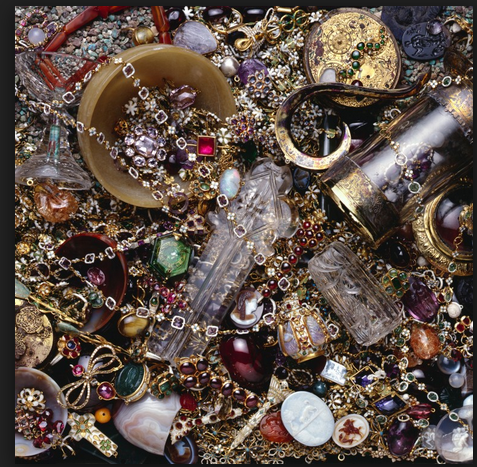
Jackdaw mindElizabeth Boyle writes on synchronicity in the writing process; something I’m experiencing every day as I write Farewell to Kindness, and pieces go ‘click’.

…in writing, it is often a sort of synchronicity of pieces: a treasure exhibit, a line from a biography, and a literature degree that left me with a profound love of myths. None of them are truly connected, but they all came together for this story. I have come to believe that nothing in life is inconsequential. It all has value eventually. Just keep your eyes and imagination open.

At last, my jackdaw mind is finding a use for all those shiny facts and snippets.

So many resources, so little time

“I have to organise my research and my plots and my characters,” I said to my personal romantic hero over the Christmas break. “I need a database. I need to be able to keep all the resources where I can reach them.”

So off he went, like the hero he is, on a quest to find a simple tool that would do what I want.

One Note database

The answer proved to be OneNote on the PC, linked via the ether with Outline on my IPad. Now I always know who lives at Dennings farm and what the head groom at Longford Court looks like. And the phases of the moon and weather in my part of England during May and June 1807.

The problem with pedantry

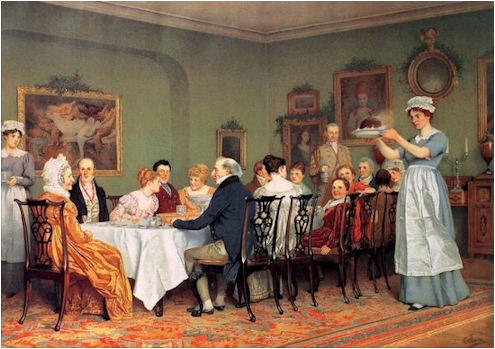
19th century dinnerMy hero and heroine being invited to dinner, I set out to confirm what I knew about seating etiquette at a formal Georgian dinner. I’ve read heaps of novels in which the dinner guests process couple by couple into the room in order of precedence, and are seated male, female, male, around the table. But I wanted to get it right.

Turns out that it isn’t that simple. Jane Austin’s world tells me that, in 1791, the etiquette was quite different.

When dinner is announced, the mistress of the house requests the lady first in rank, in company, to shew the way to the rest, and walk first into the room where the table is served; she then asks the second in precedience to follow, and after all the ladies are passed, she brings up the rear herself. The master of the house does the same with the gentlemen. Among the persons of real distinction, this marhalling of the company is unnecessary, every woman and every man present knows his rank and precedence, and takes the lead, without any direction from the mistress or the master.

When they enter the dining-room, each takes his place in the same order; the mistress of the table sits at the upper-end, those of superior rank next [to] her, right and left, those next in rank following, the gentlemen, and the master at the lower-end; and nothing is considered as a greater mark of ill-breeding, than for a person to interrup this order, or seat himself higher than he ought. –John Trusler, 1791

A further quote from the same book says that:

Custom, however, has lately introduced a new mode of seating. A gentleman and a lady fitting alternately round the table, and this, for the better convenience of a lady’s being attended to, and served by the gentleman next to her. But notwithstanding this promiscuous seating, the ladies, whether above or below, are to be served in order, according to their rank or age, and after them the gentlemen, in the same manner. – John Trusler, p 6

Austenised has these rules, culled from Georgette Heyer’s Regency World, by Jennifer Kloester.

  1. When going in to dinner, the man of the house always escorted the highest-ranking lady present. The remaining dinner guests also paired up and entered the dining room in order of rank.
  2. Dinner guests were seated according to rank, with the highest-ranking lady sitting on the right-hand side of the host, who always sat at the head of the table.
  3. When dining informally it was acceptable to talk across or round the table.
  4. At a formal dinner one did not talk across the dinner table but confined conversation to those on one’s left and right.
  5. Ladies were expected to retire to the withdrawing room after dinner, leaving the men to their port and their ‘male’ talk.
  6. A hostess should never give the signal to rise from the table until everyone at the table had finished.

I’m not sure that these would apply in 1807, though. I found a lovely post on Georgian eating, which gave the same message as Trusler – ladies on one side, and gents on the other.

A call for help on Goodreads led me to the wonderful English Historical Fiction Authors, and the post by MM Bennetts, which told me about late Georgian servings, but not about 1807 seating.

A second post on the same site. this one by Maria Grace, gave me more details about how the courses were served and what they might comprise.

The truth is out there, but perhaps I should just send my characters on a picnic!

The angler's picnic

What Elyse said

Elyse writes in defence of romance novels on Smart Bitches Trashy Books.

In the end, it doesn’t matter what I read. It doesn’t even matter that I do read, quite frankly. What matters is that we live in a world where fiction aimed directly at women is perceived as garbage. That doesn’t say anything at all about me, it says a lot about what needs to change.

I’ve quoted the last paragraph, but read the whole thing. Cheers and cookies, Elyse.

Now a Goodreads author

I woke up to the email I’ve been waiting for; I’m now a Goodreads author.

So I can get to work on a Goodreads’ author profile, and add the other two books. (I’ve already put Farewell to Kindness and A Dangerous Madness into Goodreads.

I notice that another book named A Dangerous Madness was published in May this year. It looks good; I’ll have to put it on my to read list. And I’ll have to find another title for the second Redepenning book.

UPDATE: Done. The second book is now A Raging Madness.