
Aboard the prison hulks

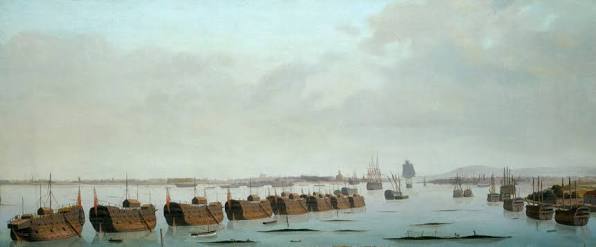
During the 17th and 18th centuries, and into the 19th, the British used former seagoing vessels as prisons for convict and prisoners of war. They were made unusable by removing rigging, masts, and rudders, reconfigured with jail cells, and moored.

Prison hulks provided a quick solution to the need for more prison space when land capacity was overstretched. During the Napoleonic wars, Britain faced the need to accommodate more than a hundred thousand prisoners at a time: French, Dutch, Spanish, Italian, Russian, Greek, Croat, Danish, Norwegian, Swedish, Polish and American.

Officers signed a parole document promising not to escape, and were assigned a place to stay. Ordinary soldiers and seamen were imprisoned, and there just were not enough prisons. The prison hulks were one of the answers.
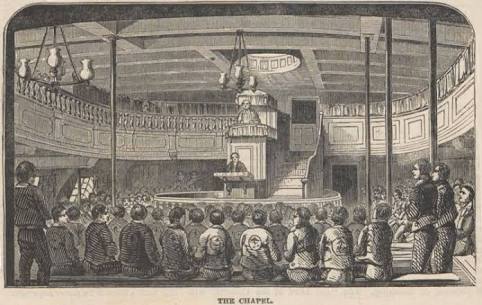
In 1806, twenty hulks were in use, the larger ones capable of containing 1200 men. By 1814, the number had climbed to fifty-one. The hulks were moored in groups in naval harbours, including Chatham, Plymouth and Portsmouth.

The British blamed Napoleon for the huge number of prisons. He, they said, changed the rules. He would not exchange prisoners; he detained civilians; he ordered returning officers to break the parole that was a condition of their return; and he would not allow invalids to go home. Furthermore, he refused to pay an allowance for the upkeep of each French prisoner in Britain. How uncivilised!

In fact, according to historian Gavin Daly, these practices of the old European aristocracy had been swept away by the French Revolution. Napoleon was not the instigator of change but the product of it. And the British were slow to react. The hulks were an ad hoc response to an unexpected situation.

During and after the war, the French decried the prison hulks for lack of food, overcrowding, the brutality of the guards, and exposure to disease. They spoke of horrendous mortality rates, and survivors who were nearly all disabled by their experiences. “Imagine a generation of the dead coming forth from their graves…and still you have no more than a feeble…idea of how my companions in misfortune appeared,” Louis Garneray wrote in The Floating Prison, the story of his nine years of captivity at Portsmouth.

This French perspective has dominated the historical narrative since Waterloo, but recent historians have questioned whether it might, in some particulars, be exaggerated.

The hulks were not palaces. They were overcrowded, and disease thrives in overcrowded situations. The average death rate was 3 to 4%, worse than most land-based prisons but slightly better than Dartmoor. But nothing like the death rate among ordinary criminals, which could be more than 20% on the hulks set aside for them.

(I tried to find a death rate for ordinary British soldiers in French prisons for comparison purposes, but the only estimates I found were in the counterpart overblown propoganda written by the British during and after the war. The only thing I can say for sure is that prisons weren’t nice places in either country, but it was better to be an English prisoner in France than a Spanish one.)

Back to the hulks. The competition for the role of commander of a hulk, evidenced by the waiting list for each commander position, hints at the opportunity for self-enrichment. Some sources claim that commanders or their officers regularly stole from the supplies, selling them for a profit and leaving the prisoners to go hungry and poorly clothed.

At the time, those in charge of the system countered such charges by claiming that the bored prisoners spent their time gambling, and those who went without were unsuccessful gamblers.

Historian Patricia Crimmins describes the food:

The prison diet was monotonous and dietetically unbalanced, but it compared favourably with that of civil prisoners in British jails and not unfavourably with the fare of British seamen. Prisoners had a quart (two pints) of beer, one and one-half pounds of bread and one-third of an ounce of salt daily; three-quarters of a pound of fresh beef on six days; half a pint of dried peas on four days; four ounces of butter or six ounces of cheese on Friday; but no fresh fruit or vegetables or wine except to the sick. British sailors had a pound of biscuit per day; and four pounds of beef, two pounds of pork, two pounds of peas, one and one-half pounds of oatmeal, six ounces each of sugar and butter, and twelve ounces of cheese per week, plus a gallon of beer and half a pint of rum per day.

Crimmins also writes of prisoners who obtained their release by volunteering to serve in the navy, and who found conditions so bad they petitioned to be returned to the hulks!

Handcrafts were not just a way to pass the time, but provided the possibility of a bit of income.

Jeopardy on WIP Wednesday

I’ve said it before. Our job as writers is to figure out what could possibly go wrong then make it happen. Maybe it’s a light-hearted comedy where the possibility of loss arises from a misunderstanding that is hilarious to the readers if not our characters. Or perhaps we’re writing a suspense novel with gothic horror elements and our characters stand to lose one another, their lives, and their very souls.

But without danger, we have no story. So this week, please share an excerpt from your novel where things go (or look as if they might go) pear-shaped. Mine is from A Raging Madness, my next novel. It’s with the proofreader and I’m planning a release in May.

She made it down the ivy without falling, but once she had picked up the blanket and wrapped it around herself, but lacked the will to move further. Leaning back against the side of the house, she let the lassitude win, and slowly relaxed down the wall until she was sitting on the ground, her head resting against the edge of a window frame.

Inside, a very long way away on the other side of the gentle fog that embraced her, two people were talking. Constance and Edwin. It did not matter. They were silly people. Gervase had not admired his older half-brother; a matter in which he and Ella were in rare accord. The two men shared a mother, but little of that kind, gentle woman showed in either son: the baronet’s son a bullying, often violent rake; the merchant’s a sanctimonious Puritan—but another bully for all that. Not as much so as his wife.

The bully was bullied. Ella suppressed her giggle. Sssshhh. Mustn’t make a sound. She was running away. Soon. First, she would have a little sleep.

But as she closed her eyes, her own name caught her attention. Constance and Edwin were talking about her? She forced herself to concentrate, to listen.

“No, Mrs Braxton. Eleanor will not convince them she is sane. I have chosen with care, I tell you. I visited six asylums before this one, and this is perfect for our purposes. The doctor in charge has promised to keep her dosed, and even if he does not, the place itself will drive her insane. If you saw it, heard the noise… Yes, my dear, I can assure you, our plans are sound.”

Constance answered, the whine in her voice grating against Ella’s eardrums. “But what if you are wrong, Edwin? If she convinces someone in authority that she is sane, prison will be the least…”

“No, my dove. Not at all. No one at the asylum will listen to her ravings, and if they did, what of it? Who will they tell? Even in the worst case, all we need do is say her mind was turned after Mother’s death, and how glad we are that she is well again.”

“I do not know.” The frown was heavy in Constance’s voice. “But we cannot keep her here. I trust Kerridge, but the other servants may start to murmur. Any one of them might have spoken to that lawyer!”

“The lawyer is gone, my love. He was no harder to send away this time than last.”

“It will drive her insane, you say?” Constance asked.

“It will. I guarantee it. I hesitate to mention it, Mrs Braxton, it not being a topic for a lady’s delicate ears…”

“Spit it out, Edwin. What?”

“My own treasure, I am given to understand that the attendants avail themselves of the, er, charms of the patients, and even do a, er, trade with the nearby town. Not, of course, with the approval of the medical staff. No, of course. That would be most unprofessional. But it is most enterprising of them, and serves our purposes rather well, dear sister being a comely woman.”

Ella puzzled this out. Surely Edwin did not mean that the attendants forced the women, and prostituted them?

“Ah. Very good,” Constance said. “The woman is horribly resilient. Any decent gentlewoman would have succumbed to madness long since with all your brother put her through, and what has happened since. But surely even she is not coarse enough to withstand multiple rapes.”

“The doctor will be here tomorrow,” Edwin said, with enormous satisfaction. “And she will be safely tucked away where she can do no harm.”

Tea with the Duchess of Haverford

To the Characters of Historical Romance

From the hand of Jude Knight
Amanuensis to Her Grace, the Duchess of Haverford

Subject: Promotional opportunity for you and your author

Dear heroine, hero, or supporting character

Her Grace has charged me with letting you know she is At Home to visitors on Mondays (USA time), and would be delighted to welcome you for conversation and a cup of tea, coffee, hot chocolate, or the beverage of your choice.

Characters from any historical fiction, any era or place, may apply. While Her Grace’s lifetime spans the late Georgian and early Victorian, and she is delighted to meet her own contemporaries from different fictional worlds, she particularly enjoys time travelers. Be warned that all metal and weapons must be left at the door. No exceptions. Not even armoured knights and Chicago gangsters.

A typical post would have a few paragraphs of conversation between you and the duchess, then your book’s blurb, buy links, and an excerpt.

I keep Her Grace’s calendar, and would love to hear from you or your author. If you wish to participate, please send the dates of three Mondays to jude [at] judeknightauthor.com (replace [at] with @). Include your name, your author’s name and pen name, and your book title.

Kindest regards

Jude Knight

(for Eleanor Haverford)

Process? Was I meant to have a process?

I’ve just sent A Raging Madness off for proofreading, which clears my mental space for the other stories that are simmering on the back of the stove or still spread out across the kitchen table as raw ingredients.

Over the past three years, since I first began Farewell to Kindness, I’ve discovered I’m neither a plotter nor a pantser, but a weird amalgam. As the current state of said stories shows.

I figured I’d be a plotter. I am in my commercial writing life, starting with a carefully structured outline, complete with an assessment of audience and purpose. So before I wrote a word of Farewell, I had character interviews and questionnaires, a detailed plot outline, and acres and acres of research. Then I started writing.

It turns out that I write by watching the movie reel unroll inside my head. My characters had no idea what was going to happen, and as I soon found out, neither did I. The villain died before chapter 1. The slightly sinister neighbour turned into a major criminal. The hero wanted to seduce the heroine instead of courting her. I ended up more or less where I expected, but by a completely different pathway.

But nor am I entirely a pantser. If I try to write without at least some of that plotting work, my muse goes into a major sulk and I bog down.  Revealed in Mist suffered from that. I began a murder mystery with no idea who the villain was or how the murder happened. At some point I had to figure that out.

I am, I guess, a patterner. It isn’t so much that I make patterns, but I recognise them. Two or more disconnected facts suddenly come together in my mind, and all of a sudden I know where I’m going.

Take Concealed in Shadow, the sequel to Revealed in Mist, which is my book after next. I know Prue has been kidnapped and is in Napoleonic France, and I know David has followed her. I know that the story involves a secondary romance between a English detainee and a prisoner-of-war. I’m not sure of much else. But last night I realised that Prue will be handed over by her captors to a French spymaster, who will use her to try to force David to give up British secrets.

I’m currently reading about spy networks in England and France during the Napoleonic wars, and also about prisoners of war in each country. And something just clicked.

I don’t know precisely how my creative process works. But I know what makes it work. Research. When my mind goes blank, I start reading. Original material such as newspapers of the time, scholarly works, other fiction set against a similar background. Whatever works.

And I didn’t do this on purpose, honest, but The Realm of Silence, the next book in The Golden Redepennings also involves prisoners of war and spies, this time on the English side of the channel. And Luddites, because why not? What I was missing there was a MacGuffin, but I found one, so all is well.

Those are the main projects at the moment, but I also have three novellas (two for Christmas anthologies) and a short story on the go. And they all have plots! (But I don’t guarantee they’ll happen the way I’ve ‘planned’.)

So that’s it. That’s how I write. Someone compared it driving after dark. As long as you can see as far as your headlines reach, you can keep going. It’s a bit scarier than that. I start out not knowing what route I’m going to follow, and with only the vaguest idea of destination, and work it out on the way. I write the book so I can find out how it ends.

My friend Caroline Warfield has also posted about process.

Attraction on WIP Wednesday

If the course of our love stories ran smooth, we wouldn’t have much of a story. We need disagreement, misunderstanding, opposition, even disaster. The forces pulling our lovers apart need to be strong and real enough to sustain our readers’ interest, but the forces pulling them together need to be stronger.

This week, I’m posting an extract about attraction. In A Raging Madness, the couple have history, and the attraction is unwilling. I’d love to see an extract from your work in progress, where your hero or heroine expresses their attraction in their thoughts, words, or actions.

Ella was grateful that Jonno had arrived, reminding her that Mr and Mrs Sedgewick were a fiction, and Alex’s loving touches and knee-melting glances merely stage dressing.

She had been, she found, unjustifiably proud of being a faithful wife, a chaste widow. Other women allowed passion to lure them into ignoring moral behaviour, breaking their marriage vows, and risking their reputation and their health. Not Ella. She had too much self respect; too much common sense. She had seen the results of careless coupling, both in social consequences and in patients she had treated: soldiers and their camp followers.

But now she suspected she had no right to her pride. She had never fallen because she had never been tempted. How easy it would be to remove the rolled blanket. Alex would not refuse her; she was certain of that. And who would know? Big Dan and Pat? They believe ‘Mr and Mrs Sedgewick’ to be husband and wife, and on their marriage tour. Big Dan undoubtedly assumed that they were exercising their marital privileges every night.

She had not much enjoyed that side of marriage, though it could be pleasant enough when Gervase was minded to take his time. Instinct told her that the act would be different with Alex; that at long last she might learn for herself the ecstasy other women spoke over cooking pots, or laundry, or on long treks in the wake of the army.

Each day, piety and self-respect seemed colder and colder bedfellows. Each day, the thought of what she might discover in Alex’s arms tempted her more.

Yes. Jonno had arrived just in time.

Tea with the Rose of Frampton

And another excerpt post, this time from A Baron for Becky. My duchess has arrived at her nephew’s house to find her son in residence, and alone with a young woman; a rather scandalous young woman! Aldridge may be enamoured, but he will not disgrace his family. Will he?

After dinner, the ladies withdrew to the great parlour, leaving the two men to the port.

“I am travelling in the morning, so will go up to bed,” the duchess announced. “Mrs Darling, perhaps you would give me a few moments of your time?”

“Be nice, aunt,” warned Lady Chirbury, making Rose even more nervous. The duchess gave an enigmatic smile and led the way upstairs.

“Leave us, dear,” she said to the maid who was standing ready by the bed. “I shall ring when I want you.” She took a chair by the fire and waved Rose to the other.

“Do not look so nervous, Mrs Darling. I do not intend to bite you.”

Rose blushed scarlet. Aldridge had promised to bite her, and had explained exactly where. No. She must not think of that. She sat, as commanded.

“Mrs Darling, you were raised gentry, were you not?”

Rose nodded, cautiously. Where was the duchess going with this?

“The manners, the speech, the accomplishments—they can all be taught, of course. But one who has learned them from the cradle…” Her Grace waved a hand as if to flick away counterfeits.

“The usual story, I imagine? Seduction or rape? And no father to defend your honour?”

“My father…” Rose swallowed hard to remove the lump that closed her throat at the memories. “My father was a librarian. He took the part of his employer.”

“Ah.” Her Grace nodded. “And the employer was the cause of your downfall. Or his son, perhaps?”

“His son,” Rose confirmed. His sons, in fact, but she would not say that.

“And Sarah was the…?”

“No, Your Grace. Sarah… came later.”

“Mr. Darling?”

“There was no Mr. Darling,” Rose admitted.

The maid must have added a fresh log to the fire just before they arrived. The top was still uncharred, but flames licked up from the bed of hot embers. A twig that jutted from one side suddenly flared, turned black, and shrivelled. The bottom of the log began to glow red.

The duchess spoke again, startling Rose out of her flame-induced trance.

“What do you want for your daughter, Mrs Darling?”

“A better life,” Rose said immediately, suddenly fierce. “A chance to be respectable. A life that does not depend on the whims of a man.”

“The first two may be achievable,” the duchess said, dryly. “The third is highly unlikely for any woman of any station. You expect my son to help you to these goals, I take it.”

Rose was suddenly tired of polite circling. “I was saving so that I could leave this life, start again in another place under another name. But my last protector cheated me and stole from me.

“I do what I must, Your Grace. Should I have killed myself when I was disgraced? I had no skills anyone wanted to buy. I could play the piano, a little; sew, but others were faster and better; paint, but indifferently; parse a Latin sentence, but of what use was that in my circumstances? Should I have starved in the gutter where they threw me?

“Well, I was not given that choice. Those who took me from the gutter knew precisely what I had that others would pay for. As soon as I could, I began selling it for myself, and I. Will. Not. Be. Ashamed.”

Her vehemence did not ruffle the duchess’s calm. “We all do what we must, my dear. I am not judging you. Men have the power in this world, and women of the gentry are raised to depend on them for our survival. But you must know that Aldridge cannot offer marriage to a woman with your history.”

The mere thought startled a laugh out of Rose. Marriage had never crossed Aldridge’s mind. Of that she was certain. “His Lordship has offered me a two-year contract as his mistress,” she said, “with very favourable terms. If I accept, and if I save carefully, I will never need to take a protector again.”

“Two years!” The duchess arched a delicate eyebrow. “Aldridge seldom keeps a mistress beyond six months. He must be utterly besotted.”

“He has no thought of marriage,” Rose found herself reassuring the duchess. “And neither do I. I like him, but do not love him, and I think only love could make marriage tolerable.”

It was only partly true. She could easily fall in love with Aldridge… was, perhaps, beginning to do so already. That way, she knew, led to heartache, for the duchess was right. Aldridge would never offer her marriage, or even permanence.

The duchess nodded, decisively. “You are wise. I think you will be good for him, Mrs Darling—which is a ridiculous name. May I call you ‘Rose’?” Her Grace’s smile was a wonderful thing, another feature her son had inherited.

“Would you…” Rose had never imagined having such a conversation, but there was something about this woman. Nothing shocked her, and she listened. “Would you call me Becky? It is my real name.”

“Becky, then. Becky, as long as you remember that you will never be accepted as a fit mate for the future Duke of Haverford—which is a great shame, for you seem to be a fine young woman, but we must live in the world as it is—you and I shall be friends, and I shall support you and little Sarah to find the new life you seek when Aldridge is finished with you. He needs someone like you. He is not happy, poor boy.”

That squashed the nascent hope that the duchess’s sponsorship might mean she could avoid accepting Aldridge’s protection. Still, it was a good offer. Becky accepted the duchess’s outstretched hands. “Thank you, Your Grace. I will do my best to make him happy.”

Animals on WIP Wednesday

All sorts of animalsThose of you who subscribe to my newsletter will know that I put a short story in each issue: one I write specifically for my newsletter. In February, I asked the newsletter readers to tell me what they’d like to see in the April newsletter, and the story I drew from the replies was one about a rescued dog and the love and bond that is formed between him and the rescuer.

That story is percolating at the back of my brain, but it got me thinking about the times I’ve used pets and other animals for my characters to relate to; a creature with whom they can be themselves.

How about you? Do you have animals in your stories? How do you use them? Please share an excerpt from a current work-in-progress in the comments.

Mine is from A Raging Madness, which is back from beta readers, requires a restructure in the last third and is currently burning a hole in the corner of my otherwise occupied brain.

The carriage way turned onto the village road. She kept to the side, ready to hide in the ditch if anyone came. Alone, in her shift, and still dazed from the drug? Being returned to the Braxtons would be the best she could expect from a casual passer by, and the worst… She shuddered. She had travelled with the army, worked as her father’s assistant, been Gervase Melville’s wife. She knew the worst that could happen to a woman at the mercy of the merciless.

A soft whicker caught her attention. Falcon’s Storm. He was a lighter shape above the hedgerow, stretching his neck to reach his mistress.

“Storm, my sweet, my champion.” She stopped to fuss over him for a minute that stretched into a timeless pause, crooning nonsense about having no treats in her pocket for she lacked a pocket. He lipped at her shoulder and her hair, but showed no offence at being denied the expected lump of carrot or apple.

“I missed you, too,” she assured him. “If only you were old enough, dearest, you would carry me away, would you not?”

He was solidly built for a two-year old, but so was she, for a woman. He could not take her, and she could not take him. She walked away with a deep sigh. He was the one thing in the world that was solidly, legally, beyond a doubt hers; her only legacy from the swine she had married, born of her mare, Hawk of May, and Gervase’s charger.

But if she took him, how would she feed him? And if they were hunting for a woman and a colt… No, she could not take him with her, and for the same reason, she could not open the gate and set him loose. He would follow her, for sure.

She could only pray that the Braxtons would leave him to the care of old Jake, the groom, or sell him to someone who appreciated him for the future champion he was.

Storm followed her to the corner of his field, and called after her until she was out of sight.

Tea with Rede

An excerpt post this week. My hero Rede from Farewell to Kindness has travelled to Margate to consult with his aunt, the Duchess of Haverford.

The sun was setting on Saturday evening, and Rede was beside himself with frustration, before the Duchess of Haverford’s coach was finally seen tooling up the road to the castle.

He was waiting when she entered the front door, and she greeted him with pleasure. “Rede, darling. What a lovely surprise. Have you been waiting for me long?

“Such a circus in Deal. The electors were inclined to listen to the merchants, and the merchants did not favour Haverford’s man. Not at all.

“So I had to visit every shop in the town and buy something. The carriage, I can assure you, is laden. But Haverford believes it may have done the trick.

“Just as well, dear, for I have enough Christmas presents for every one of my godchildren for the next three years. And some of them are not of the best quality, I can assure you.”

She was talking as she ascended the stairs, giving her cloak to a maid as she passed, her bonnet to a footman, and her reticule to another maid.

“You want something, I expect. Well, you shall tell me all about it at dinner. I left most of the food I purchased at the orphanage in Margate, but I kept a pineapple for dessert. Such fun, my dear, have you tried one?”

“No, dear aunt,” he managed to say, sliding his comment in as she paused to give her gloves to yet another maid. Or it may have been the first maid again.

“Well, today you shall. Join me in the dining room in—shall we say one hour?” And she sailed away towards her apartments, leaving him, as always, feeling as if he had been assaulted by a friendly and affectionate hurricane.

Over dinner, he laid all honestly before her. Well, perhaps not all. The lovely widow, betrayed by George, the three sisters, the little daughter. No need to mention that he’d played fast and loose himself with the lady’s virtue. Just that he needed to rehabilitate her. Just that he wanted to marry her and she had refused.

“She refused you, Rede?” Her Grace was surprised. “But you are handsome, wealthy and charming. And rich. What does she object to?”

Rede hadn’t been able to work it out, either. “I know she cares for me, Aunt Eleanor. But she keeps saying no. The first time—to be honest, the first time I made a disaster of it. I told her… I gave her the impression that I only wanted her for a wife because she was too virtuous to be my mistress.”

Her Grace gave a peal of laughter. “Oh Rede, you didn’t.”

“I’m afraid I did. But the second time I assured her I wanted her for my Countess.”

“And you told her that you loved her,” the Duchess stated.

“No. Not exactly. I told her I wanted to keep her safe. I told her I wanted to protect her.”

“I see. And I suppose you think if you bring her into society, she will consent to marry you?”

“I don’t know, aunt. I only know that she deserves a better life than stuck in a worker’s cottage in the back of nowhere working as a teacher so she can one day give her sister a decent life. If she won’t have me… Well, she has been to see a lawyer about a small inheritance she has coming. I thought perhaps I could make it a bit bigger. Without her knowing.”

“You do love her,” said the Duchess, with great satisfaction.

“Yes, but… Yes.” There were no buts. He loved her. At least he hadn’t told her so. He had no taste for laying his heart on the floor for her to walk on.

“You need to tell her so.” The Duchess echoed and denied his thinking, all in one short sentence. “She is probably afraid that you are marrying her out of a misplaced sense of duty. You are far too responsible, Rede.”

“No, she couldn’t think that. Could she?”

“Who knows? Well, I will do it. I cannot have my niece-in-law having her babies in scandal. I take it there is the possibility of a baby? You would not be feeling so guilty otherwise.”

Rede was without a response for a long moment, finally huffing a laugh. “Aunt Eleanor, a hundred years ago you would have burnt as a witch,” he told her.

Three roading heroes

In the second half of the 18th century and the early years of the 19th century, the main highways of England saw a revolution.

In 1754, an advertisement boasted that the trip from London to Edinburgh took only “ten days in summer and twelve in winter”. Compare that with the mail coach in 1832 which was advertised as 42 hours and 23 minutes. (The return trip was longer: 45 hours and 3 minutes.)

The difference was largely down to the construction of the roads.

John Metcalf was a blind Yorkshire man who had worked as a carrier, including a stint with the army moving guns over boggy ground. In 1765, he won a contract to build a three-mile section of road, and he applied his experience transporting heavy loads to such good effect that he built over 180 miles of road throughout his career.

He believed a good road needed good foundations and a smooth convex surface that would drain easily. He knew rain caused the most damage to roads, and focused on good drainage, with ditches both sides.

At around the same time, a French engineer was also experimenting with better road construction. Pierre-Marie-Jérôme Trésaguet pioneered a two-layer construction, with large stones at the base and a thin layer of smaller stone above that would be pressed down and jammed into one another as traffic passed along the road.

Thomas Telford was a Scot raised in poverty and apprenticed to a stonemason. He went on to become a largely self-taught engineer and architect. Appointed Surveyor of Public Works in Shropshire in 1787, his successful designs for bridges and roads lead him to jobs managing the design and construction of several canals, including their aquaducts, plus 184 miles of roads and bridges in the Scottish Highlands.

EDITED to add a profile of a Roman road.

EDITED to add a profile of a modern road.

Our next road hero has given his name to the road construction we still use today. John Loudon MacAdam was born in Scotland. He purportedly showed an interest in making roads as a school child, but moved to the United States on his father’s death when he was 14. Returning 13 years later with what was left of the fortune he’d made during the War of Independence (the government of the new United States confiscated quite a bit of it), he bought an estate.

At the time, most roads were made of gravel, which turned back into ruts, ridges and potholes as soon as heavy vehicles drove over the freshly spread surface. MacAdam began experimenting to see what could be done about this.

In 1798, he was on the move again, appointed as an agent for revictualling the navy in the west of England. He settled in Falmouth, but travelled all the time for his work, over roads that were “at once loose, rough, and perishable, tedious and dangerous to travel on, and very costly to repair.”

MacAdam had worked out that roads worked best when they were raised above the surrounding land, well drained, and made from stone broken into cube shaped fragments. Despite local opposition and at his own expense, he built a number of roads that were so successful he was, in 1815, appointed surveyor-general of the Bristol roads.

And the rest is history. As Bristol’s road network was transformed from muddy dangerous rutted quagmires to even well-drained surfaces that carriages could swiftly traverse, other places started asking how to take the same engineering feat home to their places.

The website Electric Scotland says:

In 1823, on McAdam’s petition, a committee of the House of Commons was set up to inquire into the feasibility of applying this new system of road-making throughout the country. McAdam, of course, attended, and gave evidence at length. Only then did it appear what immense labours and trouble he had taken in order to bring his system to perfection. Between 1798 and 1814 he had travelled no less than 30,000 miles in order to examine the roads of Britain. He had spent 2,000 days on his travels, which had cost him £5,000. Besides this sum, he had expended large sums on private experiments. All this he had carried out from entirely disinterested motives; his only wish was that the roads should be improved for the public good. Philanthropists who work among the destitute or afflicted are generally recognized, but we should not forget that the patient, painstaking round of labour which McAdam undertook for the good of his fellow men, is also philanthropy at its highest.

My characters in my current work-in-progress are on a road trip between Cambridge and Newcastle in 1812: hence the excursion down this road-making byway.

White Knights on WIP Wednesday

Or slightly tarnished, or even possibly close to black. Needed or not needed. Hero, heroine, or supporting role. This week, I’m looking for a character charging to the rescue.

My excerpt is from A Raging Madness, which has been out with beta readers and is in my sights for a weekend edit, all going well. It comes from near the beginning. An old acquaintance has turned up at the hero’s inn, in her shift, dishevelled and dirty, and clearly under the influence of drugs. He hides her from her pursuers, who claim she is a lunatic. Now he is listening to her story.

“Now, Lady Melville. What trouble are you in, and how can we help?” And would he be able to believe a word she said? She did not act like a lunatic, apart from appearing half-naked in his room in the middle of the night. Apart from the panicked response to her brother-in-law.

That she had taken opium in some form was beyond a doubt. The contracted pupils, the loss of appetite, the shaky hand, the restless shifting in her seat, all spoke to that. Thanks to his injury, Alex had far too close and personal an experience of the symptoms to mistake them.  The bruises on her jaw made him wonder how voluntary her drug taking was, but perhaps her keepers needed to drug her to keep her calm.

Sane or not, Alex hoped he would not need to hand her back to Braxton. Her fear might be irrational, but when she had stood at bay, begging for his help, he had been thrown back ten years. Not that she begged him then. But he left camp on a short trip for supplies, and returned to find Ella married and much changed, her fire banked; her joy extinguished. That time, he had ignored her plight, hardened his heart and left her to the fate she had engineered. And had suffered with her as the consequences quenched her vitality and sucked away the last of her childhood. Suffered, and been powerless to help.

“I have been drugged,” Ella said baldly. “Twice a day. For weeks now. They won’t tell me why. If I refuse, they force me.”

“‘They’ being Braxton and his wife?” Alex prompted.

“And Constance’s dresser.”

“Go on.” He was careful to show no disbelief, no surprise.

“I have been kept in my room. They locked the door. They took all my clothes, my shoes. I saw you out the window and so I came. Will you help me, Alex?”

“I can take you to the rector.” Even as he said it he remembered the plump little man greasing at Braxton’s elbow. Ella would find no help there.

“No!” Her rejection was instant and panicked. “He will give me back and they will send me to that place. No, Alex. You do not know what they plan for me.” She was weeping. Alex had seen her calm under cannon fire, dry-eyed at her father’s funeral, efficient and unemotional in the midst of the carnage of a hospital tent after a battle. He had never seen her weep.

He captured her hands, and kept his voice low and soothing. “I do not, Ella. Tell me.”

“I heard them last night. Edwin has found an asylum that will—Constance says I must be driven insane in truth. They rape the women there, Edwin says, and Constance says I am horribly resilient but even my sanity will not withstand multiple rapes.” The last word was whispered around a sob.

Alex kept his hands still with an effort. They wanted to punch and rend. No wonder she was panicked, but it could not be true, could it? Braxton was not a man Alex could like, but such wickedness? To his own sister-in-law?

“And you do not know why, Ella?” he asked.

She shook her head.

“The rector and the squire… They both believed Edwin and Constance. They came to see me, and I begged for their help, and they would not, Alex. They believed me insane. You do not believe me insane, do you, Alex?”

He did not know. That was the truth of it. His gut told him to destroy her persecutors and carry her off somewhere safe. His gut had never been reliable where Ella was concerned.

“Please, Alex.”

Alex made up his mind. “Ella, you will be safe here. Jonno and I will go and see what we can find out. Jonno, tell the innkeeper we are taking the room for another day. Then have my chaise brought round.”

“I will tell them not to do out the room,” Jonno declared. “I’ll say my gentleman won’t have anyone but me handling his stuff. You’ll be safe here, my lady.”

Alex had not taken his eyes from Ella’s. She was calmer now, the tears drying on her cheeks. “You will not betray me? No, of course not. I trust you, Alex. I know we have not always agreed, but you will not betray me.”

“I will not betray you.” Though how he would keep his word if she was, in truth, insane, he did not know. Certainly, her story sounded crazy. But she had bruises on her jaw, and the rector had been lied to. And Alex did not like Braxton or his wife.